



Build a credible buying journey for US visitors: verify audience fit, make business identity and policies clear, remove avoidable friction, and evaluate changes with GA4 and a practical trust-and-conversion audit.
To improve conversions from US website visitors, start with the offer and the buying journey—not with a promise of more traffic. Confirm that you can serve the audience, explain what they will receive and what it will cost, provide credible evidence, and make the next step work. Then measure completed purchases or qualified requests rather than assuming that longer visits mean greater trust.
Trust and conversion rate optimization (CRO) belong in the same process. A clear delivery policy can answer an objection; a working payment form lets someone act on that answer. Neither guarantees a sale. This guide combines practical trust-building with US-specific offer clarity, journey checks, and careful testing. It is not a guide to generating more visits or a claim that all American customers behave alike.
1. Define the US Audience and the Conversion You Can Serve
“American visitors” is a starting segment, not a complete customer profile. A student comparing prices, a procurement manager requesting a quote, and a returning customer reordering supplies have different needs.
Define the intended buyer, the relevant landing page, the stage of the decision, and any restrictions on delivery or service before changing the design.

Separate location from audience fit
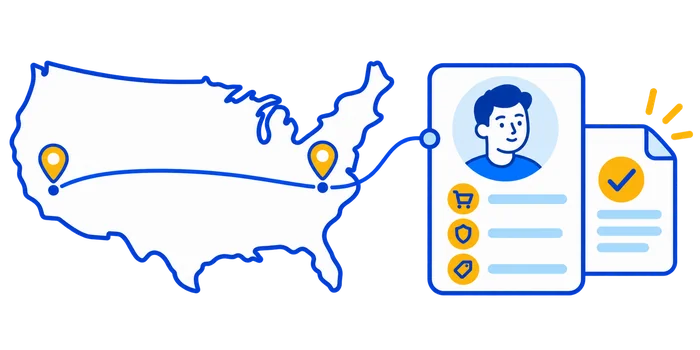
A visit reported from the United States does not establish citizenship, buying intent, affordability, or service eligibility. Check which states or addresses you can serve, whether the product fits the use case, and whether the visitor arrived through a message consistent with the offer. Do not claim a US office, warehouse, certification, or support team unless it actually exists.
Use customer questions, sales feedback, and actual order or lead records to identify uncertainty. For an overseas seller, shipping origin and return logistics may matter more than a patriotic image. For a software provider, compatibility, onboarding, access requirements, and support hours may be the unanswered questions. Address the specific uncertainty rather than decorating every page with the same badges.
Choose a meaningful outcome
For a store, a completed purchase is different from an add-to-cart. For a service business, a submitted request is different from an accepted, qualified opportunity. Choose the outcome that informs the decision and record how duplicates, cancellations, refunds, and delayed qualification will be handled. A button click can diagnose interest, but it is not automatically business value.
Write a short measurement brief: audience, page, completed action, denominator, outcome window, owner, and important guardrails. For example, a demo-request test might track qualified requests per eligible participant while protecting form reliability and support capacity. This keeps the team from declaring success because an easier-to-inflate metric improved.

2. Establish a Comparable Baseline in GA4
Before changing a page, check that its events describe what actually happened. A success event should follow a confirmed submission or purchase, not merely a press of the submit button. Reconcile a sample with the receiving system and document test activity, duplicates, consent limitations, and known collection gaps. Invalid measurement makes a persuasive dashboard an unreliable starting point.
Compare the right audience and reporting scope
Use a United States country comparison or filter in the relevant GA4 report or exploration, then consider landing page, device, and acquisition source. Keep periods, event definitions, and reporting scope consistent. Google’s Traffic acquisition documentation describes session-scoped acquisition and session key event rate. First-user acquisition answers a different question; do not mix the two when describing the same journey.
Report the rate with its denominator. GA4 session key event rate is sessions containing a key event divided by sessions. A rate based on purchasers or qualified leads per user is a different measure. Select the relevant event rather than treating every configured key event as a purchase, and show outcome counts alongside rates so a tiny sample is not mistaken for a dependable pattern.
Locate the information or action gap
Google’s Purchase journey report follows steps such as product views, add-to-cart, checkout, and purchase, using the events your implementation sends. A funnel exploration can describe a different journey. Specify the sequence, entry rules, and allowed time between steps; otherwise, two reports may appear to disagree simply because they count different paths.
Drop-off locates a question, not its answer. Visitors may lack information, encounter an error, be ineligible, or decide the offer is not suitable. Read support questions and investigate representative journeys before labeling every exit a trust problem. Search Console describes organic search visibility and clicks; it does not measure whether a customer trusted your checkout.
3. Build Trust with Evidence at the Point of Doubt
A trust signal is useful when it answers a real concern. Place evidence near the decision it supports: delivery information beside the purchase option, relevant customer experience beside a product claim, and accessible support before someone shares details. A footer full of logos cannot compensate for an unclear offer or a business that is difficult to identify.
Make the business and its promises verifiable
Keep the business name, contact details, and description consistent across the landing page, About page, policies, confirmation messages, and payment journey. Explain who operates the service and how a customer can obtain help. Where relevant, provide real company or professional information that the visitor can check. Do not invent an address to make an overseas business appear local.
Replace broad statements such as “trusted by everyone” with evidence you can substantiate. Explain the scope and validity of a certification, use client logos only with permission, and link to an issuer’s verification where available. Remove expired or unrelated badges. A visitor should be able to understand what the credential establishes—and what it does not.
Use authentic reviews and documented case studies
A specific review can explain a real use case, limitation, or experience better than a generic compliment. Present genuine feedback accurately and make its source understandable. Do not rewrite a customer’s experience into a result they never reported, create fictional reviewers, or manufacture an impressive rating. If you lack reviews, demonstrate the product and explain policies rather than pretending to have customer proof.
A service case study should distinguish the starting problem, work performed, measurement period, observed outcome, and relevant constraints. Obtain permission for identifiable customer material and keep supporting records. One customer’s result is evidence of that experience, not a forecast for every future buyer. Educational content can also establish competence by answering a real implementation or suitability question.
For businesses reaching US consumers, the FTC’s consumer reviews and testimonials guidance addresses deceptive practices including fake reviews and incentives conditioned on positive or negative sentiment. Apply the rules relevant to your circumstances and review material relationships and disclosures. This is not a substitute for legal advice, and a persuasive testimonial does not excuse an unsupported marketing claim.
Explain security without overstating it
Use a secure connection and a properly implemented payment process. Google’s Chrome connection-security guidance distinguishes a secure connection from the need to check the site itself. HTTPS protects data in transit; it is not proof that a seller will fulfill an order. Avoid “100% secure” claims or badges that imply an audit you have not obtained.
Explain what information is required and why, and link to readable privacy information at the relevant point. Keep sensitive details out of analytics identifiers, URLs, and recordings. Test payment and form failures as well as success: a clear recovery message and an accessible support route are more useful than a reassuring badge beside a broken action.
4. Make Pricing, Delivery, Returns, and Support Clear for US Visitors
Localization should remove ambiguity, not create a false impression of being local. Use understandable English and make the actual service area and fulfillment conditions visible. Show the currency clearly, explain whether amounts are estimates or final totals, and let a visitor correct a location assumption. IP location alone should not silently decide their identity or shipping eligibility.

Put practical conditions beside the decision
Explain shipping origin, eligible destinations, delivery estimates, and relevant charges before the visitor commits. If a final amount depends on an address, show how and when it will be calculated. State exclusions and uncertainty instead of promising overnight delivery everywhere. For digital services, explain access, implementation requirements, recurring billing, cancellation, and what the purchased service includes.
Summarize return or refund conditions in plain language and link to the complete policy. Distinguish a refund policy from a guarantee and explain important deadlines, exclusions, fees, and the contact process. Make the product page, checkout, and policy agree. A reassuring summary that contradicts the actual terms can undermine the confidence it was intended to create.
Offer support you can reliably provide
Publish realistic response expectations and opening hours with a clear time zone. Offer appropriate contact methods rather than displaying an unattended chat widget as if it were instant support. Give staff a consistent source of answers for delivery, compatibility, billing, and refunds. Escalate complex or account-specific issues through a secure process instead of guessing in public chat.
Use repeated questions as an improvement queue. If customers regularly ask where an order ships from, answer that on the page before asking them to buy. Keep product FAQs and onboarding resources aligned with current operations. Helpful support can reduce uncertainty, but a contact click or longer conversation alone does not establish that trust or conversion improved.

5. Audit the Journey and Prioritize a Specific Fix
Walk through the page as an eligible first-time visitor on representative devices. Read the promise that brought you there, find the full conditions, and attempt the intended action. Record observations separately from hypotheses. The following worksheet turns the combined trust and conversion review into decisions rather than another generic list of redesign ideas.
| Observed uncertainty or friction | Evidence to check | Possible action | Verification |
|---|---|---|---|
| Visitor cannot identify the seller | Inconsistent names or missing contact details | Align business identity and provide a verifiable support route | Task-based usability check and relevant customer questions |
| Delivery or total cost is unclear | Policy views, support questions, and checkout experience | Show truthful destination, timing, currency, and cost conditions earlier | Controlled outcome comparison with cancellation/refund guardrails |
| Claims have no credible support | Review provenance, permissions, and case-study records | Use relevant genuine evidence or remove the claim | Evidence review and comprehension test |
| Interested visitors cannot complete a form | Reproduced validation, delivery, or accessibility failure | Fix the confirmed defect and explain recovery | Successful, invalid, and duplicate-submission checks |
| Mobile page is difficult to use | Representative device tests and performance measurements | Repair the specific control, layout, or loading issue | Repeat the task and monitor comparable business outcomes |
Prioritize a confirmed broken action before a speculative visual improvement. For uncertain issues, consider the number of eligible people affected, the likely consequence, strength of evidence, effort, and risk of the change. Assign an owner and a verification method. Do not interpret the table as proof that every suggested action will increase conversion.
Check message, layout, performance, and checkout together
The headline should explain the offer and who it serves; the CTA should describe the next real action. “Request a quote” should not unexpectedly enroll someone in a paid subscription. Place essential eligibility and pricing information where people can find it, and use readable text, clear form labels, keyboard-operable controls, and useful error messages. More buttons are not a remedy for an unclear proposition.
Preserve useful product demonstrations, educational explanations, and genuine proof while removing distractions. In checkout, review unnecessary fields, account requirements, payment availability, and inconsistent conditions. Offer only payment options the business can actually support. Avoid fake scarcity, resetting countdowns, and invented delivery claims; urgency should reflect a real condition, not substitute for a credible offer.
Measure performance instead of assuming that a cleaner design loads faster. Current Core Web Vitals guidance uses LCP, INP, and CLS, with good thresholds of 2.5 seconds, 200 milliseconds, and 0.1 respectively, assessed at the 75th percentile. A threshold is a technical experience target, not a guaranteed conversion uplift. Diagnose the actual bottleneck and repeat the relevant measurements after repair.
For broader diagnosis across targeting, product, offer, and checkout, use our guide to why a website gets traffic but no sales. Here, keep the review focused on the US audience’s actual uncertainty and the specific conversion path instead of rebuilding every part of the business at once.

6. A Hypothetical Example: From Delivery Doubt to a Measurable Test
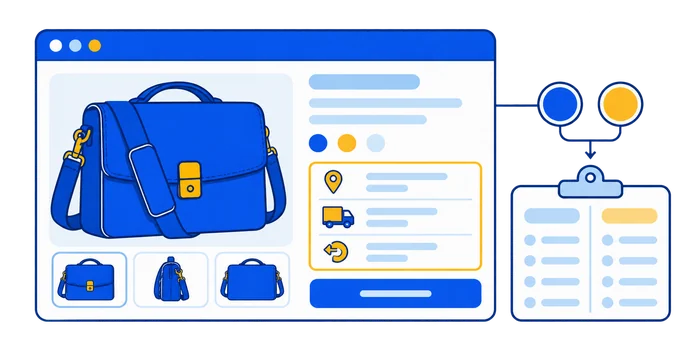
This example is hypothetical, not a SEOVisitor case study, benchmark, or predicted result. Imagine an overseas store selling a laptop bag to customers in the contiguous United States. Its page explains the bag’s dimensions, but shipping origin and return costs appear only in a footer policy. A visitor has to leave the product description to find information needed for a purchase decision.
Problem and evidence
Suppose a fictional baseline contains 800 eligible users viewing the product, 120 adding it to cart, 60 starting checkout, and 24 completing a purchase within the defined journey. These illustrative counts locate questions; they do not prove distrust. Support messages about delivery and return postage, plus a reproduced mobile information gap, give the team a more specific hypothesis.
The team first verifies that the funnel events reflect actual actions and that purchases reconcile with orders. It checks whether stock, prices, promotions, or acquisition sources changed during the period. It also asks representative participants to find the delivery and return conditions. If a payment defect is reproduced, that defect is repaired directly rather than deliberately left in a control group.
Decision and page change
The hypothesis is that explaining delivery and return conditions beside the purchase decision will help eligible visitors make an informed choice. The proposed version shows the real shipping origin, an honest delivery estimate, any relevant limitations, and a short return-cost explanation linked to the full policy. It keeps the product, price, audience, and campaign message consistent with the control.
If genuine reviews about the bag’s fit or durability exist, they can support those specific claims. A delivery guarantee the store cannot fulfill is not added. The purpose is to remove uncertainty, not hide an inconvenient condition. Some visitors may correctly decide the offer is unsuitable; fewer inappropriate orders can be valuable even without a higher raw order count.
Measurement and decision rule
The team plans a controlled test with consistent participant assignment, one primary outcome, an appropriate sample requirement, and a complete outcome window. It evaluates purchasers per assigned eligible user, along with cancellations, refunds, support burden, and form or checkout failures. Acquisition labels identify how visitors arrived; they do not replace the experiment’s version identifier.
No after-test figures or winning version are invented here. If reliable outcomes and guardrails support the change, the team can retain it. If results are inconclusive, it records that uncertainty. If the change harms the journey or measurement breaks, it stops or repairs the test. A simple before-and-after comparison remains observational when seasonality, audience mix, or other changes could explain the difference.
7. Keep Acquisition Separate from Conversion Improvement
Once the page’s promise, conditions, action, and measurement work, consider whether a separate acquisition campaign fits the business goal. It does not repair missing evidence, create customer trust, or guarantee buyers. An increase in visit volume is different from an improvement in the proportion or value of useful actions, and a geographically reported visit is not a qualification certificate.
If you evaluate SEOVisitor’s existing USA traffic service, identify that campaign separately and assess its actual delivery, relevant actions, and costs. Do not treat configured visit duration or page depth as independent evidence of intent, and do not describe bought visits as a direct organic-ranking benefit. Leave unresolved tracking or checkout failures fixed before interpreting a campaign’s commercial result.

8. Review Outcomes Without Mistaking Behavior for Trust
Combine quantitative outcomes with qualitative evidence. A longer session might mean interest or confusion; a short visit might mean an efficient answer. Do not assign a universal “good” bounce rate, US conversion rate, or improvement percentage. Compare the same audience and journey under consistent measurement, and examine whether useful orders or qualified requests improved without worsening important guardrails.
Session recordings can help investigate where people hesitate or encounter errors, but they cannot reveal every person’s motivation. Use appropriate consent and privacy controls. Microsoft’s Clarity masking guidance explains how content is protected and warns that masking changes do not apply retroactively. Check configuration before recording sensitive journeys, and avoid treating a few memorable recordings as representative of everyone.

For lead businesses, allow time for qualification and follow-up before judging a page. For stores, review refunds and cancellations as well as purchases. Annotate releases, offer changes, and collection problems. A country-level aggregate can improve because the mix of visitors changed, even when the page itself did not become more effective. Attribution reports help describe credited outcomes; they do not by themselves prove the cause of an improvement.
Finish each review with a decision: fix a confirmed defect, test a specific uncertainty, retain a supported change, or collect better evidence. Record the reason, owner, affected page, and next review condition. Building trust and improving conversion is a process of truthful information, reliable actions, and disciplined learning—not a guaranteed consequence of adding testimonials, badges, or more traffic.
Frequently Asked Questions
Quick answers to common questions about increase conversions from American website visitors
Start with a clearly defined audience and completed outcome. Verify that the offer is available to those visitors, explain pricing and delivery conditions, provide credible evidence, remove confirmed journey defects, and test a specific remaining hypothesis. Measure useful purchases or qualified requests rather than visit volume alone.
There is no dependable universal rate for every US-facing website. Product, price, intent, device, acquisition source, and measurement definitions differ. Use a comparable baseline with a stated numerator, denominator, outcome window, and downstream quality checks rather than an unsupported national benchmark.
Use evidence that answers a real doubt: identifiable business details, genuine relevant reviews, documented customer experiences, clear pricing and fulfillment policies, a secure working action, and accessible support. Explain credentials accurately; badges and testimonials do not guarantee trust or sales.
Demonstrate the product or process, identify the business honestly, explain suitability and limitations, publish clear policies, and make support reachable. Ask real customers for genuine feedback as experience accumulates. Do not invent testimonials, case studies, certifications, or reviewer identities.
No. HTTPS protects communication with the site but does not establish that the seller is legitimate, the product is suitable, or an order will be fulfilled. Combine secure implementation with verifiable business information, accurate conditions, and a reliable support and purchase journey.
Use a United States country comparison or filter with the appropriate page, device, and acquisition scope. Validate completed-action events against business records. State whether the rate is based on users or sessions, use consistent outcome windows, and review qualification, refunds, and collection limitations.
No device is guaranteed to perform better for every business. Compare your own eligible visitors under consistent definitions and check the actual tasks on both devices. Differences can reflect audience intent, acquisition mix, usability, and tracking rather than device preference alone.
No. A separate traffic campaign does not repair unclear policies, missing evidence, broken checkout, or an unsuitable offer, and it does not guarantee sales or organic rankings. If you test one, identify it separately and evaluate useful outcomes, costs, and audience fit using valid measurement.


Comments
Leave a Comment