


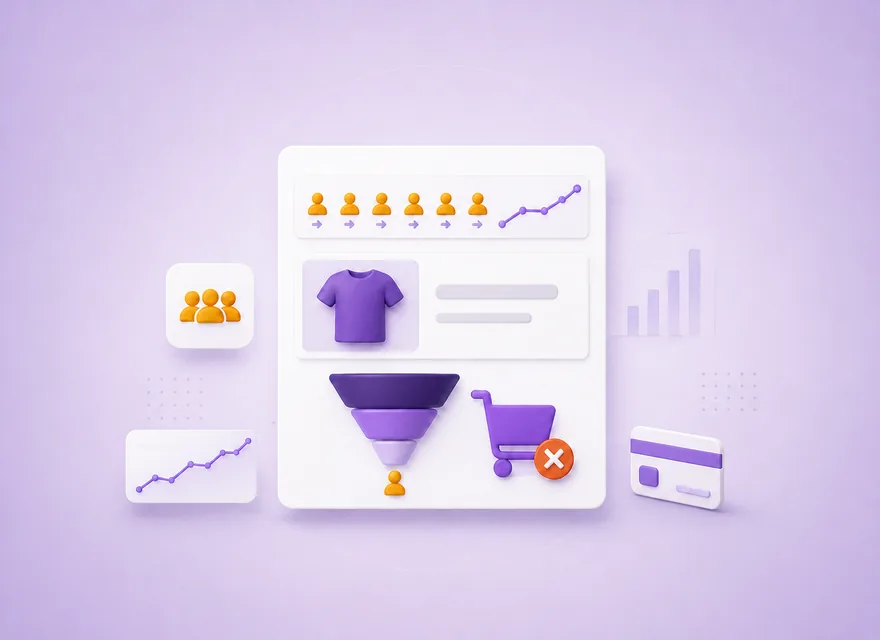
Learn why your website gets traffic but no sales and how to fix targeting, trust, landing page, offer, and checkout problems that block conversions.
You open Google Analytics and see the number you wanted to see: traffic is growing. Your pages are getting impressions, visitors are clicking through, and some of them are even spending several minutes on your website.
But then you check your sales.Nothing.Or almost nothing.This is one of the most frustrating situations for any website owner. You have done the hard part of attracting people to your website, so why aren’t they buying?
The answer is often uncomfortable: your website may not have a traffic problem at all.
It may have a targeting problem, an offer problem, a trust problem, a landing page problem, or a broken conversion funnel.
A website can receive thousands of visitors every month and still generate fewer customers than a smaller website with a fraction of the traffic. In fact, research into traffic sources and ecommerce journeys has repeatedly shown that different acquisition channels can behave very differently once visitors reach the site.
So instead of asking, “How can I get more traffic?”, the better question is:
“Why isn’t the traffic I already have turning into customers?”
This guide will help you diagnose exactly where the problem is, from the quality of your visitors to your landing pages, product pages, trust signals, mobile experience, and checkout.
Traffic Isn’t the Problem—Your Conversion Funnel Might Be
Getting someone to visit your website is only the first step.
Think about the customer journey as a series of stages:
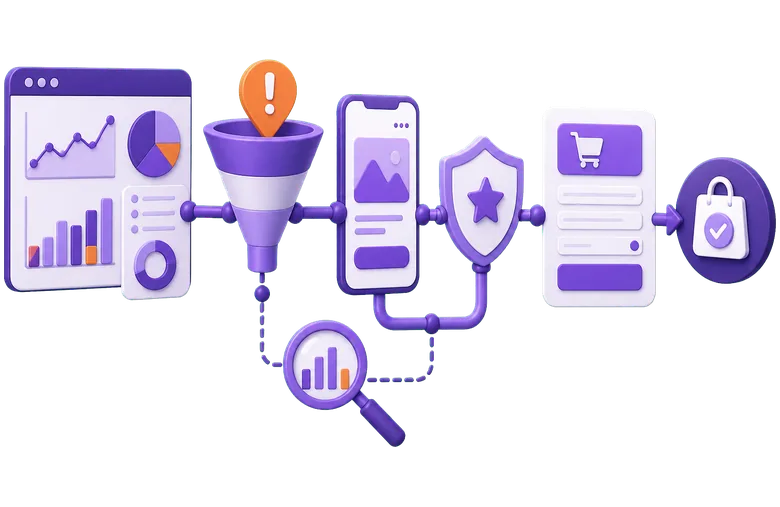
Traffic → Landing Page → Product or Service → Intent → Checkout/Lead → Purchase
Every stage creates an opportunity for the visitor to leave.
For example, imagine that 10,000 people visit your website in a month.
If only 1% become customers, you have 100 customers.
Now imagine another website gets only 2,000 visitors but converts 3% of them.
That website gets 60 customers.
At first glance, the first website looks much more successful because it has five times as much traffic. But the difference becomes much smaller when you look at the entire funnel.
This is why raw traffic is a poor standalone measure of business performance.
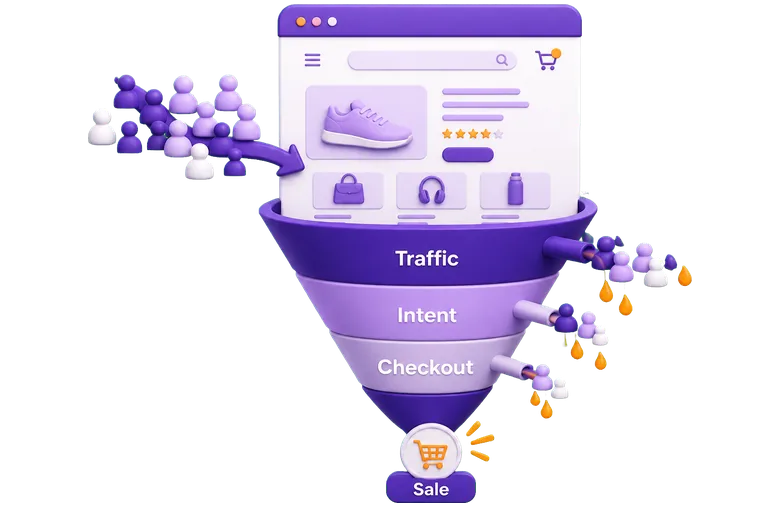
10,000 Visitors Don’t Mean 10,000 Potential Buyers
Not every visitor arrives with the same intention.
One person might be researching a problem. Another might be comparing products. Someone else might already know exactly what they want and be ready to buy.
Those visitors have completely different commercial value.
Consider someone searching for:
“What is SEO?”
They are probably in an informational stage.
Now compare that with:
“Buy SEO audit service for small business”
The second search indicates a much stronger commercial intent.
Both searches can generate website traffic, but expecting them to produce the same conversion rate would be a mistake.
The goal isn’t simply to get more visitors.
The goal is to get the right visitors at the right stage of the buying journey.
First, Find Out Where Your Visitors Are Dropping Off
Before redesigning your homepage, changing your pricing, launching another advertising campaign, or buying more traffic, find the point where visitors disappear.
This is where your analytics becomes much more useful than a simple traffic counter.
For an ecommerce website, Google recommends measuring events such as view_item, add_to_cart, begin_checkout, and purchase so you can understand the shopping journey instead of looking only at total visitors.
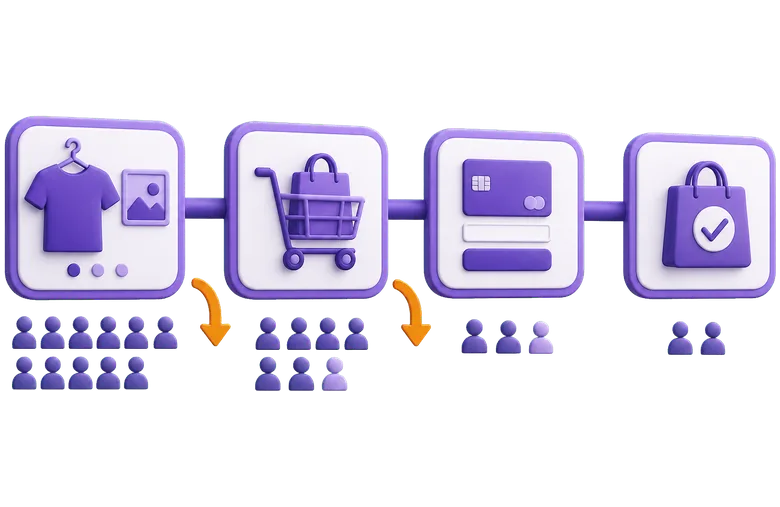
Your funnel might look like this:
10,000 visitors
↓
4,000 product/service page views
↓
600 add-to-carts or leads
↓
250 checkout starts
↓
100 purchases
Now you can see where the problem is.
Lots of Visitors but No Product Views
If people arrive but rarely explore your products or services, the problem may be your navigation or messaging.
Ask:
- Can visitors immediately understand what you offer?
- Are important pages easy to find?
- Are your calls to action visible?
- Does your homepage guide users toward the next step?
- Are internal links helping users discover relevant pages?
If visitors cannot figure out what to do next, they will leave even if your traffic is highly relevant.
Lots of Product Views but No Add-to-Carts
This points toward a different problem.
The traffic is interested enough to view the product, but something prevents them from taking action.
Potential causes include:
- unclear product benefits
- weak product images
- confusing descriptions
- lack of reviews
- poor pricing presentation
- weak CTA
- missing information
- lack of trust
- poor perceived value
Lots of Add-to-Carts but No Checkouts
Now the problem may be closer to the buying process.
Look at:
- shipping costs
- delivery information
- unexpected fees
- required account creation
- confusing cart design
- unclear return policies
A visitor who adds a product to their cart has already demonstrated meaningful interest. Losing them at this point deserves more attention than losing someone who simply bounced from a blog post.
Lots of Checkouts but No Purchases
This is an even stronger signal.
If users begin checkout but don’t finish, investigate:
- payment failures
- technical errors
- complicated forms
- unexpected charges
- lack of preferred payment methods
- security concerns
- confusing checkout steps
Google’s GA4 documentation specifically recommends measuring events such as begin_checkout, add_shipping_info, add_payment_info, and purchase when building a purchase funnel.

buy usa traffic
If you want to increase your website traffic directly and have a targeted impact on Google’s algorithms, use the increase website visits Seovisitor service.
10 Reasons Your Website Gets Traffic but No Sales
Once you understand where visitors are dropping off, you can investigate the underlying reason.
1. You’re Getting the Wrong Traffic
The first possibility is simple: your visitors aren’t your customers.
This happens more often than many businesses realize.
You might rank for a high-volume keyword and celebrate when thousands of people arrive, only to discover that most of them have no intention of buying your product.
For example, imagine you sell premium accounting software.
You might attract thousands of visitors through an article targeting:
“How to calculate business expenses.”
That’s useful traffic, but it doesn’t necessarily mean those people are looking for accounting software.
Compare that with:
“Best accounting software for small businesses.”
The second audience is much closer to a purchase decision.
This is why keyword volume shouldn’t be the only metric you use when evaluating SEO traffic.
Look at:
- search intent
- location
- audience
- device
- industry
- buying stage
- landing page
- conversion behavior
A smaller amount of high-intent traffic can be far more valuable than a huge volume of irrelevant visitors.
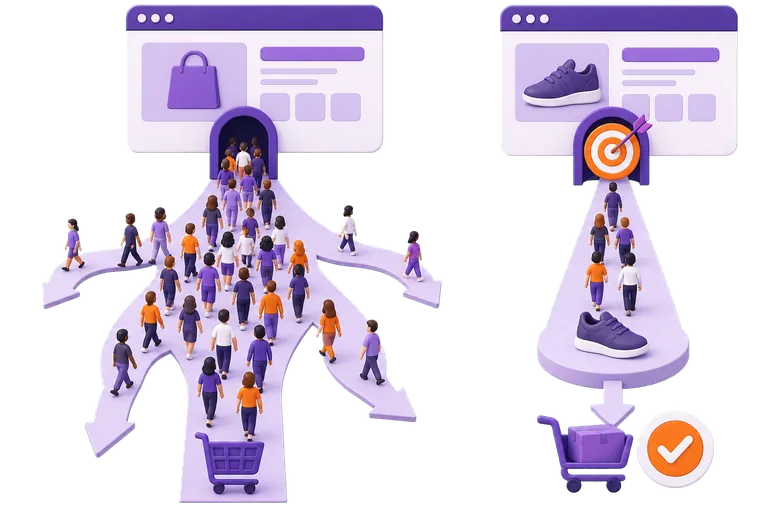
2. Your Traffic Doesn’t Match Your Offer
Even relevant traffic can fail if the offer doesn’t match what visitors expected.
Imagine someone clicks a result promising:
“Affordable USA Website Traffic for Small Businesses.”
But the landing page immediately talks about enterprise digital transformation, expensive consulting packages, and unrelated marketing services.
The visitor has to mentally connect the dots.
Most won’t.
The page needs to feel like a continuation of the search or campaign that brought them there.
This is known as message match.
The headline, offer, CTA, and supporting copy should reinforce the expectation created before the click.
If the visitor thinks:
“This isn’t what I came here for.”
you’ve probably lost them.
3. Visitors Don’t Understand What You’re Selling
A surprisingly large number of websites make visitors work too hard.
Within a few seconds, someone should be able to answer:
What do you sell?
Who is it for?
Why should I care?
What should I do next?
If your homepage opens with something vague like:
“We empower businesses through innovative solutions.”
the visitor still doesn’t know what you actually do.
A stronger message would communicate the specific outcome.
For example:
“Get targeted website visitors from the USA for your next campaign.”
The second statement is immediately understandable.
Your Homepage Is Making Visitors Work Too Hard
Look at your homepage from the perspective of someone who has never heard of your company.
Can they understand your offer without scrolling?
Can they identify your main benefit?
Can they find pricing?
Can they find proof?
Can they see what to do next?
If the answer is no, more traffic may simply send more people into the same confusion.
4. Your Landing Page Doesn’t Match the Traffic Source
Your landing page shouldn’t exist in isolation.
It should continue the conversation that started before the visitor arrived.
For example, if someone searches:
“Buy USA Traffic for Affiliate Websites”
and lands on a generic homepage with no mention of affiliate marketing, there is an obvious disconnect.
Instead, the landing page should immediately confirm:
Yes, you’re in the right place.
This principle applies to:
- SEO traffic
- Google Ads
- social media
- referral traffic
- influencer campaigns
- purchased traffic
The more specific the source, the more specific the landing page should ideally be.
5. Your Website Doesn’t Look Trustworthy
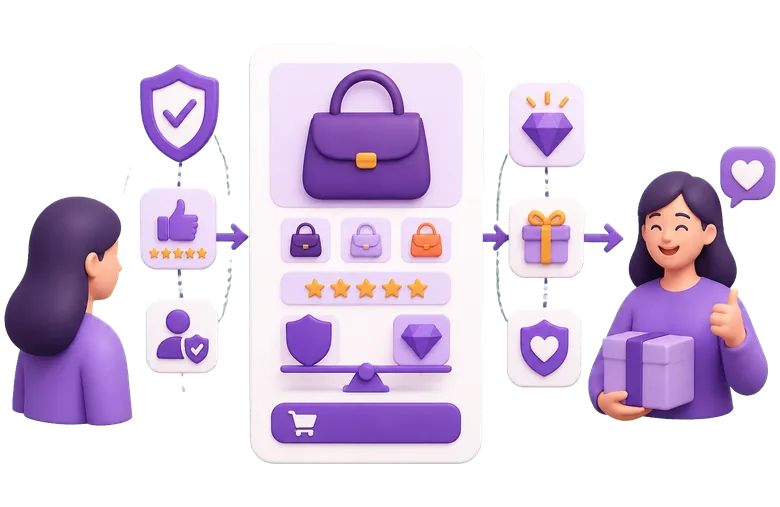
People don’t hand over money to websites they don’t trust.
This is especially important for unfamiliar brands.
Visitors may ask themselves:
Is this company legitimate?
Will I actually receive what I’m paying for?
Can I contact them if something goes wrong?
What happens if I want a refund?
Your website should answer these questions before the visitor has to ask them.
Important trust signals can include:
- genuine customer reviews
- testimonials
- case studies
- clear contact information
- company information
- transparent pricing
- refund policies
- guarantees where appropriate
- secure payment information
- recognizable payment methods
- clear terms and conditions
Trust is particularly important when the visitor is purchasing something for the first time.
You don’t necessarily need dozens of trust badges.
You need credible evidence that reduces uncertainty.
6. Your Product Page Isn’t Doing the Selling
A product page shouldn’t simply describe what something is.
It needs to explain why someone should buy it.
A strong product page answers four questions:
What is it?
What does it do for me?
Why should I choose this instead of an alternative?
Why should I buy it from you?
If your product page contains only technical specifications, the visitor is forced to translate features into benefits themselves.
For example:
Feature: 10,000 USA visitors
is less persuasive than:
Benefit: Reach more potential customers in the United States with targeted website traffic.
7 Things a High-Converting Product Page Should Have
A strong product or service page should generally include:
- A clear headline
- A concise value proposition
- Strong visuals
- Benefits, not just features
- Social proof
- Clear pricing or a clear path to pricing
- A prominent CTA
None of these guarantees sales.
But together, they reduce the number of unanswered questions a buyer has.
7. Your Price Isn’t the Problem—Your Value Perception Is
When sales are low, many businesses immediately assume:
“We’re too expensive.”
Sometimes that’s true.
But often the actual problem is that the customer doesn’t understand why the product is worth the price.
Imagine two services both costing $100.
One page simply says:
“10,000 website visitors — $100.”
The other explains:
- where visitors come from
- who the traffic is designed for
- what targeting options are available
- how traffic is delivered
- what analytics can be used to measure it
- what the customer should realistically expect
The second offer may feel more valuable even at exactly the same price.
Before reducing your price, ask:
Have I clearly communicated the value?
Price objections often become easier to overcome when customers understand the outcome they’re paying for.
8. Your Website Is Too Slow or Difficult to Use on Mobile
A website can look fantastic on a desktop monitor and still provide a terrible experience on a smartphone.
This matters because visitors may arrive from different devices, browsers, and connection conditions.
Common mobile problems include:
- tiny buttons
- difficult navigation
- oversized popups
- slow-loading images
- text that is difficult to read
- forms that are painful to complete
- sticky elements covering important content
- checkout fields that are difficult to use
Research on ecommerce traffic and conversions has also highlighted differences in exit behavior across devices and the importance of mobile optimization and browser compatibility.
Your Mobile Visitors May Be Seeing a Different Website
Don’t simply resize the browser window and assume the site works.
Actually use your website on a phone.
Try to:
- Find a product.
- Read its description.
- Add it to the cart.
- Start checkout.
- Enter your information.
- Complete the purchase.
You may discover problems your analytics cannot explain by itself.
9. Your Checkout Is Killing the Sale
A visitor can be convinced to buy and still abandon the purchase because checkout is frustrating.
Every additional field, unexpected cost, or confusing step creates another opportunity for abandonment.
Look for:
- unnecessary form fields
- forced account creation
- unexpected shipping costs
- unclear taxes or fees
- limited payment methods
- confusing error messages
- slow checkout pages
- unclear return policies
The important thing is to distinguish between cart abandonment and checkout abandonment.
Someone who adds an item to their cart and leaves may still be comparing options.
Someone who enters payment information and leaves may have encountered a very different problem.
That’s why funnel tracking is so important.
10. You’re Asking Visitors to Buy Too Soon
Not every visitor is ready to purchase.
This is particularly true for organic search traffic.
Someone who discovers your website through an educational article may have never heard of your company.
Asking them to immediately:
“BUY NOW”
may be premature.
Instead, consider matching the CTA to the visitor’s buying stage.
For colder visitors:
- Read the guide
- Compare options
- See how it works
- Download the checklist
For warmer visitors:
- View pricing
- Get a quote
- Start a trial
- See plans
For high-intent visitors:
- Buy now
- Get started
- Order today
The best CTA isn’t always the most aggressive one.
It’s the one that matches the user’s intent.
How to Diagnose a Traffic-but-No-Sales Problem in Google Analytics 4
If you want to solve a conversion problem, stop looking at sessions as your primary success metric.
Instead, connect traffic to actions.
For ecommerce websites, Google Analytics can measure product views, add-to-cart behavior, checkout actions and purchases when the appropriate ecommerce events are implemented.
Check Conversion Rate by Traffic Source
Compare:
- Organic Search
- Paid Search
- Social
- Referral
- Direct
- Other campaigns
You may discover that one channel generates most of your traffic while another generates most of your revenue.
That changes the question from:
“Which channel sends the most visitors?”
to:
“Which channel sends visitors who become customers?”
Check Your Top Landing Pages
Find pages that receive significant traffic but generate few or no conversions.
Then ask:
- Does the page match search intent?
- Is the CTA visible?
- Is the offer clear?
- Is there enough trust?
- Is the next step obvious?
- Does the page work properly on mobile?
A page receiving 20,000 visits and zero meaningful business actions deserves investigation.
Compare New vs Returning Visitors
New visitors and returning visitors don’t necessarily behave the same way.
Someone who has visited your website five times may already understand your product.
A first-time visitor may need more explanation and proof.
This is another reason not to treat all sessions as equal.
Track the Full Funnel
For ecommerce, Google recommends events such as view_item, add_to_cart, begin_checkout, and purchase to understand different stages of shopping behavior.
If you only track pageviews, you know people arrived.
You don’t know why they didn’t buy.
Your Traffic Source May Be the Real Problem
Sometimes the website is fine.
The problem is who you’re sending to it.
SEO, paid advertising, social media, referrals and other channels can produce dramatically different types of visitors.
SEO Traffic vs. Social Traffic
Someone searching for a solution on Google may have a specific problem they want to solve.
Someone scrolling social media may not have been looking for your product at all.
Both can be valuable, but they require different messaging.
Paid Traffic Can Bring Clicks but No Customers
A campaign can generate cheap clicks and still lose money.
That’s because cost per click isn’t the same thing as cost per customer.
If one campaign produces 1,000 clicks and another produces 300 clicks, the first isn’t automatically better.
If the first produces two customers and the second produces 20, the numbers tell a very different story.
Geographic Traffic Matters
For businesses that operate in a specific country, traffic location can dramatically affect its commercial value.
A local service provider may get thousands of visitors from countries where it doesn’t operate and still generate almost no business.
This is why targeted traffic should be evaluated based on:
location + relevance + intent + behavior
rather than volume alone.
Does More USA Traffic Mean More Sales?
Not automatically.
If your business sells specifically to American customers, targeted USA visitors can be more relevant than a much larger volume of visitors from unrelated markets.
But relevance doesn’t guarantee conversion.
Your offer, landing page, pricing, trust and customer journey still need to work.
What to Fix First When Your Website Gets Traffic but No Sales
Don’t change everything at once.
Use this order:
1. Check Traffic Quality
Are visitors actually relevant to your business?
2. Check Search Intent
Did they arrive because they were looking for what you sell?
3. Check the Offer
Is the value obvious?
4. Check the Landing Page
Does it match what the visitor expected?
5. Check Trust
Why should someone believe you?
6. Check the Buying Process
Can they easily complete the action?
This gives you a practical diagnostic framework:
Traffic → Intent → Offer → Page → Trust → Checkout
Fix the earliest major bottleneck first.
There’s little point optimizing a checkout that only five people reach every month because the landing page is losing everyone before they get there.
A 30-Minute Website Conversion Audit You Can Do Today
You don’t need a six-month CRO project to identify obvious problems.
Spend 30 minutes doing the following.
Minute 1–5: Check Your Traffic Sources
Identify where visitors come from.
Look for sources that generate traffic but almost no meaningful actions.
Minute 6–10: Check Your Landing Pages
Find your highest-traffic pages.
Open them as if you’ve never seen your company before.
Ask:
Would I understand this offer in five seconds?
Minute 11–15: Test Mobile
Use your phone.
Don’t just look at the homepage.
Try the actual customer journey.
Minute 16–20: Test the Buying Process
Pretend you’re a customer.
Can you complete the purchase without confusion?
Minute 21–25: Check Product or Service Pages
Look for:
- unclear benefits
- weak images
- missing proof
- confusing pricing
- weak CTA
Minute 26–30: Check the Funnel Data
Look for the largest drop-off.
That is where your next optimization effort should begin.
Traffic vs. Conversion Rate: Which One Should You Improve First?
The answer depends on the current state of your website.
| Situation | Likely Problem | First Priority |
|---|---|---|
| Low traffic + good conversion | Not enough visitors | Traffic acquisition |
| High traffic + low conversion | Conversion problem | CRO |
| High traffic + irrelevant audience | Targeting problem | Traffic quality |
| Many product views + few carts | Offer/page problem | Product page |
| Many carts + few checkouts | Checkout friction | Checkout |
| Many checkouts + few purchases | Payment/trust issue | Checkout & payment |
| Good conversion + low volume | Scale problem | More qualified traffic |
This is why blindly increasing traffic can be expensive.
If your website converts poorly, sending more visitors can simply create a larger pool of people who leave without buying.
When You Actually Need More Traffic
The answer isn’t always “optimize your website.”
Sometimes you really do need more visitors.
If you have:
- relevant traffic
- strong search intent
- a compelling offer
- a clear landing page
- good trust signals
- a smooth checkout
- a healthy conversion rate
but simply don’t have enough qualified visitors, then increasing traffic makes sense.
Your acquisition options may include:
- SEO
- Google Ads
- social media
- email marketing
- referral campaigns
- partnerships
- targeted USA traffic
The key is to scale after you know your funnel can convert.
Otherwise, you’re scaling the leak.
How to Turn More Website Visitors Into Customers
Once you’ve identified the bottleneck, focus on the fundamentals.
Match Traffic With Search Intent
Build pages around what people actually want, not simply high-volume keywords.
Make Your Value Proposition Obvious
Tell visitors what you offer, who it’s for and why it matters.
Strengthen Trust Before Asking for the Sale
Use real evidence rather than generic claims.
Remove Unnecessary Steps
Every unnecessary click or form field creates friction.
Make Your CTA Easy to Find
Visitors shouldn’t have to hunt for the next step.
Give Visitors Enough Information to Decide
Answer objections before they become reasons to leave.
Test Before You Guess
Don’t redesign an entire website because one page underperformed.
Change one important variable, measure the result and learn from it.
What AI Traffic Teaches Us About Website Conversions
There’s another reason to stop thinking about traffic as one giant number: the way people discover websites is changing.
AI-driven referrals are becoming an increasingly important source of ecommerce traffic. A recent analysis cited by TechRadar Pro found that AI referrals from tools such as ChatGPT were converting at a higher rate than traditional Google search traffic in its dataset.
The broader lesson isn’t that AI traffic is automatically better.
It’s that visitor intent can vary dramatically depending on how the visitor discovered your website.
Someone who arrives after receiving a detailed recommendation from an AI system may already know what they want.
Someone arriving from a broad informational search may still be researching.
That means businesses need to think beyond:
“How much traffic did we get?”
and toward:
“What did the visitor already know before they arrived?”
That question can fundamentally change how you design landing pages and conversion paths.
Conclusion
If your website gets traffic but nobody buys anything, don’t immediately assume that you need more visitors.
You may have a traffic quality problem.
You may have a search intent problem.
Your offer might not be compelling enough.
Your landing page might not match the visitor’s expectations.
Your website might not provide enough trust.
Your mobile experience might be frustrating.
Or your checkout might be quietly killing conversions.
The fastest way to find the answer is to stop looking at traffic as one number and start looking at the journey:
Traffic → Intent → Landing Page → Offer → Trust → Checkout → Purchase
Find the biggest drop-off, understand why it is happening, and fix that problem before spending more money on acquisition.
And if your funnel is already working but you genuinely need more qualified visitors, then it’s time to scale traffic—not blindly, but based on your target audience, location and campaign goals.
If your business specifically needs more visitors from the United States, explore targeted USA website traffic options and make sure the traffic you acquire matches the audience your website is built to convert.
The goal isn’t to win a traffic report.
The goal is to turn the right visitors into customers.
If this guide helped you identify a leak in your funnel, share it with someone who is struggling with the same problem—and if you’ve discovered a specific reason why your own website gets traffic but no sales, share your experience in the comments.
Frequently Asked Questions
Quick answers to common questions about website gets traffic but no sales
Usually because traffic volume isn't the only factor determining sales. The problem may be irrelevant visitors, weak search intent, unclear messaging, low trust, poor UX, an ineffective offer or friction during checkout.
Start by checking where visitors drop out of your funnel. Compare landing-page visits with product views, leads, add-to-carts, checkout starts and purchases.
Improve the quality of your traffic, match your landing pages to user intent, clarify your value proposition, strengthen trust signals and remove unnecessary friction from the buying process.
There is no universal number. It depends on your conversion rate, audience, offer, industry, traffic source and buying intent. A smaller amount of highly relevant traffic can outperform a much larger amount of low-intent traffic.
Common causes include poor traffic targeting, unclear offers, weak landing pages, low trust, bad mobile UX, slow pages, complicated checkout and a mismatch between visitor intent and the product.
Look beyond sessions. Analyze location, traffic source, landing pages, engagement, returning visitors, product views, leads, add-to-cart events and purchases. High-quality traffic should show meaningful behavior relevant to your business.

Comments
Leave a Comment