


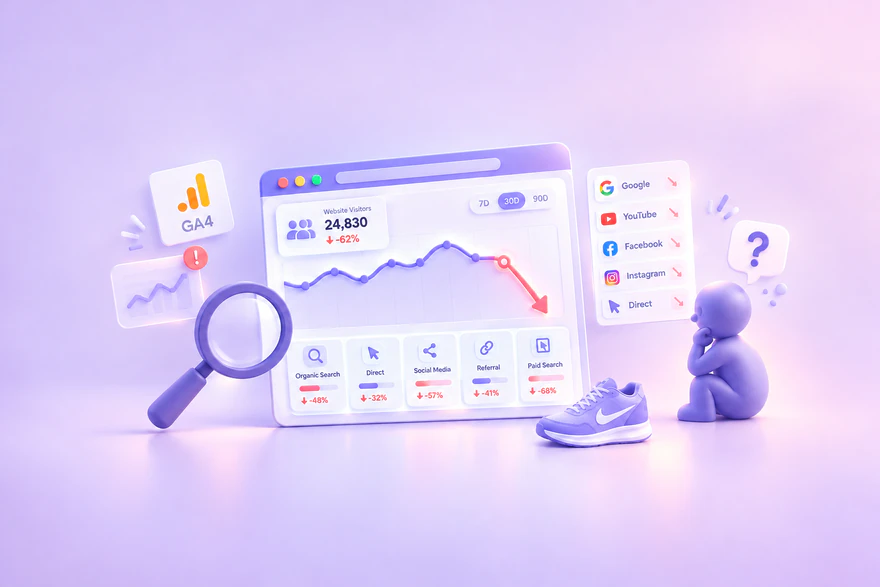
Investigate a sudden drop in website traffic before changing your site. Use a channel-by-channel process, practical worksheets and a hypothetical example to separate reporting changes from real losses.
A sudden drop in website traffic can mean fewer visits, incomplete measurement, a change in how sources are classified, or an unfair comparison. Start by defining what fell, checking the reporting conditions, and finding the sources and landing pages responsible for the change. A lower total does not automatically mean your SEO failed.
Do not begin by rewriting every article or replacing the missing sessions with purchased visits. First establish whether the site is accessible, whether visits are being recorded, and whether a particular campaign or audience stopped arriving. More than one explanation can be true at the same time.
This guide investigates declining traffic across the website. It helps you choose the right next action from evidence. Detailed Google ranking recovery, complete GA4 setup, and general traffic-growth tactics have different jobs; follow those specialist paths only when the investigation points there.
Start by Defining the Website Traffic Drop
Write a precise incident statement: which metric decreased, in which property and report, over which dates, and compared with what baseline. “Traffic is down” could describe users, sessions, views, search clicks, or the share of traffic assigned to a channel. Those are different observations.
For a sudden decline, locate the first affected day and the pages or sources that changed with it. For a gradual decline, extend the comparison to comparable earlier periods. The same investigation can help with both patterns, but a one-day chart should not be used to explain a months-long trend.
Choose complete periods of equal length and account for weekdays, holidays, seasonality, and unusual promotions. Comparing a partial day with a completed day can create an apparent crash. Google’s data freshness guidance explains why recently collected information may still change during processing. Check the report’s available data before treating its newest point as final.
Preserve the original view: dates, metric, filters, reporting scope, and the first affected day. Save a recent change log covering releases, consent configuration, campaigns, and measurement edits. This is a record for diagnosis, not evidence that the closest event caused the decline.
| Observed pattern | Next evidence to inspect | Conclusion to avoid |
|---|---|---|
| Several channels fall after a release | Template coverage, measurement changes and actual page availability | All-channel loss proves that the analytics tag broke |
| One source loses most of its sessions | Delivery history, tagged destinations and source-specific records | The whole website needs an SEO rewrite |
| GA4 falls while comparable Google clicks hold | Scope, collection, consent, dates and affected templates | The two tools should have identical totals |
| One channel falls while another rises | Source/medium and classification or tagging changes | The visits definitely vanished or definitely moved |
| The earlier period contains a large spike | Its source, campaign, audience and repeatability | Every later period must match that exceptional peak |
Prioritize the questions that can change the decision. If important pages are unavailable, restore access through the responsible technical team. If the apparent loss exists only in one incomplete report, validate the reporting view before making broad marketing changes.
Google Analytics Traffic Drop: Separate Lost Visits from Lost Measurement
Compare the analytics trend with evidence collected independently of the website tag. For Google organic search, use Search Console clicks alongside GA4 sessions filtered to google / organic. Do not compare all website sessions, or every search engine in Organic Search, with Google’s click total.
Clicks and sessions describe different things. Consent, collection, reporting settings, URL attribution, and time zones can create discrepancies. Google’s guide to using Search Console and Analytics together explains why their numbers need not match. A new divergence is a reason to investigate, not automatic proof of a broken tag.
For a paid campaign, compare platform delivery and clicks with the recorded landing-page activity. For email, compare actual sends and link activity with the relevant campaign. For a partner placement, check the live destination link and the partner’s available reporting. These sources use different definitions too; look for a coherent explanation rather than forcing equality.
Check More Than the Homepage
A release can affect an article template, product category, checkout, or embedded form while the homepage still works. Test representative affected pages and a comparable unaffected page. Check that they load, lead to the intended destination, and record the expected page view and completed action under the applicable consent conditions.
Use DebugView with debug mode enabled for an identifiable test device. Tag Assistant or Tag Manager preview can help inspect implementation. DebugView and Realtime have limited attribution; they do not replace acquisition reports for deciding which channel declined. Coordinate collection changes with the measurement owner rather than bypassing privacy controls to make a test appear.
Orders, valid inquiries, uptime records, or server evidence can provide context. However, raw requests include bots and assets, and business outcomes can lag behind visits. A stable order count does not establish that every channel stayed healthy. State what each independent source can and cannot verify.
Find Which Sources Contributed to the Decline
In GA4 Traffic acquisition, compare sessions by a session-scoped channel or source/medium dimension over the same periods. Keep the metric and scope consistent as you drill down to the source, campaign, and landing page.
Calculate the absolute change as well as the percentage. A tiny channel losing half its sessions may contribute less to the total decline than a large source losing a small fraction. Channel share is different again: a source can gain percentage share simply because another channel shrank.
Start with the largest contributors, then examine their landing pages, device types, and relevant markets. A decline isolated to one template or browser suggests a more focused investigation than an equal-looking site-wide total. Do not assume that a segmented pattern establishes its cause; use it to choose a test.
Check Whether the Labels Changed
Review campaign naming, source values, attribution scope, and channel definitions when one category falls and another grows. A source label is a reporting classification. Missing or altered tags do not always produce the same destination category, so inspect the actual records before declaring that traffic moved into Direct.
Keep a note of any reporting changes. If the earlier and later periods use different collection conditions, describe the break in comparability. A cleaner dataset can be lower than the old total without representing the same-sized loss of useful visitors.
Build a Small Evidence Packet Before Changing Anything
Capture the same comparison at three levels: the website total, the main contributing sources, and their affected landing pages. Include the report name and dimension beside each export or screenshot. Someone reviewing the incident should be able to distinguish a session-based acquisition view from a user-based acquisition view without guessing.
Add the relevant campaign dates and release notes, then mark which observations are confirmed and which remain hypotheses. For example, “the partner campaign ended on Tuesday” is a fact if its delivery record confirms it. “The new page design discouraged visitors” remains a hypothesis until you have evidence about the affected audience and its experience.
Start with broad segments and narrow them only when the result can guide an action. Repeatedly slicing a small sample by country, browser, device, campaign, and page can produce unstable patterns. Record that limitation instead of presenting the smallest segment with the largest percentage loss as the main cause.
Follow the Branch for the Affected Channel
Different sources stop delivering for different reasons. Check the activity that generated the visits before commissioning new content or increasing spend. The following branches are starting points for an investigation, not universal explanations.
Organic Search: Confirm the Search Loss First
When comparable Google clicks also fall, review the affected queries and pages in Search Console. Distinguish lower visibility, a changed query mix, and a different click response. Google’s traffic-drop guidance covers demand, technical access, search changes, and other possibilities; timing alone does not prove an algorithmic penalty.
Use the dedicated guide below for Query × Page, impression, CTR, position, and indexing analysis. If the page never had established organic traffic, follow our no-organic-traffic diagnostic instead. Missing initial visibility and losing previously earned clicks require different baselines.
Paid Traffic: Review Delivery and the Campaign Calendar
Check whether the campaign was paused, ended, exhausted its budget, changed its audience, or began sending people to another URL. Compare the platform’s delivery history with the date the analytics trend changed. Fewer paid sessions after an intentional stop may be expected rather than evidence of a website defect.
If delivery continues but recorded visits decline, test the destination, redirects, tracking identifiers, and measurement. Platform clicks are not guaranteed analytics sessions. Keep campaign visits separate from independent organic growth; restarting a paid campaign can increase the combined total without repairing lost search visibility.
Email: Compare Similar Sending Activity
Review whether a newsletter actually went out, how many eligible recipients received it, and which destination links were used. A week with no send is not a fair comparison with a product-launch email. Examine link activity, recorded sessions, and completed actions; an open-rate change alone cannot explain the number of website visits.
Inspect broken links and changed campaign tags. Where deliverability may be involved, investigate through the email platform and its responsible owner. Do not buy another list or increase send frequency simply to replace the missing traffic total.
Referral and Partner Traffic: Find the Specific Source
Identify the referrer that contributed the loss. The placement may have ended, moved, changed its link, or lost its own audience. Confirm that the current link still leads to the appropriate page. A source’s disappearance from one analytics label does not prove that the publisher removed it.
Compare the placement dates and available partner evidence with your records. A one-off mention can produce a temporary peak that will not repeat on an ordinary week. The relevant question is whether the agreed activity and useful destination still exist.
Social Traffic: Separate Reach, Link Response, and Arrival
Review publishing frequency, placement, audience reach, and the link destination. A highly visible post may have aged out of distribution, or the new post may provide less reason to open the website. Platform reach, platform link clicks, and measured sessions are different stages.
Check whether the promotion still points to the relevant resource and whether the page works in the browser users open from the platform. Make a focused correction when you find one, rather than posting the same link repeatedly to compensate for an unexplained decline.
Direct and AI-Assistant Traffic: Treat Attribution Carefully
Direct is not a complete count of people who deliberately typed your brand’s URL. Attribution and available source information affect classification. Review whether a campaign, redirect, application, or reporting change coincided with the shift, and avoid inventing the missing origin.
Google’s channel definitions include recognized external AI Assistant sources, while Google AI Overviews and AI Mode search visits are part of Organic Search. A lost sampled citation does not establish a measured visit loss. For source-specific reporting, use our AI traffic tracking guide.
Investigate Site Changes Without Assuming They Caused the Drop
If website traffic dropped after a redesign, record exactly what changed: templates, tags, public URLs, navigation, consent implementation, forms, or hosting. These are separate interventions. A visual redesign that keeps the same URLs needs a different investigation from a migration that changes them.
Check the affected landing pages and their expected next actions. An unavailable page can reduce real arrivals; a missing tag can reduce recorded activity; a broken form can reduce inquiries while visits remain. Investigate each stage rather than treating all three as a single SEO issue.
When evidence identifies a technical problem, assign it to the appropriate owner and verify the repair on the affected templates. Do not disable security protections or remove measurement safeguards just to make a chart larger. Use the technical reference below for the relevant access and indexing concepts.
Prioritize the Affected Journey, Not Just the Largest Page Total
A high-volume article and a lower-volume product page may have different business roles. Review the intended next action for each affected landing page: reading a resource, viewing a product, starting a trial, or submitting a valid inquiry. A large loss of incidental views and a smaller loss of relevant arrivals should not automatically receive the same response.
Check the journey on the device or template implicated by the evidence. Can a visitor understand the offer, open the next page, and complete the intended action? Keep those checks distinct from acquisition: a failed form can explain fewer leads without explaining fewer arrivals. Document both problems if both exist, rather than using one convenient explanation for every declining metric.
A Hypothetical Example: Total Traffic Falls, Google Is Nearly Stable
Imagine a business reviewing two complete, equal-length periods. All figures in this example are hypothetical, not SEOVisitor campaign results. The session groups are comparable and non-overlapping; “Other” contains every remaining source.
| Session group | Earlier period | Later period | Change |
|---|---|---|---|
| Google organic | 7,000 | 6,900 | −100 |
| Paid Search | 4,000 | 0 | −4,000 |
| 2,000 | 1,500 | −500 | |
| Referral | 1,500 | 1,700 | +200 |
| Other | 1,500 | 1,500 | 0 |
| Total | 16,000 | 11,600 | −4,400 |
The total declined by 27.5%, but the largest contribution is the missing Paid Search activity. The team checks the campaign calendar and finds that the promotion ended as planned. Email requires its own review because sending activity may also have changed. A small Google organic change does not explain the entire loss.
This does not prove that every search page is healthy. The correct decision is to investigate the smaller organic change at its own scale, reconcile the email activity, and decide whether the paid campaign should resume for a separate commercial reason. Rewriting the whole blog would not address the main recorded contributor.
In a different hypothetical branch, independent clicks remain similar but one article template stops sending its expected page view after a release. A test confirms the missing event. The team repairs that implementation, checks new visits, and records the measurement gap. It does not claim that previously unrecorded activity has been automatically reconstructed.
Keep Additional Promotion Separate from Traffic Recovery
Once the landing page works and measurement is reliable, a separate campaign may have a valid promotion objective. Define the destination, budget, delivery conditions, and useful outcome independently of the investigation. Delivered visits do not repair a tag, restore a ranking, or prove that previously lost organic demand returned.
Retain campaign dates and identifiers in the incident record. If campaign activity affects the same page, the combined chart is no longer a clean view of independent recovery. Report what the campaign delivered separately from what search or other established sources regained.

Turn the Investigation into an Action Record
For each significant contributor, record the observation, supporting evidence, competing explanation, owner, and next check. Fix a confirmed access or measurement defect before testing an unrelated editorial idea. Keep separate work items when different sources have different causes.
| Work item | Evidence and action | Verification |
|---|---|---|
| Missing collection on one template | Document the failed test; measurement owner repairs the implementation | Expected events appear on representative new visits under the intended conditions |
| Stopped campaign delivery | Reconcile the end date and objective with the campaign owner | Reporting distinguishes the planned stop from unrelated channel changes |
| Confirmed organic click loss | Assign affected URLs to the search-specific investigation | Review the same query/page scope after the relevant intervention |
The record should let someone else repeat the test. “Improve SEO” is too broad to verify; “check whether the category template records the expected event” is specific. Avoid closing the incident because the total happens to rise after several unrelated changes.
Define a pass condition before making the correction. For a repaired destination link, that might mean reaching the intended page with the expected campaign parameters intact. For measurement, it might mean a controlled visit records the appropriate event under the intended consent state. Neither test alone proves that the original volume of visits will return.
Where several teams are involved, choose one incident owner to reconcile the evidence. Keep the page developer, analytics owner, and channel manager responsible for their respective checks. This prevents a marketing team from restarting spend to cover a collection problem, or a developer from rolling back a release when the main loss came from a scheduled campaign ending.
Review Recovery Without Promising a Deadline
Separate implementation verification from audience recovery. A working form or tag can be checked on a new test visit. Search performance, campaign response, and qualified demand need appropriate observation windows. The first successful technical test does not establish that the earlier audience has returned.
Compare the same metric, segment, and complete periods. Check whether the apparent improvement came from the repaired source, a different promotion, or a change in measurement. Preserve an inconclusive result when the sample is limited. A traffic total can recover while the commercially important page remains weak.
If collection was missing, annotate the affected dates in your reporting process and explain which comparisons are compromised. Do not quietly treat an incomplete period as a normal baseline for future growth claims. Use a later, consistently measured period when you need a defensible comparison, while preserving the original incident record.
Keep a lightweight change log and review the sources that matter to the business. Diversification may reduce dependence on one route, but it cannot prevent all fluctuations. A useful monitoring routine identifies a change early and provides enough context to investigate it without turning every dip into an emergency rewrite.
The next step is the smallest action supported by the evidence: repair a verified defect, reconcile a campaign, investigate an affected search page, or continue collecting comparable data. That is more reliable than choosing a recovery tactic before you know what actually declined.
Frequently Asked Questions
Quick answers to common questions about sudden drop in website traffic
The loss may involve another channel, changed search demand or click response, reporting conditions, or a different mix of pages and queries. A site-wide average ranking can hide individual changes. Identify the source and landing pages responsible before choosing a fix.
No. It makes measurement and site availability important early checks, but a pattern alone does not prove a cause. Validate collection on affected templates, review reporting changes, and compare appropriate independent evidence. Multiple problems can occur together.
First compare the same Google organic scope, dates and pages. Clicks and sessions use different definitions, and collection, consent, attribution and time zones can affect the relationship. A new divergence warrants testing; it does not automatically establish lost rankings or a broken tag.
Compare session-scoped channels or source/medium over equivalent periods, then calculate absolute changes. Review the largest contributors by campaign and landing page. Percentage share alone can mislead because a channel can gain share while its own sessions stay flat.
List what actually changed, then test representative affected pages for availability, the expected measurement events and the intended user action. Review changed URLs and search evidence where relevant. The redesign date is a useful lead, not proof of the cause.
Yes. If paid delivery stops, its sessions may disappear from the combined total while Google organic remains similar. Reconcile the campaign calendar and investigate each source separately; do not treat the total decline as proof of lost organic visibility.
There is no universal acceptable percentage. Consider the site's usual variation, sample size, seasonality, campaign schedule and business outcomes. An unusual change on an important page can deserve investigation even when the site-wide percentage looks small.
There is no fixed recovery period. A collection repair can be tested on new visits, while search or audience changes require further observation. Fixing a tag does not automatically restore unrecorded history, and no repair guarantees that previous traffic will return.
No. Establish whether the loss involves access, measurement, delivery, search visibility or the page's information. Preserve useful material and make targeted changes only when the evidence supports them. Deleting or rewriting many pages can obscure the original problem.
A separate campaign may deliver visits under its own conditions, but those visits do not prove recovered organic visibility or repair tracking and indexing problems. Keep campaign reporting separate from the source whose decline you are investigating.




Comments
Leave a Comment