


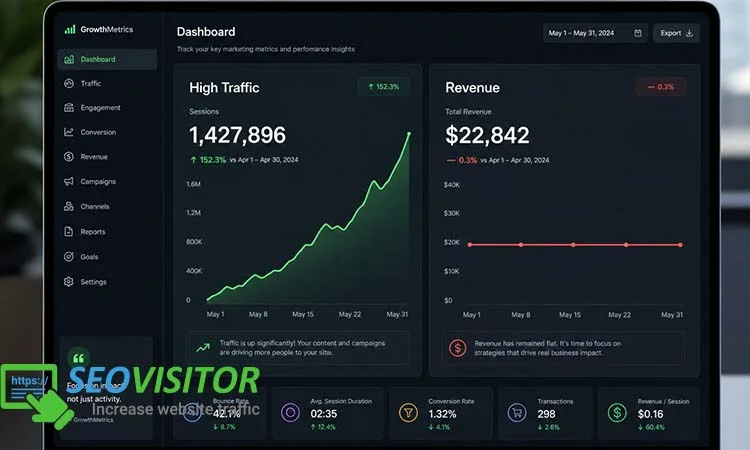
There is a moment in almost every growth campaign when the numbers look good on the surface and terrible underneath. Traffic is up. Clicks are rising. Sessions are flowing into the dashboard. Maybe the campaign even looks impressive in a report shared with a founder, client, or team…
There is a moment in almost every growth campaign when the numbers look good on the surface and terrible underneath.
Traffic is up. Clicks are rising. Sessions are flowing into the dashboard. Maybe the campaign even looks impressive in a report shared with a founder, client, or team lead.But revenue stays flat. Leads are weak. Demo requests do not close. Add-to-cart activity appears without actual purchases. Affiliate pages get impressions without meaningful commissions.That disconnect is where the hidden cost of untargeted traffic starts doing real damage.
Most marketers think bad traffic only wastes ad budget. In reality, the losses go much deeper. Untargeted traffic distorts analytics, trains ad platforms on the wrong signals, inflates customer acquisition costs, misleads conversion rate optimization efforts, and drains time from teams trying to fix the wrong problem.For SaaS brands, this can mean bloated CAC and low-quality trial users who never activate. For affiliate marketers, it can destroy click-through performance and reduce trust with networks or merchant partners. For ecommerce businesses, it often creates the illusion of demand while purchase intent remains weak.
In this guide, we will break down what untargeted traffic really costs, why it hurts different funnels in different ways, how to identify the warning signs, and what to do if you want cleaner data, stronger conversions, and more reliable growth.
Why More Traffic Is Often a Metric for Failure
One of the most common mistakes in digital marketing is assuming that more traffic automatically means more opportunity.
In some cases, that is true. But in many cases, especially in competitive funnels, more traffic simply means more noise.
Traffic becomes valuable only when it aligns with audience intent, offer relevance, and funnel stage.
If those elements are mismatched, high traffic volume can actually make performance analysis harder. A campaign with poor-fit visitors may produce misleading engagement patterns, inconsistent conversion data, and false optimism that delays real improvements.
The Vanity Metric Trap vs. Revenue Reality
Vanity metrics are numbers that look positive but do not tell you much about business outcomes. Sessions, impressions, cheap clicks, and even superficial engagement can make a campaign appear healthy when it is not producing qualified action.
Revenue metrics tell a different story. These include:
- Conversion rate
- Revenue per visitor
- Cost per qualified lead
- Customer acquisition cost
- Return on ad spend
- Average order value
- Lead-to-sale close rate
If traffic goes up while these metrics weaken, your campaign is not scaling. It is expanding inefficiency.
How Untargeted Traffic Pollutes Your Data and AI Models
Modern ad platforms and analytics tools learn from behavior. Meta, Google Ads, and many third-party optimization systems rely on user signals to understand what kind of visitor is likely to convert. When your funnel attracts the wrong audience, the system starts learning from the wrong people.
This is one of the most overlooked consequences of poor traffic quality. Instead of optimizing around real buyers, your campaigns may begin optimizing around accidental clicks, low-intent browsers, or irrelevant audiences who engage just enough to confuse attribution but never enough to generate revenue.
Over time, this creates a compounding problem:
- Your retargeting pool fills with weak prospects
- Your lookalike audiences reflect poor-fit users
- Your landing page tests produce unreliable conclusions
- Your analytics lose clarity around what actually drives results

Buy Website Traffic
If you want to increase your website traffic directly and have a targeted impact on Google’s algorithms, use the increase website visits Seovisitor service.
The Hidden Cost of Untargeted Traffic in SaaS Funnels
SaaS funnels are especially vulnerable to untargeted traffic because the sales process usually depends on user intent, product fit, and ongoing engagement after the initial click.
A SaaS company does not just need a visitor. It needs the right visitor: someone with a relevant problem, budget potential, and a realistic use case for the software.
Inflated Customer Acquisition Costs
SaaS brands often track CAC closely because growth efficiency depends on predictable unit economics.
When traffic quality drops, CAC rises quickly.
You may still generate signups or free trial users, but if those users are not aligned with the actual product value, they rarely become paying customers.
This creates a dangerous illusion. Early funnel conversion rates may look acceptable, but downstream monetization weakens. The business ends up paying to acquire users who were never likely to convert into valuable accounts.
The Churn Effect From Low-Fit Users
Poor targeting does not just hurt acquisition. It hurts retention too.
Users who enter the funnel without a strong need for your product often sign up with curiosity rather than intent. They explore briefly, fail to activate, and disappear.
In subscription businesses, this is expensive. Even when a low-fit user converts initially, they are more likely to cancel early, ask for support that does not lead to value, or never fully onboard.
That means bad traffic can quietly reduce lifetime value while increasing churn-related costs.
Wasted Sales and Support Resources
SaaS teams often underestimate the operational cost of poor traffic.
Low-quality signups trigger emails, demos, onboarding sequences, sales calls, and support tickets. Every unqualified user consumes some combination of automation budget, team time, or pipeline attention.
When this happens at scale, the sales team starts chasing weak leads, customer success spends time on accounts that never activate, and leadership may blame the team instead of the traffic source.
That is why traffic quality is not just a marketing issue. It is a cross-functional efficiency issue.
How Poor Traffic Quality Destroys Affiliate Marketing Margins
Affiliate marketing lives on thin margins and fast behavioral signals.
In many cases, a small drop in click-through rate or conversion rate can make the difference between a profitable funnel and a losing campaign.
That makes traffic quality a core asset, not a secondary variable.
The Bridge Page Breakdown
Many affiliate funnels rely on a bridge page, presell article, review page, or comparison page before sending users to the final offer.
These pages work only when the visitor arrives with enough relevance to continue.
Untargeted traffic tends to bounce early because the visitor has no strong connection to the problem, offer category, or buying context.
That hurts not just conversions but the entire economics of the traffic source.
You pay for the click, lose the visitor, and collect almost no useful data except proof that the audience was wrong.
Weak Intent Lowers EPC and ROI
Affiliate marketers often optimize around EPC, CTR, and overall campaign ROI.
Untargeted visitors reduce all three.
They do not read deeply, they do not trust quickly, and they do not click through with enough intent to convert on the merchant side.
Even if your content is strong, traffic quality sets the ceiling for performance.
A good page can improve weak traffic somewhat. It cannot turn irrelevant audiences into consistent buyers at scale.
Reputation Risk With Networks and Partners
Some affiliate ecosystems monitor suspicious traffic patterns, low engagement behavior, or low-value referral quality.
If a marketer continuously sends traffic that performs poorly or looks unnatural, trust can erode.
That does not always mean penalties in a formal sense, but it can mean reduced partner confidence, lower approval rates for certain campaigns, or more scrutiny over promotional methods.
In affiliate marketing, trust is part of the asset base. Bad traffic weakens it.
Ecommerce Funnels and the Hidden Cost of Untargeted Traffic
Ecommerce brands often experience untargeted traffic as a volume illusion.
Product pages get visits. Collection pages get impressions. Retargeting pools grow. Cart activity appears.
But if the visitors were never likely to buy, those signals create activity without meaningful commercial intent.
Abandoned Carts and Low Average Order Value
Not every abandoned cart is a traffic problem, but poor targeting often makes cart data harder to interpret.
Shallow-intent visitors may add products casually, react to discounts without commitment, or browse across devices without serious purchase motivation.
This inflates top-of-funnel and mid-funnel metrics while suppressing final revenue.
It can also reduce average order value if campaigns attract bargain seekers or curiosity-driven users who do not fit the brand’s ideal customer profile.
Retargeting Gets More Expensive and Less Relevant
Retargeting works best when the audience already demonstrated meaningful interest.
If your retargeting pool is filled with low-intent traffic, follow-up campaigns become broader, weaker, and more expensive.
Instead of reminding serious shoppers to complete a purchase, you end up paying to chase people who clicked accidentally, bounced quickly, or never had product-level intent in the first place.
This drives up cost and lowers overall campaign efficiency.
Product Feedback Becomes Misleading
Ecommerce teams rely on data to make decisions about pricing, merchandising, product selection, and page design.
When the audience is poor-fit, the signals become unreliable.
You may think a product has weak demand when the real issue is audience mismatch.
You may blame product pages for low conversion when the campaign was attracting visitors from the wrong geography, wrong demographic, or wrong intent stage.
That is a costly misdiagnosis.
read more:Cold Traffic vs Intent Traffic
The Hidden Costs You Are Probably Not Tracking
Direct ad spend is only the visible part of the problem.
The real damage from untargeted traffic is often indirect, cumulative, and spread across multiple systems.
Opportunity Cost
Every dollar spent on poor-fit traffic is a dollar that could have gone toward a better source, a stronger campaign, or a more profitable experiment.
This matters even more for smaller businesses or lean teams with limited budgets.
Opportunity cost is frustrating because it does not appear clearly in dashboards.
You do not see a line item labeled “profitable alternative we failed to fund.”
But that loss is real.
CRO Blindness
One of the most damaging effects of untargeted traffic is that it makes marketers misread landing page performance.
If the audience is wrong, even a strong page may convert poorly.
Teams may then redesign the page, rewrite the copy, change the offer, or blame the checkout flow when the real issue is traffic quality.
This leads to wasted design cycles, unnecessary A/B tests, and internal confusion about what actually needs fixing.
Algorithmic Weakening
While search engines and ad platforms use many signals, low engagement and poor audience alignment can still weaken performance over time.
High bounce patterns, poor dwell time, weak downstream actions, and irrelevant audience interactions do not help platforms trust your relevance.
That does not mean every bounce is harmful, but a persistent pattern of low-quality visits can undermine optimization in both paid and organic ecosystems.
How to Clean Up Your Traffic Strategy and Improve Funnel Conversion Rate
The solution is not to obsess over eliminating every imperfect visit.
The solution is to build a strategy where traffic sources, audience filters, and landing pages are aligned with real business goals.
Tighten Your Targeting Parameters
Start with the basics:
- Refine geo-targeting to match your actual market
- Exclude irrelevant placements or audiences
- Separate awareness campaigns from conversion campaigns
- Build dedicated pages for specific intent groups
- Use negative keywords and better audience layering where applicable
If you sell to US-based customers, your tests and paid campaigns should reflect that. A US landing page tested with broad global traffic often produces misleading conclusions.
Use Pre-Qualification in the Funnel
Not every visitor should go directly to a sales page.
For many businesses, especially in SaaS and affiliate marketing, pre-qualification improves efficiency.
This can include:
- Bridge pages
- Comparison content
- Use-case filters
- Short surveys
- Industry-specific landing pages
The goal is simple: help the right people move forward and let the wrong people self-select out before they distort your funnel data.
Validate With Geo-Relevant High-Quality Traffic
Before scaling major campaigns, many marketers benefit from testing engagement and page behavior with visitors who match the intended market.
If your funnel is built for American users, validating it with relevant US-based traffic can produce cleaner insights.
How to Identify Untargeted Traffic Before It Drains More Budget
The earlier you catch the problem, the easier it is to fix.
Untargeted traffic leaves patterns. You just need to know where to look.
Behavioral Warning Signs
- Very high bounce rates from specific campaigns
- Short engagement time with little scroll depth
- Low conversion rate despite solid page design
- Weak assisted conversions across channels
- Unusual geographic traffic patterns
- High click volume with low downstream action
Segment by Source Geography and Landing Page
Never evaluate traffic only in aggregate.
Segment by source, campaign, device, location, and landing page.
Often, the overall numbers hide the real issue because a small number of good segments are masking a much larger set of poor-performing visits.
Conclusion: The Hidden Cost of Untargeted Traffic Is Bigger Than Ad Spend
The core lesson is simple but expensive to ignore: the hidden cost of untargeted traffic is not limited to wasted clicks.
It affects acquisition efficiency, conversion clarity, retargeting quality, sales productivity, retention, testing accuracy, and strategic decision-making.
For SaaS, untargeted traffic inflates CAC and brings in low-fit users who churn. For affiliate marketers, it destroys margins by weakening click intent and downstream conversions. For ecommerce brands, it creates the illusion of traction while revenue stays disconnected from traffic volume.
The best growth teams do not chase traffic for its own sake. They chase relevance.
They segment performance carefully, test with the right audience, and treat traffic quality as a core growth lever rather than a background metric.
Frequently Asked Questions
Quick answers to common questions about The Hidden Cost of Untargeted Traffic
Untargeted traffic consists of visitors whose location, intent, needs, or characteristics do not match the website's offer and conversion goal. It can increase sessions without creating qualified leads, sales, or useful audience data.
Irrelevant visitors are less likely to engage with the offer, so they can lower conversion rates, inflate acquisition costs, increase abandonment, distort experiments, and make successful customer journeys harder to identify.
When low-fit visitors consume advertising, onboarding, sales, and support resources without becoming durable customers, the cost required to acquire each qualified account rises. Poor-fit signups can also increase churn and weaken product feedback.
Weak-intent visitors click fewer relevant offers and convert at lower rates, reducing earnings per click and return on investment. Repeated low-quality activity can also create compliance and reputation concerns with affiliate networks.
It can increase product views and carts without purchases, enlarge low-value retargeting audiences, reduce conversion rate, waste ad spend, and create misleading product feedback. Revenue and margin matter more than raw session volume.
Segment performance by source, campaign, keyword, location, device, and landing page. Look for high volume with weak product interaction, qualified events, conversions, revenue, retention, or geographic relevance, and validate suspicious patterns with logs.
Tighten audience and geographic targeting, align messages with landing pages, target stronger intent, use pre-qualification, exclude poor sources, improve offers and page experience, and optimize toward qualified revenue events instead of cheap clicks.


Comments
Leave a Comment