



Cold traffic and buyer intent can overlap. Learn how to match US audiences to landing pages and measure qualified customers, acquisition cost, and revenue.
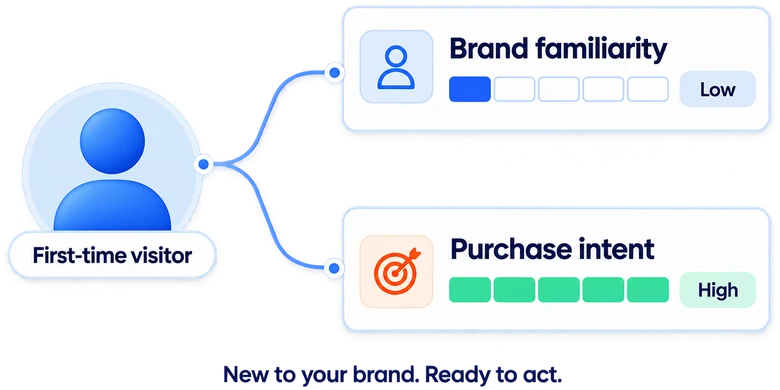
Cold traffic vs intent traffic is not an either-or choice. Cold traffic describes how familiar visitors are with your brand. Intent describes what they want to accomplish. A first-time visitor searching for a specific product can be cold to your business and ready to buy at the same time.For a US-focused website, the useful question is not which label attracts more visits.
It is which combination of audience, offer, landing page, and acquisition cost produces qualified customers at a sustainable margin.This guide explains the distinction, shows how to match each audience to an appropriate page, and gives you a practical measurement framework. It also separates useful traffic tests from claims that a visitor count, US location, or long session can prove buying intent.
What Is Cold Traffic?
Cold traffic consists of visitors who have little or no previous relationship with your brand. They may arrive through a social ad, a search result, a creator recommendation, a referral, or another discovery channel. The source alone does not determine how ready they are to purchase.
Someone who discovers an unfamiliar shoe store while searching for a specific running shoe is cold to the store, but not necessarily cold to the product. Someone watching a general fitness video may be unfamiliar with both. These visitors need different messages even if both are new to your website.

Looking for keyword-focused traffic to your website? Explore Seovisitor’s organic traffic service and choose campaign settings that match your selected keywords, target country, and landing pages.
Where Cold Audiences Come From
Prospecting campaigns can introduce your business to people who have not interacted with it before. Common examples include paid social, display ads, video campaigns, creator partnerships, and non-branded search. However, any of these channels can also reach existing customers.
Treat a campaign audience definition as a starting hypothesis. Analytics cannot perfectly identify brand familiarity: a visitor may know your company offline, return on another device, or be counted as new after cookie changes.
What a First-Time Visitor Needs
A visitor unfamiliar with your company needs to understand the offer and decide whether to trust you. Make the next step appropriate to the problem they are trying to solve.
- Explain the value: say who the product is for and what it helps them do.
- Reduce uncertainty: show relevant proof, delivery details, support options, and clear terms.
- Offer a suitable next step: an educational guide may fit early research, while a product page should let a ready buyer purchase.
Do not force every new visitor through a long nurturing sequence. A ready-to-buy customer still needs a clear route to checkout.
What Is Intent Traffic?
Intent traffic is a marketing description for visits associated with an identifiable goal. That goal could be learning, comparing alternatives, finding a particular website, or purchasing. Intent is not a standard GA4 traffic channel, and informational intent is not the same as purchase intent.
Informational, Commercial, and Transactional Intent
Consider three searches for the same product category. Each suggests a different task and a different landing page:
- Informational: “how to choose running shoes” calls for useful guidance, not an immediate sales pitch.
- Commercial investigation: “running shoe A vs B” calls for specific comparisons, trade-offs, and evidence.
- Transactional: “buy running shoe A size 10” calls for stock availability, pricing, delivery information, and checkout.
These are clues, not proof of an individual visitor’s intentions. Use query patterns, campaign messaging, landing-page purpose, and downstream actions together to evaluate an audience.
Why Familiarity Does Not Prove Purchase Intent
Branded searches, return visits, and email clicks can indicate familiarity, but they are not automatic buying signals. An existing customer may want support. A subscriber may open a tutorial without any plans to purchase.
Likewise, a new visitor can arrive with strong commercial intent. The most useful classification considers both dimensions: familiarity with your business and readiness to take the action you value.
Cold Traffic vs Intent Traffic: Match the Page to the Visitor
Instead of assigning one landing page to all cold traffic and another to all intent traffic, consider four practical situations. This prevents brand familiarity from being confused with funnel stage.
New to Your Brand and Still Learning
Start with the visitor’s problem, explain relevant options, and show how your solution fits. A useful guide, product demonstration, or low-commitment next step can help. Measure whether visitors progress toward a meaningful action, not just whether they scroll.
New to Your Brand but Ready to Buy
Use a relevant product or service page with clear pricing, proof, availability, and a direct CTA. Place trust information close to the decision point. Do not hide the purchase route behind an unnecessary email form.
Familiar with Your Brand but Not Ready to Buy
Help visitors with their current task. They may need documentation, a comparison, or a reason to reconsider the product later. Repeatedly showing a checkout CTA will not resolve an unanswered question.
Familiar with Your Brand and Ready to Act
Remove obstacles such as unclear delivery costs, long forms, missing plan details, or confusing checkout steps. Use relevant evidence rather than adding more promotional copy. Reviews are most helpful when they address the specific risks a buyer is considering.
Which Traffic Actually Grows Revenue? A Worked Example
Neither cold nor high-intent traffic is automatically more profitable. A higher purchase rate can be offset by expensive acquisition, low margins, refunds, or weak repeat business. Compare the economics of each campaign using the same definitions.
Compare Acquisition Cost, Not Just Click Price
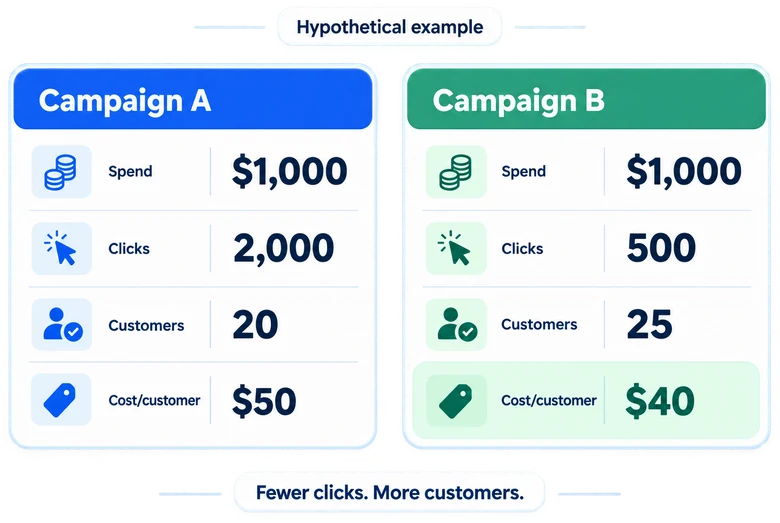
The following numbers are hypothetical, not Seovisitor campaign results or industry benchmarks. Assume two campaigns each cost $1,000, all orders come from new customers, and every order is worth $100.
- Campaign A: 2,000 clicks produce 20 customers. Click cost is $0.50, click-to-customer conversion is 1%, campaign acquisition cost is $50 per customer, and revenue is $2,000.
- Campaign B: 500 clicks produce 25 customers. Click cost is $2, click-to-customer conversion is 5%, campaign acquisition cost is $40 per customer, and revenue is $2,500.
Campaign B attracts fewer clicks and costs more per click, yet produces more customers for the same spend. Its revenue-to-ad-spend ratio is 2.5, compared with 2.0 for Campaign A. The result follows from the numbers, not from labeling either audience cold or high intent.
Separate Revenue from Profit
If contribution margin before advertising is 40%, Campaign A generates $800 of contribution before the $1,000 ad cost, leaving a $200 loss. Campaign B generates $1,000 before advertising, leaving zero. Neither has demonstrated profit after other business overhead.
For this simplified example, break-even return on ad spend is 1 divided by 0.40, or 2.5. Your actual threshold depends on fulfillment costs, refunds, discounts, overhead, and the contribution margin definition you use. Do not justify current losses with an assumed lifetime value that has not been observed.
How to Plan a US-Focused Traffic Strategy
The US is not one uniform audience. Country targeting is useful when you serve US customers, but it cannot establish income, product fit, buying intent, or whether a visit represents a real prospective customer.
When to Prioritize Demand Capture
If people already search for your solution and you have a working offer, start by testing relevant commercial demand. Match search terms or placements to dedicated pages, exclude obvious mismatches, and measure qualified outcomes.
A local service business should confirm that leads fall inside its service area. An ecommerce store should show shipping costs and availability. A SaaS business should connect feature claims to the buyer’s use case and evaluate trial activation or paid accounts, not sign-ups alone.
When Prospecting Makes Sense
Prospecting can be useful when your product needs explanation, brand awareness is limited, or existing demand is too small to support expansion. Use creative that explains a real problem and send visitors to a page that fulfills the ad’s promise.
Choose an initial success measure before spending. For a long sales cycle, this might be a qualified consultation that later becomes an opportunity. For ecommerce, it may be a completed purchase with acceptable acquisition cost. An inexpensive click is not a substitute for either outcome.
How to Combine Both Approaches
Use prospecting to reach new audiences and relevant search or comparison content to help people who are evaluating solutions. Follow up through consent-based email or eligible remarketing audiences where appropriate. Exclude existing customers from new-customer campaigns when that matches the objective.
Do not adopt a universal budget split. Allocate a bounded test budget to each hypothesis, allow for the normal buying cycle, and expand only when repeated results support the economics. A small campaign with one sale is not enough to establish a dependable acquisition cost.
Measure Traffic Quality and Revenue in GA4
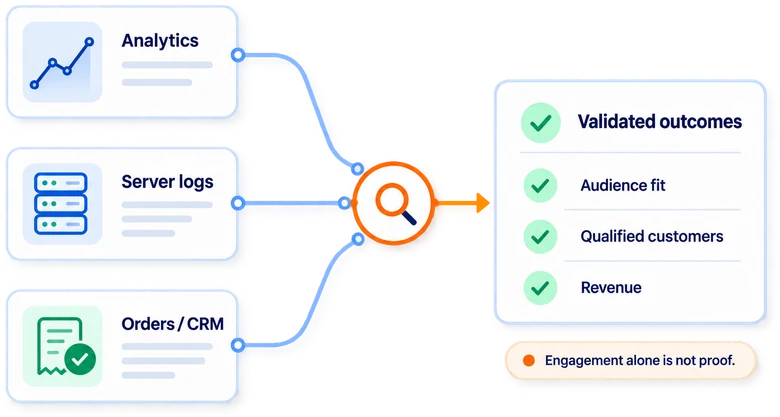
Start with reliable tracking. Check that purchase events are not duplicated, revenue and currency are correct, and lead events represent successful submissions rather than button clicks. Reconcile orders or qualified leads with your commerce system or CRM.
Use Consistent Campaign Segments
Tag external campaigns consistently, then compare session source/medium, campaign, landing page, device, and country over the same period. Avoid adding campaign UTMs to internal navigation links.
Google distinguishes user- and session-scoped acquisition data. Use session-scoped dimensions to examine visits from a campaign and first-user dimensions when investigating initial acquisition. Mixing these scopes can produce comparisons that answer different questions.
Keep an explicit record of which campaigns you classify as prospecting, commercial research, or purchase-focused. GA4 does not read a visitor’s mind, and a source such as organic search can contain several levels of intent.
Track Business Outcomes Alongside Engagement
Build a compact scorecard that connects activity to the result your business actually needs:
- Traffic: sessions and relevant landing-page entries, separated from ad-platform clicks.
- Progression: product views, checkout starts, trial activation, or genuinely qualified enquiries.
- Outcome: new customers, net revenue, qualified pipeline, and campaign acquisition cost.
- Economics: contribution after acquisition, refunds, and observed repeat purchases.
For a session-based purchase rate, divide sessions containing a purchase by total sessions. Orders divided by sessions is a different calculation because one session can contain multiple orders. Keep the numerator and denominator consistent when comparing campaigns.
Google defines engagement rate and bounce rate using engaged sessions. Engagement can come from duration, a key event, or multiple page or screen views. It does not establish purchase intent, traffic authenticity, or profitability.
Account for Delayed and Attributed Conversions
Use the same observation window and allow time for the usual sales cycle. A lead generated today may become a customer weeks later. Compare qualified leads and closed sales when evaluating lead-generation campaigns.
Attribution assigns credit; it does not by itself prove a campaign caused additional sales. Branded and returning-audience campaigns may capture demand that already existed. Where scale permits, use a properly designed holdout or controlled experiment to evaluate incremental results.
What Purchased US Traffic Can and Cannot Tell You
Purchased visits should be evaluated as a separate traffic source, not assumed to represent the same audience as a search campaign. Matching a country setting does not make a sample representative of US buyers, and configured engagement does not demonstrate genuine interest.
Seovisitor provides paid website traffic services, so this guide has a commercial context. Evaluate any provider, including Seovisitor, using the same independent checks and documented business outcomes.
Check the Source Before Interpreting the Results
Ask how visits are sourced, whether they are automated or incentivized, which targeting criteria are supported, and what delivery means in the provider’s reporting. Clarify exclusions and measurement limitations before treating a campaign as an audience test.
Controlled visits may help reveal tracking or navigation problems, depending on how the traffic is generated. They cannot establish product-market fit or predict customer conversion rates unless the sample genuinely represents potential customers and the test supports that conclusion. More visits also do not guarantee higher organic search rankings.
Investigate Suspicious Behavior with Multiple Signals
Compare analytics with CDN, WAF, or server-log evidence where available. Look for inconsistent geography, repeated request patterns, unusual bursts, and a gap between reported activity and validated outcomes.
A short visit can be legitimate, while a long or human-like session can be automated. No single engagement metric proves authenticity. First rule out tracking failures, duplicate events, consent-related gaps, and landing-page errors before blaming the audience.
A Practical Checklist Before You Scale
Before increasing spend, make sure you can answer each of these questions with evidence rather than assumptions:
- What makes this audience relevant, beyond being new, returning, or US-based?
- Does the landing page match the visitor’s current task and the campaign promise?
- Are purchases or qualified leads measured correctly and reconciled with business records?
- Are campaigns compared over the same buying cycle with consistent cost and conversion definitions?
- Does the contribution after acquisition justify scaling, without relying on invented future value?
- Have suspicious activity and tracking problems been investigated separately from poor conversion?
If the page receives relevant visits but few qualified actions, investigate the offer, proof, usability, and checkout or form flow. If visitors are consistently mismatched to the offer, revisit targeting and sourcing. Buying more of the same traffic does not resolve either problem.
Looking to bring more visitors to your website? Explore Seovisitor’s website traffic options and choose a campaign that fits your target audience, landing page, and marketing goals.
Final Takeaway
The useful distinction in cold traffic vs intent traffic is brand familiarity versus the visitor’s goal. They overlap. New audiences can buy immediately, and familiar audiences can visit without buying.
For sustainable US revenue growth, match the page to the task, measure qualified outcomes, and compare acquisition cost with contribution margin. Use prospecting and demand capture as complementary tactics when the evidence supports them, not as competing labels with a guaranteed winner.
Frequently Asked Questions
Quick answers to common questions about cold traffic vs intent traffic
Yes. A visitor may be unfamiliar with your brand but already know exactly what they want to buy. Brand familiarity and purchase intent are separate dimensions. A first-time visitor can therefore need reassurance about your business without needing an introduction to the product category.
No. A higher conversion rate does not guarantee profit if acquisition costs, refunds, or fulfillment expenses are too high. Compare the cost of acquiring a customer with the contribution that customer generates, rather than judging performance by clicks or conversion rate alone.
The choice depends on the offer and existing demand. If potential customers already search for your solution, test relevant demand-capture campaigns. If the product requires explanation, prospecting may help introduce it. Start with a defined objective and a limited test budget rather than assuming one approach will always work.
No. Geographic targeting does not establish product interest, purchasing power, or readiness to buy. Evaluate how visitors are sourced, whether they match your intended audience, and whether their visits produce validated enquiries or purchases. Location alone is not evidence of traffic quality.
Not by themselves. Long sessions, scrolling, and multiple pageviews can provide useful context, but they do not prove genuine buying interest or human activity. Compare engagement with verified orders, qualified leads, and supporting server-side evidence before drawing conclusions about campaign value.
Cold traffic describes visitors who are unfamiliar with the brand, while high-intent traffic describes visitors who show a strong likelihood of taking a valuable action. A first-time visitor can still have high purchase intent if the page and offer match an urgent need.
Segment traffic by source, campaign, landing page, location, and device, then compare meaningful events such as product views, qualified leads, checkout starts, purchases, revenue, and repeat behavior. Engagement metrics alone do not prove commercial intent.


Comments
Leave a Comment