


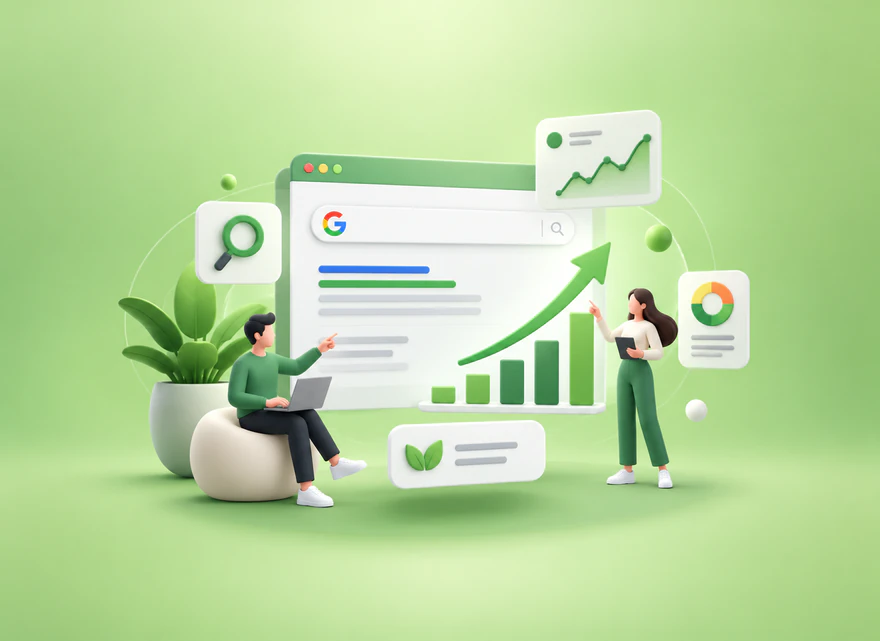
Compare Organic Search, Google Images, Discover, eligible Business Profiles and product listings, and paid Google Ads by fit, prerequisites, destination, measurement, and limits.
“Google traffic” is not one channel. A website may receive unpaid query-driven visits from Search or Images, interest-driven exposure in Discover, local actions from Search and Maps, product visits through free listings, or paid clicks from Google Ads. Each route has different eligibility, landing pages, measurement, and limits. This guide helps you choose a route before optimizing it; it is not another list of ten general SEO tactics.
Choose a Google route by the visitor’s task
Start with what the visitor is trying to do. Someone asking a question may need a useful article or service page in organic Search. A person comparing a visual product may discover an image. A nearby customer may seek directions or opening hours. A shopper may inspect a product listing. An advertiser can pay for placement against an eligible campaign goal. The same business can use more than one route, but the data should remain distinct.
Do not add every Google-sourced click together as if each report counted the same thing. Search Console covers search-result visibility and has separate search-type filters; Discover has its own report when data qualifies. Business Profile and Merchant Center provide product-specific performance views, while Google Ads reports paid spend and conversions. GA4 helps measure on-site actions after arrival, subject to its own collection and attribution rules.
Compare six ways to receive visits from Google
The table describes where each path begins and what can limit it. Eligibility never guarantees a listing, position, click, or customer. On a narrow screen, swipe horizontally to see all columns.
| Route | Best fit | Prerequisite | Destination page | Where to measure | Important limit |
|---|---|---|---|---|---|
| Organic Search | Businesses answering a known query | Useful, accessible, indexable page | Article, service, category, or product page matching intent | Search Console Web; GA4 actions | Indexing and ranking are not guaranteed |
| Google Images | Visual products, examples, tutorials, design, or photography | Discoverable images and relevant landing-page context | Page containing the useful image | Search Console Image search type; GA4 | An image impression is not automatically a site visit |
| Discover | Publishers with useful interest-led content | Indexed content that meets Discover policies | Relevant article or video page | Search Console Discover report if available | Personalized exposure is unpredictable |
| Business Profile / Maps | Eligible in-person or service-area businesses | Eligible, verified, accurate profile | Business website or relevant location page | Business Profile performance; GA4 for site visits | Online-only businesses generally are not eligible |
| Merchant Center free listings | Eligible stores with products to sell | Approved product data and program eligibility | Accurate product detail page | Merchant Center performance; GA4 | Free eligibility does not guarantee display |
| Google Ads | Businesses with a funded, measurable offer | Budget, policy-compliant ad, landing page, tracking | Ad-matched product, service, or lead page | Google Ads cost/conversions; GA4 | Paid clicks are not organic rankings |
Organic Search and Images: answer or show the right thing
For regular Search, identify a reader task, use an existing page that answers it, and check crawl and index eligibility before judging rankings. A title and opening should describe the actual answer. This page does not repeat the detailed workflow in the Search Console organic-growth guide.
For Images, use an image that contributes to the page, descriptive alt text, and nearby explanatory content. Google must be able to discover the image and understand its landing page. Review the Image search type in Search Console rather than assuming all image exposure appears in the default Web view. Google’s image SEO documentation explains the fundamentals.
Discover: interest-led visits are not keyword rankings
Discover can recommend content based on interests without the person typing a query. Indexed content that meets its policies is eligible, but no special tag guarantees inclusion. A publisher may consider original explanations, accurate headlines, and strong relevant images; it should not plan revenue around a forecast of Discover clicks.
The related guide covers Discover-specific examples, while Google’s official guidance explains eligibility and reporting. If a Discover report appears in Search Console, compare its visits with Web and Image data separately; a spike is not a stable traffic forecast.
Maps and free product listings require the right business
A Google Business Profile is for an eligible business that makes in-person contact with customers, including qualifying service-area businesses. An online-only site should not create an ineligible profile to seek Maps traffic. A verified business can keep hours, location or service-area details, and the website link accurate, then inspect website clicks and other interactions in Business Profile performance. The eligibility rules matter more than a generic local SEO checklist.
Merchant Center free listings serve eligible products, not every page on a store. The store needs valid product information and applicable program requirements; the landing product page should match price, availability, and offer details. Review the official free-listings guidance and Merchant Center performance before investing in a feed. “Free listing” means no ad placement fee for that listing, not guaranteed display or cost-free store operations.
Google Ads is paid reach, not an SEO shortcut
Google Ads can send visitors to a focused landing page while a funded campaign runs. Define an action such as a qualified lead or purchase, test conversion measurement, and compare cost with business value. Use Google Ads reporting and GA4 for paid outcomes; do not mix those clicks with Search Console organic clicks. Paying for Ads or buying visits does not purchase indexing, Discover placement, or organic rank.
For choosing and measuring paid traffic alongside email, partnerships, and other non-SEO channels, see the traffic-without-SEO channel guide. A third-party keyword-traffic service is also separate from Google Ads. Evaluate any purchased visits under their actual source and terms, without presenting them as Google Ads clicks or organic-search gains.
Make one route decision, then measure it correctly
A local repair business may start with an eligible Business Profile and a useful service page; a visual retailer may prioritize product imagery and an eligible product feed; a publisher may compare Web Search, Images, and Discover separately. These are decision examples, not promised outcomes. Choose the route that matches your business and asset, verify eligibility, provide the right destination, and review its own report before expanding. When multiple Google surfaces overlap, avoid double-counting exposure as distinct customers.
Frequently Asked Questions
Quick answers to common questions about Google traffic sources
No. Discover is interest-led and does not require a typed search query. When enough data is available, Search Console reports it separately; exposure and clicks can vary and are not guaranteed.
An eligible store can submit accurate product data through Merchant Center for free listings, subject to product and program requirements. Eligibility does not guarantee that a listing will display or generate visits.
Use the Image search type in Search Console to inspect image-search impressions and clicks. GA4 can help assess actions after a visitor lands on the site. An image impression is not itself a website visit.
No. Google Ads can generate immediate paid visits and useful campaign data, but paying for ads does not buy organic rankings. Evaluate ads with conversions, cost per lead, revenue, and return on ad spend.
Eligible businesses that make in-person customer contact, including qualifying service-area businesses, can use a verified profile. Online-only businesses generally are not eligible. A profile does not guarantee Maps visibility or website visits.

Comments
Leave a Comment