



More visits do not necessarily create more profit. Follow two explicitly hypothetical traffic sources from visits to qualified leads, sales, acquisition cost, and contribution after cost.
Website visits create opportunities, but visit count is not the economic value of a channel. A source is valuable when it brings people whose needs match the landing page, produces verified qualified actions, and leaves enough margin after acquisition cost. This guide compares traffic quality with sales and contribution, rather than becoming a troubleshooting manual for checkout or forms.
Traffic quantity, audience fit, and business value are different
Quantity counts visits or users. Audience fit asks whether the person’s intent, location, and needs match the offer. Economic value follows the journey from that visit to a qualified lead or purchase, then subtracts the cost of earning the outcome. A high engagement rate can support an investigation, but it cannot replace lead quality, sales, or margin.
“Targeted” describes relevance, not a channel. Organic Search, referral links, email, paid ads, and returning visits can each bring either well-matched or poorly matched people. “Referral” only describes how a visitor arrived; a referral from an unrelated placement is not automatically high quality. A purchased visit does not directly improve organic rankings or guarantee a sale.

Follow one source from visit to qualified lead to sale
Choose a business definition of a qualified lead before comparing sources. For example, a training company might require the right job role, region, course need, and a valid contact request. Track the landing page and GA4 key event, then connect accepted leads and closed sales in a CRM or order system where possible. Do not treat every form submission as equal to a sale.
A useful chain is source → relevant visit → qualified lead → sale → contribution after acquisition cost. The visit and conversion reports are observations, while the source’s causal credit can be uncertain when people interact with several channels. Keep the attribution model and comparison window consistent. If data is missing, label it unknown rather than estimating it as fact.
A hypothetical comparison of two traffic sources
The numbers below are entirely hypothetical and illustrate the calculation; they are not SEOVisitor results or a performance promise. Suppose each sale brings $150 in revenue and costs $75 to fulfill, leaving $75 contribution margin before marketing. Source A is a relevant partner newsletter; Source B is a broader paid placement. Both send visitors to the same offer during a comparable period.
| Source | Visits | Qualified leads | Sales | Revenue | Margin before marketing | Acquisition cost | Contribution after cost |
|---|---|---|---|---|---|---|---|
| A: partner newsletter | 1,000 | 80 | 16 | $2,400 | $1,200 | $400 | $800 |
| B: broad paid placement | 4,000 | 40 | 8 | $1,200 | $600 | $500 | $100 |
Source B has four times the visits, but Source A produces twice the qualified leads and sales. Its qualified-lead rate is 8% versus 1%; its acquisition cost per sale is $25 versus $62.50. The calculation is sales × $75 margin − acquisition cost, giving $800 versus $100 after marketing. A real decision would also account for staff time, refunds, repeat purchases, and attribution uncertainty. The table demonstrates why maximizing visits alone can misallocate budget.

Use GA4 for the visit, then verify the commercial outcome
In GA4, compare session source/medium, campaign, landing page, engaged sessions, and verified key events. An engaged session meets GA4’s engagement criteria; it is context, not a quality score by itself. When a lead event is important, test that it fires once and can be matched to a real enquiry. Revenue and sales quality may require ecommerce data or a CRM beyond GA4.
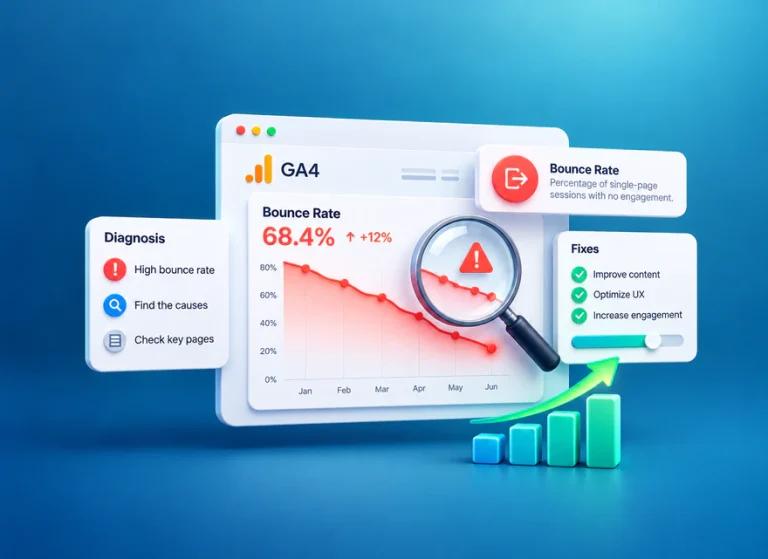
Compare like-for-like periods, audience segments, and landing pages. A source may look weak because it sends people to an unrelated page, because its traffic is invalid, or because its audience simply does not fit the offer. Diagnose these before scaling it. A low bounce rate does not prove profit, and a high bounce rate on a page that answers a question does not automatically prove poor traffic.
Make a repeatable source-value scorecard
For every source, keep the same columns: visits, share of visitors who become qualified leads, share of qualified leads who buy, revenue, margin before acquisition, campaign cost, and contribution after cost. Compare these for a consistent date window and annotate changes in audience, offer, pricing, or tracking. If source A produces $0.80 contribution per visit in the hypothetical example and B produces $0.025, the difference is worth investigating, not blindly extrapolating to a larger budget.
Set a minimum sample and review window before making a scale-or-stop decision. A small number of sales can swing ratios dramatically. Also check whether a source brings first-time buyers, repeat customers, or leads with different future value. Where lifetime value is uncertain, report the observed first-sale economics separately rather than assuming a favorable future. Use a simple status: continue testing when the economics and lead quality are credible; revise targeting or destination when relevant visits fail to progress; stop or audit when the source is unverifiable or contribution stays negative.
Referral traffic is a measurable channel, not a quality guarantee
Editorial links, partners, directories, and paid referral campaigns have different audiences and economics. Record the referring source, landing page, campaign cost, qualified actions, and sales. Compare earned referrals with any purchased campaign separately. If the source cannot be verified or the visits appear invalid, do not count volume as evidence of value.
SEOVisitor’s referral-traffic service can be evaluated as one paid acquisition source. It does not promise qualified buyers, sales, or a ranking effect; any claim of value must come from the destination page’s actual measured outcomes and costs.

Test a referral-traffic campaign on a specific landing page, then compare verified visits, qualified actions, and costs with other sources before deciding whether to continue.
When the problem is the sales funnel, investigate it separately
If two sources bring similarly qualified people but both fail at the same checkout or form step, the bottleneck may be on the site rather than in acquisition. This article stops at that diagnostic boundary. Use the guide to traffic without sales for landing-page, trust, offer, and checkout troubleshooting.
Choose the next investment using verified lead and sales value, contribution after cost, and reasonable confidence in the data. A smaller source with stronger economics may deserve more attention, but no hypothetical table predicts what a real campaign will produce.
Frequently Asked Questions
Quick answers to common questions about website traffic and sales
No. More traffic creates more opportunities, but sales depend on traffic relevance, conversion rate, offer quality, pricing, trust, usability, and the customer's intent. A smaller number of qualified visitors can outperform a much larger untargeted audience.
For each source, compare relevant visits with qualified leads, confirmed sales, revenue, fulfillment margin, and acquisition cost. Use engagement as context, not as proof of buyer quality, and investigate tracking or attribution gaps before changing budget.
Referral traffic is traffic that arrives through links from other websites or apps. In GA4, referral is a traffic-source category. Referral traffic can be either targeted or untargeted depending on the source and audience.
Referral visits do not automatically improve Google rankings. A relevant referral source can still be valuable for audience acquisition, brand awareness, leads, and potential natural links or mentions, but those benefits should not be confused with a guaranteed ranking effect.
Bounce rate can provide context, but it should not be used alone. In GA4, bounce rate is the percentage of sessions that were not engaged. Compare it with key events, engagement time, conversion performance, revenue, and the purpose of the page.
Combine GA4 source and landing-page data with verified leads or orders, acquisition costs, and margin in your CRM or sales records. Compare source-level contribution after cost, not visits alone, and note that attribution across devices or channels may be incomplete.
No. Paid traffic describes how visitors were acquired. It becomes targeted when the campaign reaches an audience that closely matches the offer or objective.


Comments
Leave a Comment