


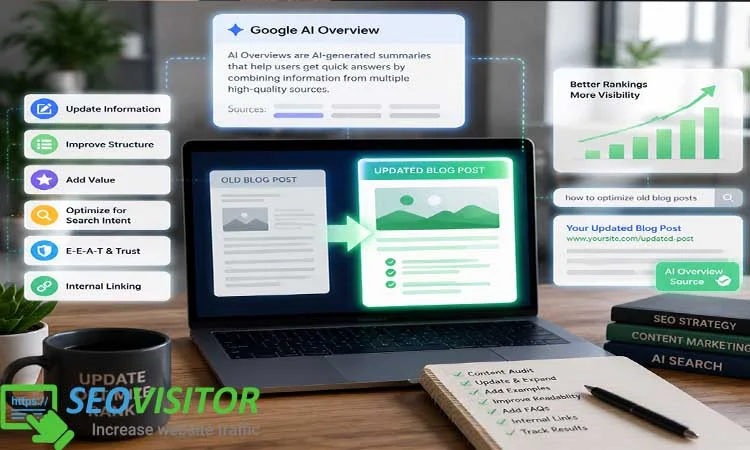
Old blog posts are not useless pages sitting in your archive. In many cases, they are valuable SEO assets that already have history, backlinks, impressions, and topical relevance. The problem is that search has changed. A blog post that performed well two or three years ago may now…
Old blog posts are not useless pages sitting in your archive. In many cases, they are valuable SEO assets that already have history, backlinks, impressions, and topical relevance. The problem is that search has changed. A blog post that performed well two or three years ago may now look outdated, incomplete, poorly structured, or less helpful compared with newer content and AI-powered search results.
That is why learning how to optimize old blog posts for AI Overviews matters. Google AI Overviews are changing the way users interact with search results. Instead of only scanning traditional search results, users may now see AI-generated summaries that answer their questions directly. This does not mean traditional SEO is dead. It means content needs to be clearer, more useful, more trustworthy, and easier for both users and search systems to understand.
The goal is not to trick Google AI Overviews. The real goal is to make your old content stronger. When you update an old blog post properly, you can improve search intent alignment, refresh outdated information, strengthen internal links, add original value, and increase the chances of better visibility in both traditional search results and AI-powered search experiences.
What Are Google AI Overviews?
Google AI Overviews are AI-generated summaries that can appear in Google Search for certain queries. They are designed to help users understand a topic faster by combining information from different sources and presenting a summarized answer.
For website owners, this creates a new challenge. Ranking on the first page is still important, but your content also needs to be source-worthy. In other words, your page should provide clear, accurate, well-structured, and helpful information that search systems can understand and users can trust.
AI Overviews usually appear for informational searches. These are queries where people want explanations, comparisons, steps, definitions, or recommendations. For example, searches like “how to increase organic traffic,” “what is AI search optimization,” or “how to update old blog posts for SEO” may fit this type of intent.
This is why old blog posts should not be ignored. If an old post already targets an informational topic, it may still have strong potential. But to compete in the age of AI search, it may need a serious content refresh.
read more:What Is Content Marketing?
Why Updating Old Blog Posts Matters for AI Overview SEO
Old content often loses performance for simple reasons. The statistics may be outdated. The screenshots may no longer match current tools. The introduction may be weak. The article may not answer newer questions users are asking. Or the structure may be too messy for readers to scan easily.
A common mistake is thinking that updating old content only means changing the publish date. That is not a real content update. If the article still contains outdated information, thin explanations, broken links, and vague headings, changing the date will not make it more useful.
A proper update should improve the actual value of the page. You should make the content more complete, more accurate, more readable, and more aligned with current search intent.
For AI Overview SEO, clarity matters a lot. A page that answers questions directly, uses clear headings, provides practical examples, and supports claims with reliable sources is stronger than a generic article filled with repeated keywords.
How to Optimize Old Blog Posts for AI Overviews
The best way to optimize old blog posts for AI Overviews is to follow a clear process. Do not start by rewriting everything randomly. Start by choosing the right pages.
Open Google Search Console and look for posts that have impressions but low clicks. These pages are often good opportunities because Google is already showing them for some queries, but users may not be clicking enough. Also look for posts that used to get traffic but have declined over time.
Good candidates for updating usually include posts that rank on page one or page two, have backlinks, target evergreen topics, or answer informational questions. If a post has no impressions, no backlinks, and no clear search demand, it may not be the best first priority.
Once you choose a post, compare it with the current top-ranking pages. Look at what competitors are doing better. Do they have clearer headings? Better examples? More recent information? Stronger FAQs? Better visuals? More practical steps?
This competitor review will show you what your old post is missing. Your goal is not to copy competitors. Your goal is to create a better version by adding more useful information, better structure, and original value.
Match the Updated Content to Current Search Intent
Search intent can change over time. A keyword that once needed a simple definition may now require a detailed guide. Before updating an old blog post, ask yourself what the searcher actually wants today.
For example, someone searching “AI Overviews SEO” probably does not only want to know what AI Overviews are. They may also want to know how AI Overviews choose sources, whether schema helps, how to update old content, how to track performance, and what mistakes to avoid.
This means your old article may need new sections. Do not only rewrite sentences. Add missing subtopics that match current user questions.
A good method is to turn user questions into headings. Instead of using vague headings like “Important Tips,” use specific headings like “How to Track AI Overview Visibility” or “How to Add Original Value to Old Blog Posts.”
Every major section should answer a real question. This makes the article easier to read and more useful for search.
Improve Content Structure for AI Search Visibility
Content structure is one of the easiest ways to improve an old blog post. Many older posts have long paragraphs, weak headings, or sections that jump from one idea to another without a clear flow.
To improve structure, use one clear main title, organized sections, short paragraphs, and helpful lists. Each heading should tell the reader exactly what the next section is about.
A strong structure helps readers scan the article quickly. It also helps search engines understand the relationship between different parts of the content.
Can Old Blog Posts Appear in Google AI Overviews?
Yes. Old blog posts can potentially appear in Google AI Overviews if they are crawlable, indexed, accurate, helpful, well-structured, and aligned with current search intent.
This kind of short answer is useful because it gives readers immediate value. Then the rest of the section can explain the answer in more detail.
You can also improve readability with tables, checklists, examples, and summary boxes. These elements make complex SEO topics easier to understand.
Add Original Value That Generic AI Content Cannot Replicate
One of the biggest problems in SEO today is generic content. Many articles say the same thing in slightly different words. This is especially common when people use AI tools without adding real expertise, examples, or editing.
If you want your old blog posts to perform better, add something unique. This could be your own experience, your own screenshots, a before-and-after example, a practical checklist, a case study, or a clear framework.
For example, if you are updating a post about website traffic, you can include a real example of how traffic changed after updating old content. If you are writing about GA4, you can show which reports to check. If you are writing about AI Overviews, you can show how you changed the article structure to better answer user intent.
Original value does not always mean original research. It can also mean better explanation, better organization, stronger examples, and practical advice that readers can actually use.
Update Facts, Dates, Screenshots, and External References
SEO and AI search change quickly. A post that was accurate last year may already need updates. Google features change, analytics platforms change, and best practices evolve.
When refreshing old blog posts, check every important detail. Replace outdated statistics, remove broken links, update old screenshots, and correct outdated terminology. If your post mentions a tool interface, make sure the instructions still match the current version of that tool.
You should also update external references. Link to reliable sources such as Google Search Central, Google Search Console Help, and official documentation when possible. These sources help support your claims and improve trust.
Do not add external links randomly. Each link should help the reader learn more or verify important information.
If the update is meaningful, you can add a visible “Last updated” date near the top of the article. This is especially useful for topics like SEO, analytics, AI search, and digital marketing, where freshness matters.
Strengthen E-E-A-T Signals
E-E-A-T stands for experience, expertise, authoritativeness, and trust. While it is not a simple ranking button, it represents the type of quality signals that matter in content evaluation.
To strengthen E-E-A-T on old blog posts, add a clear author name, a short author bio, relevant experience, reliable sources, and transparent explanations. If the topic is complex, explain how you know what you are saying.
Avoid exaggerated claims. Do not say things like “guaranteed to appear in Google AI Overviews” or “rank first overnight.” Nobody can guarantee that. Strong SEO is about improving probability, not promising impossible results.
Trustworthy content is honest. It explains what works, what may help, what is uncertain, and what should be tested.
Use Structured Data Carefully
Structured data can help search engines understand your page better. For blog posts, Article or BlogPosting schema is usually a good choice. You can also use Breadcrumb schema, Organization schema, and author-related schema where appropriate.
If your article includes visible FAQs, FAQ schema may also be useful. However, do not add fake FAQ schema or mark up content that is not visible on the page.
Schema is not a magic shortcut. It does not guarantee that your page will appear in AI Overviews. But it can support your overall SEO by making your page information clearer to search engines.
After adding structured data, validate it with tools such as Google Rich Results Test or Schema Markup Validator. Also check Google Search Console for any structured data errors.
Improve Internal Linking and Topical Authority
Internal linking is one of the most important steps when updating old content. Many old blog posts lose visibility because they become buried deep in the site. Internal links help search engines and users rediscover them.
When you update an old post, add links from newer related posts to that updated page. Also add links from the updated page to other relevant articles on your site.
Use descriptive anchor text. Instead of writing “click here,” use natural anchor text like “AI Overviews and organic traffic,” “how to analyze referral traffic in GA4,” or “safe traffic acquisition.”
For this article, good internal link opportunities may include posts about Google AI Overviews, RankBrain, Navboost, referral traffic in GA4, organic traffic growth, safe traffic acquisition, and brand search traffic.
This helps build a topic cluster. A strong topic cluster tells search engines that your website covers a subject in depth, not just with one isolated article.
Optimize Images, Videos, and Page Experience
Visual elements can make an old blog post much stronger. Screenshots, diagrams, comparison tables, short videos, and infographics help readers understand complex ideas faster.
For this article, you could add a screenshot of a Google AI Overview, a content refresh checklist, a before-and-after heading structure example, or a Google Search Console performance screenshot.
Use descriptive alt text for every image. Alt text should explain what the image shows. Do not stuff keywords into alt text unnaturally.
- Google AI Overview example for SEO search query
- Before and after blog post structure for AI Overview optimization
- Checklist to optimize old blog posts for AI Overviews
- Google Search Console report for old blog post optimization
Also make sure the page is mobile-friendly. Use short paragraphs, readable font sizes, compressed images, and clear spacing. Avoid large popups and crowded layouts that make reading difficult on mobile devices.
Republish, Request Indexing, and Monitor Performance
After updating the article, do not just publish and forget it. Submit the updated URL in Google Search Console using the URL Inspection tool. This helps Google discover the updated version faster.
Then monitor the results over the next few weeks. Track impressions, clicks, CTR, average position, new queries, long-tail keyword growth, engagement, and conversions.
Do not expect instant results. Some updates may show movement quickly, while others may take longer. SEO improvement often depends on competition, crawl frequency, content quality, and how much the update improved the page.
A simple tracking spreadsheet can help. Include the URL, update date, main keyword, old clicks, new clicks, old CTR, new CTR, internal links added, and notes. This turns content refreshing into a repeatable process.
After updating an old blog post, it is important to analyze how real users interact with the content. Traffic testing can help marketers evaluate engagement metrics, landing page performance, and user behavior before making further SEO improvements. For businesses targeting US audiences, solutions such as Buy USA Traffic can be used as part of a broader traffic analysis strategy.
Common Mistakes to Avoid
The first mistake is only changing the date. If the content is still outdated, readers will notice.
The second mistake is keyword stuffing. Repeating “AI Overviews SEO” too many times can make the article sound unnatural. Use related terms naturally, such as AI search visibility, content refresh, Google Search Console, structured data, and old blog post optimization.
The third mistake is deleting sections without checking data. Some older sections may still rank for valuable long-tail keywords. Always review Search Console before removing major parts of a post.
The fourth mistake is relying on generic AI-generated content without human editing. AI can help with outlines and drafts, but human judgment, examples, fact-checking, and experience are what make the content valuable.
The fifth mistake is ignoring internal links. A refreshed article should not stand alone. It should become part of a stronger content cluster.
Old Blog Post Optimization Checklist
- Review Google Search Console data.
- Identify declining or underperforming queries.
- Check current search intent.
- Study competing pages.
- Update outdated facts and statistics.
- Remove or replace broken links.
- Rewrite the introduction.
- Improve the heading structure.
- Add direct answer sections.
- Add original examples or insights.
- Add internal links to related posts.
- Add credible external references.
- Optimize images and alt text.
- Add Article or BlogPosting schema.
- Improve the meta title and meta description.
- Check mobile readability.
- Submit the URL in Google Search Console.
- Monitor results after publishing.
Conclusion: Turn Old Blog Posts Into AI Search Assets
Learning how to optimize old blog posts for AI Overviews is not about chasing a shortcut. It is about making your existing content more useful, accurate, structured, and trustworthy for modern search.
Start with posts that already have impressions, rankings, backlinks, or evergreen potential. Update them with fresh information, clearer headings, stronger examples, better internal links, reliable sources, optimized visuals, and structured data.
Then monitor the results in Google Search Console and repeat the process with your next high-potential article.
Your next step is simple: choose one old blog post today, audit it using the checklist above, and turn it into a stronger asset for both traditional SEO and AI-powered search visibility. If this guide helped you, share it with your team or leave a comment with the old post you plan to update first.
Frequently Asked Questions
How do I optimize old blog posts for Google AI Overviews?
To optimize old blog posts for Google AI Overviews, update outdated information, improve the structure, add direct answers, strengthen trust signals, include original examples, add internal links, use reliable sources, optimize images, and make sure the page is crawlable and indexed.
Can old blog posts appear in Google AI Overviews?
Yes. Old blog posts can potentially appear in Google AI Overviews if they are helpful, accurate, crawlable, indexed, well-structured, and aligned with current search intent. There is no guaranteed method, but strong SEO fundamentals can improve your chances.
Is AI Overview optimization different from traditional SEO?
AI Overview optimization is not completely different from traditional SEO. It builds on the same fundamentals, such as helpful content, crawlability, internal linking, authority, and relevance. However, it puts more emphasis on clarity, direct answers, topical coverage, and source quality.
Should I update the publish date on old blog posts?
You should only update the publish date after making meaningful improvements. If you only change the date without improving the article, it may reduce user trust.


Comments
Leave a Comment