


A practical guide to branded search: identify query intent, separate visibility from demand, use Search Console and GA4 correctly, and turn the evidence into useful content and reporting decisions.
Brand search traffic is traffic from people who search for your business, website, or a distinctive branded product and then visit your site. For organic SEO reporting, it means clicks from unpaid results for those branded queries, not visits from brand-keyword ads. A search for “Seovisitor reviews” is branded; “how to measure website traffic” is not.
These searches can reveal recognition, purchase research, or a need to return to an existing account. They do not automatically prove trust, new-customer demand, or a sale. The useful question is not simply whether branded clicks increased, but which searches changed, which pages received them, and what the business should do next.
This guide explains how to identify branded queries, measure them in Google Search Console, interpret website outcomes in GA4, and create a realistic plan for genuine brand demand. It focuses on branded search measurement and intent rather than another general guide to increasing traffic.
Brand Search Traffic, Brand Demand, and Direct Traffic Are Different
A branded query names a particular business or one of its recognizable products. It can contain a company name, domain, spelling variation, or a unique product name without the company name. A generic product description is not automatically branded just because you sell that product.
Brand demand is broader than the visits your site receives. Someone may search your name, read an independent review, find an answer on the results page, or choose not to click. Search Console reports your site’s search visibility and clicks, not every search involving your identity. Keep “observed branded search performance” distinct from “total market demand.”
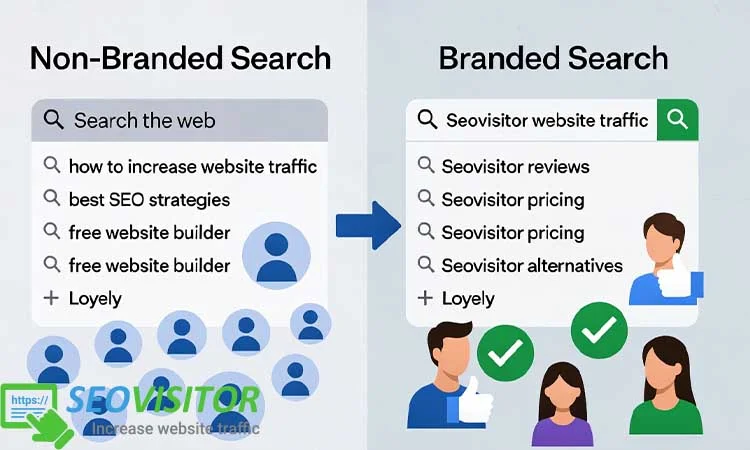
Branded versus non-branded organic search
Non-branded queries describe a problem, product category, or task without identifying your business. They help you assess discovery outside your name. Branded queries show a more specific relationship with your identity, but the searcher may be a prospective customer, an existing user, a journalist, or someone investigating a complaint.
Neither group is synonymous with new or returning visitors. An existing customer can search a generic troubleshooting question, and a first-time buyer can search a name recommended by a friend. Report query type separately from audience status instead of using one as a shortcut for the other.
Direct traffic is a website acquisition classification, not a list of people who searched your name. Likewise, an email click or a social referral can involve someone who knows your brand without becoming a branded search visit. Keep the search journey and the website acquisition channel as separate concepts.
Paid branded search versus organic branded search
An advertisement triggered by your name belongs in paid campaign reporting. An unpaid result for the same name belongs in organic search reporting. They may serve overlapping audiences, but combining them hides differences in cost, presentation, and measurement.
If you run a purchased traffic campaign, annotate its dates and affected destinations. Do not treat the additional activity as independent evidence that more people remembered your brand. A campaign can be evaluated against its own objective without claiming that it improves organic rankings or creates authentic brand demand.
Group Branded Keywords by the Searcher’s Task
Tracking only the exact brand name misses important questions. Build a small query inventory covering the name, domain, distinctive products, known variants, and useful modifiers. The examples below illustrate intent categories; they are not claims about actual SEOVisitor query volumes.
| Query group | Possible task | Suitable destination | Interpretation |
|---|---|---|---|
| Core name or domain | Find the official business | Clear homepage | Navigation or recognition, not necessarily a purchase |
| Brand + product or pricing | Evaluate a specific offer | Accurate product or service page | Commercial research; confirm suitability |
| Brand + reviews or complaints | Check experience or credibility | Verifiable information and support routes | Investigation can be positive, neutral, or negative |
| Brand + alternatives or comparison | Compare available options | Fair, current comparison where useful | Decision-making, not guaranteed preference |
| Brand + login, contact, or support | Complete an existing-user task | Account, contact, or help page | Service demand, not new-customer acquisition |
Assign each group a page and an appropriate outcome. Pricing research might lead to a qualified enquiry; a support query might lead to a resolved problem. Evaluating both groups by purchase rate would penalize useful support visits and overstate the commercial meaning of a larger branded total.
Be careful with ambiguous names. A word shared with a location, a common phrase, or another organization needs manual review. A founder’s name may refer to their separate work. Include a term because the query context identifies your business, not simply because the same letters appear in it.

Keep the inventory versioned. If a product launches, the company changes its name, or you add a spelling variation, record the change. Otherwise, an expanded filter can look like audience growth when the reporting definition is what actually changed.
How to Measure Brand Search Traffic in Search Console
Start with the property that covers the intended website. Choose a consistent search type, market, device scope, and complete date range. Then separate branded queries before investigating individual destinations. The goal is a repeatable comparison, not the largest number you can produce by changing filters.
Use the branded queries filter when available
In the Performance report, open the query filter and choose Branded queries where available. Google’s classification considers the brand name, variations, and associated products rather than relying only on an exact text match. Review the resulting queries for ambiguous or unexpected classifications.
Google limits this feature to eligible top-level properties with enough query and impression data. The classification can make mistakes and does not affect rankings. If the filter is missing, use manual filters instead; absence of the feature is not evidence that your website has no branded searches. See Google’s branded queries filter documentation.
Build a manual filter without confusing matches with intent
A query filter containing your brand name provides a straightforward starting point. For multiple variants, use a custom regular expression. An illustrative pattern for SEOVisitor is seovisitor|seo[ -]?visitor, which covers the joined name and versions with an optional space or hyphen. It is a starting pattern, not a complete or verified inventory of this site’s searches.
Review matching queries before adopting the pattern. Add genuine variants or distinctive products when relevant, and document exclusions for unrelated meanings. Do not add every generic service keyword to the branded group. Google’s query filtering guidance explains the regular-expression option.
Choose either the automatic classification or a documented manual definition for a recurring report. If you compare the two, label them separately. Switching definitions between periods can change branded totals even when underlying search behavior is unchanged.
Read clicks, impressions, CTR, and position together
Clicks record clicks to your site from Google results. Impressions record appearances according to Google’s reporting rules; they are not unique people or the full number of searches for your name. CTR is clicks divided by impressions, multiplied by 100. Average position summarizes your relevant search positions rather than a fixed rank for every searcher. Google’s Performance report guide defines these metrics.
Compare complete periods of equal length, with similar weekday coverage. For seasonal businesses, examine a comparable period a year earlier as well. Keep search type, country, device, and query definition consistent, and exclude incomplete recent days from a final comparison.
A higher CTR can accompany fewer impressions if only the strongest navigational queries remain. A lower CTR can accompany more clicks if a broader set of queries appears. Interpret the combination and query mix before deciding that the title, brand awareness, or page quality improved or deteriorated.
Move from the query to its destination
Select an important branded query or group, then open Pages to see the destinations receiving visibility and clicks. Check whether a login search reaches the account page, a pricing search reaches current offer information, and a product query reaches the product rather than an unrelated article.
Next, compare devices and countries. A site-wide result can hide a mobile problem or a market where your name means something else. Give priority to mismatches affecting a relevant audience and an important task, not merely the query with the most impressions.
Keep reporting limitations visible. Some queries are anonymized, and tables can omit rows; query filters can therefore change totals. Property-level and page-level aggregation can also differ, and much performance data is assigned to canonical URLs. Do not force exported rows to reproduce every chart total. Consult Google’s performance data limitations when reconciling a report.
A practical report should state its coverage, filter definition, dates, and exclusions. This makes a modest but consistent branded trend more useful than an apparently precise total with an undocumented scope.
Use that broader workflow for page-improvement opportunities. For branded search, retain the extra intent categories and name-definition checks, because a support visit and a purchase enquiry answer different business questions.
Use GA4 for Website Outcomes, Not a Query-Level Conversion Shortcut
Search Console describes search activity; GA4 describes measured activity after arrival. In GA4, review the relevant landing pages with session-scoped source and medium, such as google / organic. Use Traffic acquisition for session acquisition, and distinguish it from the first-user perspective in User acquisition. Google’s acquisition report comparison explains the scopes.
The source and medium do not tell you whether an organic query contained your brand. A homepage can receive branded and non-branded searches, so its entire organic conversion count cannot be labeled “branded conversions.” Treat landing-page outcomes as supporting evidence, with the audience ambiguity stated clearly.
Understand what the Search Console connection provides
The GA4 Search Console connection provides an organic query report with Search Console metrics and a landing-page report combining compatible search and analytics metrics. It does not provide a standard join from each organic search query to an individual purchase. Google lists landing page, device, and country as compatible Analytics dimensions for these reports. See the official integration documentation.
Report observed brand-query clicks alongside the organic outcomes for relevant destinations, without claiming that the two datasets identify the same individual people. For sales, verify completed transactions; for lead generation, distinguish a submitted form from a qualified enquiry. A product view or button click can help diagnose a journey, but it is not the final business result.
Campaign tags help identify clicks from your own newsletters, partnerships, or ads when implemented correctly. They do not reveal a later organic query used by the same person. Do not add tracking parameters to ordinary internal navigation just to manufacture a branded acquisition segment.
Keep a measurement log for consent, event definitions, tracking outages, and other changes that can affect comparisons. If measured outcomes fall while GSC clicks stay stable, check measurement and the destination before deciding that search demand weakened.
Use that guide for channel and behavior comparisons. In the branded report, label website outcomes by their actual landing-page and acquisition scope rather than claiming more query-level precision than the tools provide.
A Hypothetical Example: More Brand Clicks, Less Commercial Growth
Imagine Northstar Packs, a fictional bag retailer. The following figures are entirely hypothetical, not SEOVisitor results or a forecast. The team compares two complete 28-day periods using the same Web search, country, device scope, and manual branded-query definition.
At first glance, brand clicks rose from 800 to 850 while impressions increased from 2,000 to 2,500. Overall CTR fell from 40% to 34%. That combination does not establish that brand awareness improved or the search presentation became worse. The team separates the query groups before choosing an action.
| Query group | Period A: impressions / clicks | Period B: impressions / clicks | Next check |
|---|---|---|---|
| Core brand | 1,000 / 500 | 1,000 / 500 | Stable recognition-related visibility |
| Product and pricing | 500 / 200 | 500 / 200 | No observed commercial-query growth |
| Login and support | 500 / 100 | 1,000 / 150 | Investigate returning-user tasks |
| Total | 2,000 / 800 | 2,500 / 850 | Growth came from support-related queries |
The core group retains a 50% CTR and the product group a 40% CTR. Support impressions doubled, but clicks increased less proportionally. The lower aggregate CTR partly reflects more exposure to a lower-CTR group; it is not evidence that every brand query performed worse.
Turn the pattern into a testable decision
The team checks support queries and destination pages, then discovers that an old article appears for account-access questions. Its hypothesis is a navigation mismatch, not weak purchase intent. It improves the help article, adds a clear route to the existing account page, and checks that the page explains the current sign-in process.
The review criteria are support-query clicks to the appropriate destination, successful account access where measurable, and related customer enquiries. Product-page organic sales are reported separately in GA4; the team does not attribute them to a particular branded query. No numerical improvement after the edit is assumed.
The same method applies to a different pattern. If product-query clicks decline within a stable market and device segment, inspect the offer page and actual search presentation. If impressions fall across groups, investigate visibility, naming changes, seasonality, and campaign context before assuming an awareness problem.
Diagnose Low or Falling Brand Search Traffic Before Adding Content
Low branded traffic can reflect a small audience, an ambiguous name, limited site visibility, or a reporting definition that misses relevant searches. It is not automatically evidence of poor SEO or weak trust. Start by determining whether the issue concerns measurement, search visibility, or genuine audience recognition.
Check measurement and visibility first
Confirm that the property covers the live website and that the brand filter still matches the intended names. Review recent rebranding, product naming, site moves, and changed destinations. For a page that unexpectedly loses appearances, inspect its current availability and indexing information before rewriting it.
Compare like-for-like groups instead of relying on a site average. When clicks fall but impressions remain similar, examine CTR, position, query composition, and the current results. When both fall, a demand change is one possible explanation, but reduced visibility or missing query coverage must also be considered.
Use external context cautiously
A launch, promotion, news story, or support incident can change branded searches for very different reasons. Maintain annotations and ask customer-facing teams what changed. An increase in complaint searches deserves investigation rather than celebration as a marketing win.
Google Trends can add context for a recognizable name when enough data exists. Keep the country, date range, and term or topic selection consistent. Trends uses sampled, normalized interest on a 0–100 scale, not exact search volume; a low-volume brand may provide insufficient data. See Google’s Trends data explanation.
Increased searches after a campaign are a correlation, not proof that the campaign caused them. Compare relevant categories and comparable markets where practical, record other changes, and describe uncertainty. Do not divide campaign spending by an assumed number of “new branded customers” that neither dataset actually identifies.
How to Build Genuine Brand Demand and Serve It Well
The practical strategy is to give the right audience a reason to remember you and a useful destination when they return. More repeated mentions of your name are not a substitute for a distinctive offering, helpful content, or a reliable experience.
Create something readers can recognize and return to
Develop useful assets associated with your real expertise: an original worksheet, a documented method, a practical tutorial, or a transparent product explanation. Explain the limits and show how the asset helps with a specific task. Brand identity should make the source recognizable without interrupting the answer with repeated sales language.
For SEOVisitor, a clear measurement example can be more memorable than another generic list of traffic tips. The aim is to connect a useful idea with the business honestly, not to imply that buying visits improves organic authority. Link to the next relevant explanation after solving the immediate question.
A focused content marketing strategy can organize that work around recurring audience needs. Keep this article’s branded-search measurement distinct from the broader content plan, and use relevant pages rather than publishing near-identical articles for every name variation.
Earn relevant exposure without manufacturing searches
Share useful work through suitable communities, professional partnerships, newsletters, and social channels. Use consistent names and accurate descriptions, respect each channel’s rules, and provide value before asking people to visit. A relevant mention can introduce your business, but it does not guarantee a later brand search.
Do not instruct staff, bots, or purchased audiences to search and click simply to inflate a demand report. Such activity makes the report less representative of genuine audience interest. Evaluate paid distribution through its own costs and meaningful actions, and keep it separate from organic brand-demand analysis.
Answer reputation and comparison questions honestly
Publish accurate company information, reachable contact details, current conditions, and verifiable customer feedback. If a comparison is useful, explain its criteria and limitations rather than inventing a favorable competitor story. Reviews and complaints are questions to address, not keywords to fill with fabricated endorsements.
When a concern is legitimate, improve the underlying experience and the explanation together. A new reassurance page cannot repair unclear refund conditions or an unanswered support request. Track whether people can complete the intended task, not only whether reputation-related searches produce more visits.
Review Your Branded Search Results Without Assuming You Control Them
Periodically inspect important name, product, pricing, and reputation queries in the markets you serve. Record the query, date, location, device, and visible destination. One manual search is a snapshot, so use it to investigate presentation rather than override a broader performance report.
Check whether official pages describe their purpose clearly, existing navigation helps users reach account and support routes, and offer information remains current. Keep brand naming consistent across your homepage and legitimate profiles. You can improve your own information, but cannot guarantee the ordering of results, removal of criticism, or the appearance of particular profiles.
Google treats a site’s displayed name separately from individual page titles. Its site-name guidance recommends a recognizable, consistent identity; supported homepage markup expresses a preference rather than guaranteeing display. Adding the brand name repeatedly to every heading is not a substitute for that clarity.
A keyword tracker can provide an additional record of selected positions under defined location and device settings. That is different from Search Console’s observed average position and from measuring total demand. Use the tools for their respective questions instead of expecting identical readings.

Follow selected branded keyword positions by location and device with Seovisitor’s Keyword Rank Tracker. Use the records alongside Search Console; tracking measures visibility, not total demand, and does not improve rankings by itself.
Search presentation may also include ads, AI answers, or third-party references. A mention does not necessarily produce a visit, and a later branded query does not reveal which earlier exposure created it. Investigate those experiences separately rather than claiming that brand search is immune to changes in search results.
Build a Monthly Report That Leads to a Decision
Keep the report small enough to use. Include the branded definition, comparison periods, query-group performance, important destination pages, website outcomes with their actual scope, and a short change log. Show non-branded organic performance alongside it so one type of growth does not hide a decline in the other.
If you calculate branded click share, state the denominator. A transparent calculation is branded clicks divided by branded plus non-branded clicks under the chosen reporting method. It describes the classified search clicks you measured, not market share or all searches for your name. Google also describes manual brand-share estimation and its limitations.
For each material change, record the affected query group, observed pattern, plausible explanation, next action, responsible person, and review criterion. The action might be repairing a navigation mismatch, clarifying an offer, investigating support demand, or improving a useful brand-led asset. Do not rewrite every page because one blended CTR moved.
For a small brand, accumulate enough observations to identify a meaningful pattern instead of imposing a universal target percentage or deadline. Keep a consistent baseline and explain when the sample cannot support a conclusion. More months of a poorly defined metric do not make it a better metric.
Start with one branded query group and one decision. Confirm what searchers need, check the destination, compare equivalent periods, and improve the confirmed gap. Brand search becomes useful when it helps you serve real audience demand—not when it is treated as a guaranteed ranking signal or a flattering traffic total.
Frequently Asked Questions
Quick answers to common questions about brand search traffic
Brand search traffic consists of visits following searches for your business, website, or distinctive branded products. In an organic SEO report, measure clicks from unpaid branded search results separately from paid search activity.
It helps separate searches involving your identity from non-branded discovery and reveals the pages people need. It is not proof of trust, new-customer demand, or a guaranteed improvement in generic keyword rankings.
Branded search queries identify a particular brand, such as Seovisitor reviews. Non-branded queries describe a broader need, such as how to measure website traffic. Either group can include new or returning visitors.
In the Performance report, use the Branded queries filter if available, or a query filter containing your name and relevant variants. Review matching queries, then compare clicks, impressions, CTR, and destination pages across equivalent periods.
The filter is limited to eligible top-level properties with enough query and impression data. If it is unavailable, use manual query filters and review ambiguous names, spelling variants, and product terms rather than assuming every match belongs to your brand.
No. Search Console impressions describe your site's appearances in Google results, not every search for the brand or a count of unique people. Visibility, query mix, and reporting limitations affect the figures.
Not directly through its standard organic acquisition reports or the Search Console link. Use query-level evidence in Search Console and landing-page outcomes in GA4, but do not label every conversion on a mixed-intent landing page as branded.
A purchased campaign is a separate acquisition activity. Recorded visits do not establish that independent customers wanted to search for your brand, and they do not guarantee rankings, indexing, or sales. Keep campaign activity separate from brand-demand reporting.




Comments
Leave a Comment