



Plan and evaluate A/B tests for traffic campaigns using qualified outcomes, comparable audiences, GA4 and variant tracking, realistic sample requirements, and a hypothetical results example.
To A/B test a traffic campaign, define a useful business outcome, randomly divide a comparable audience between a control and a variation, and measure both groups with the same tracking rules. Judge the result by qualified actions and costs, not by whichever version produces more visits, longer sessions, or a more attractive dashboard.
A good experiment answers a narrow decision: should this audience receive a different message, landing page, offer presentation, or next step? It does not certify every visitor as a potential customer, guarantee conversions, or turn paid visits into organic search growth. This guide explains how to plan, instrument, evaluate, and act on a test without confusing traffic volume with traffic quality.
What Are You Actually A/B Testing?
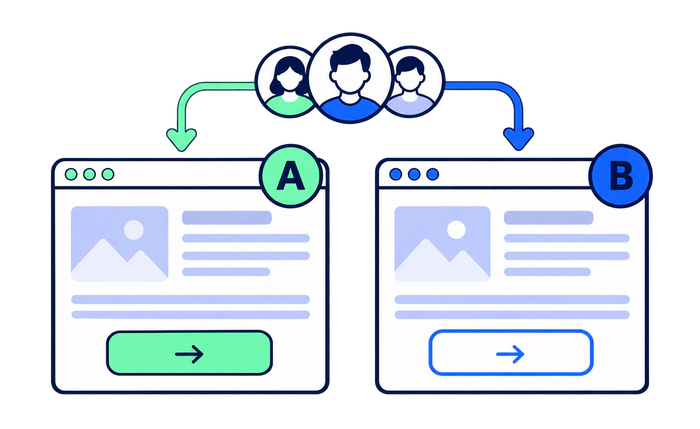
A/B testing compares a control, usually the current experience, with a variation under a planned allocation of eligible participants. Random assignment helps make the groups comparable. The experiment then measures whether the changed experience affects a predefined outcome. Google’s A/B testing guidance for GA4 distinguishes the experiment from the analytics used to measure it.
Landing-page tests versus campaign tests
In a landing-page test, visitors from the same eligible campaign are assigned to page A or page B. Keep the acquisition conditions stable so that a different audience does not explain the result. For example, test a clearer delivery explanation while keeping the advertisement, destination intent, price, and targeting unchanged.
In a campaign-message test, you compare creatives or offers before the visit. The message can change who clicks as well as what they expect. Track delivery, spend, qualified actions, and downstream value; the website conversion rate alone cannot describe the whole campaign’s performance. Use a platform’s documented experiment method where available rather than assuming that two independently optimized campaigns are randomized.
A channel comparison is not automatically an experiment
Comparing last month’s search visitors with this month’s social visitors can help allocate resources, but the audiences, timing, intent, and prices differ. It does not isolate the causal effect of the channel. If controlled assignment is unavailable, call the exercise a comparison and document the factors you could not hold constant.
A/B tests may compare a complete page redesign, not just one button. That estimates the effect of the package of changes; it does not reveal which individual change caused it. A focused change is often easier to interpret. Multivariate testing investigates combinations of changes and requires a design and traffic level suited to the larger number of combinations.
Define Traffic Quality Before Choosing a Metric
Traffic quality is the fit between the audience, the promise that brought them to the page, and the valuable action the business can serve. Define that action before running the test. A visitor who finds an answer and leaves may have succeeded; a visitor who spends several minutes struggling with a broken form may not have.
Choose one primary outcome and a clear denominator
For a lead-generation campaign, a useful primary outcome might be the proportion of assigned eligible users who become qualified leads within the agreed follow-up window. For a store, it might be contribution margin per assigned user, with cancellations and refunds considered. For an educational campaign, a genuinely useful completion can be appropriate if its connection to the campaign goal is explicit.
Write the numerator and denominator together. “Conversion rate” can mean users with a conversion divided by eligible users, or sessions with a key event divided by sessions. Repeated event counts are different again. Pick the unit that matches your assignment and analysis, deduplicate where needed, and use it consistently in both groups.
| Metric | Useful question | Interpretation limit |
|---|---|---|
| Qualified-action rate | Does the experience produce useful actions per eligible participant? | Requires consistent qualification and a defined follow-up window. |
| Cost per qualified action | Is the acquisition cost acceptable for the resulting opportunity? | Include relevant spend; do not substitute raw form submissions. |
| Value per assigned user | Does the variant create economically useful value? | Account for refunds, costs, and delayed outcomes where relevant. |
| Engagement and bounce rate | Does observed on-site interaction change? | These depend on tracking definitions and are not proof of buyer intent. |
| Errors and harmful outcomes | Does the change create technical or customer harm? | A positive primary metric does not excuse a failed guardrail. |
Separate a primary decision metric from diagnostic metrics and guardrails. Diagnostic metrics help explain the journey; guardrails protect outcomes such as form reliability, refund rates, or lead suitability. This prevents a team from selecting whichever metric happens to look positive after the test.
Use GA4 engagement as context, not a quality certificate
In GA4, bounce rate is the percentage of sessions that are not engaged, not simply the percentage of single-page visits. By default, an engaged session lasts longer than 10 seconds, includes a key event, or has at least two page or screen views; the engagement timer can be configured. Google’s engagement and bounce-rate documentation explains the definitions.
Changing a key-event setting or accidentally sending duplicate pageviews can change these metrics without improving the experience. A lower bounce rate is worth investigating, but qualified outcomes and valid measurement determine whether the campaign became more useful. Do not present GA4 bounce rate or purchased engagement as a proven direct ranking lever.
For the broader economics of visitor relevance, our guide to traffic quality and sales explains how useful actions and acquisition costs differ from visit totals. This article focuses on testing a specific change, not on replacing that wider assessment.
Turn a Real Problem into a Testable Hypothesis
Start with evidence of a mismatch or obstacle, then propose a change that addresses it. A hypothesis should identify the audience, the problem, the intervention, the expected outcome, and the reason. “Make the page more engaging” is too vague to design or evaluate.
Prioritize message match, information, and friction
A hypothetical hypothesis could read: “For visitors responding to our small-business demo campaign, placing the eligibility requirements beside the request button will increase qualified requests because unsuitable visitors can self-select before submitting.” This makes lead suitability part of the decision rather than treating every form submission as a success.
Other useful tests include a headline that accurately reflects the advertisement, a product image that demonstrates the intended use, shipping information near the purchase decision, or simpler form instructions. Preserve the meaning of the offer. Do not test a promise the business cannot deliver or remove information people need to make an informed choice.
Content length, CTA wording, layout, and visuals remain valid test candidates, but no format is universally best. A shorter page may reduce distraction or remove necessary reassurance. A longer page may answer objections or hide the next step. Explain which obstacle the change addresses rather than testing length for its own sake.
Distinguish a hypothesis from a confirmed cause
Funnel drop-offs, support questions, recordings, and surveys can reveal where people struggle. They do not by themselves prove that a proposed redesign will help. Check consent and privacy controls for qualitative tools, and avoid interpreting a few memorable recordings as representative of the entire audience.

Prioritize a problem by how many eligible visitors encounter it, its likely business impact, the evidence supporting it, and the effort needed to test safely. Fix a confirmed broken button or inaccessible form directly; there is no need to expose half the audience to an avoidable defect merely to create an experiment.
Write a Test Brief and Keep the Audience Comparable
A short brief prevents the test from becoming a moving target. Record the decision owner, hypothesis, eligibility rules, control, variation, allocation, primary metric, guardrails, required sample, planned duration, outcome window, and stop conditions. Specify who will check implementation and who will judge lead or sales quality.
Assign participants consistently
Choose a randomization unit appropriate to the experience, such as a user or account. For a continuing landing-page journey, keep that participant in the same version where the technology permits. Reassigning a returning visitor on every pageview can mix exposures and undermine a user-level comparison.
Browser-based identifiers have limitations: cookie deletion, different devices, consent choices, and shared browsers can affect identity. Record those limitations instead of claiming perfect user recognition. For account-level journeys, assess whether an account-based experiment is appropriate and technically supported.
Hold acquisition conditions stable
For a page test, use the same eligible source, geography, device criteria, campaign message, schedule, and offer for both variants. A 50/50 allocation is a common starting choice, not a universal requirement. Whatever allocation you choose, record it and verify observed assignment against it.
Do not put all mobile users in A and all desktop users in B, or send one version paid visitors and the other organic visitors. Those designs confound the version with the audience. Similarly, one week on A followed by another week on B is exposed to timing effects and should not be described as a clean concurrent A/B test.
List planned segments, such as device or new versus returning participants, before analysis. Avoid defining the main audience after exposure by whether users clicked the changed button: the treatment can affect that selection. When several experiments overlap on the same journey, document the overlap and coordinate their allocation or isolate the tests if necessary.
Set Up GA4, Campaign Tags, and Variant Measurement
Use the experiment platform to assign experiences and evaluate its statistical design, GA4 to understand acquisition and on-site events, and the business system to validate lead or order quality. They perform different jobs. GA4 does not automatically randomize a campaign or declare an experiment winner; Google documents integration with a third-party testing tool for A/B testing.
Keep campaign identity separate from page-variant identity
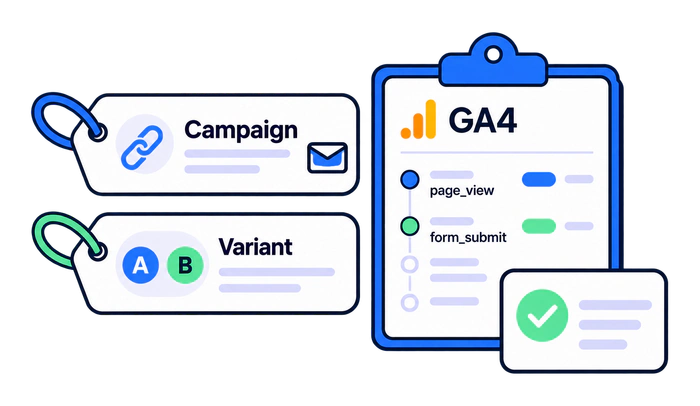
Use consistent external campaign tags such as utm_source, utm_medium, and utm_campaign. Use utm_content to distinguish creatives when that is what you are testing. Google’s campaign URL guidance explains these fields and their reporting.
For example, a hypothetical newsletter link might use utm_source=newsletter, utm_medium=email, utm_campaign=demo_october, and utm_content=eligibility_message. Use these values to identify the acquisition context; record page assignment separately. UTM parameters label visits but do not randomly allocate participants.
For a landing-page experiment after the click, plan identifiers such as experiment_id=demo_message_01 and variant_id=a or b. These are example custom names, not built-in GA4 events. Have your implementation send the identifiers with the exposure and relevant outcome events, and register appropriate custom dimensions when needed for reporting.
Google’s event-scoped custom-dimension instructions describe how parameters become reportable. Registration does not repair previously missing variant data. Keep parameter values low-cardinality, and never send email addresses, names, or other personal information as analytics identifiers.
Validate the action, not just the button click
A request-button click, form start, successful submission, accepted lead, and completed sale are distinct events. Fire the submission event after confirmed success, not merely when the visitor presses Submit. For purchases, use consistent transaction identifiers and reconcile duplicates, refunds, and test orders through the appropriate business records.
Mark genuinely important actions as key events where appropriate. Do not mark routine pageviews as business success simply to improve the displayed engagement rate. For lead qualification, maintain the same definition and review process across variants. If outcome data arrives later, apply the same maturation window before comparing groups.
Run measurement checks before interpreting results
Check both experiences on the devices they serve. Confirm that assignment is stable, exposure is logged at the intended point, the correct variant reaches the outcome event, and the journey preserves campaign attribution across redirects and domain transitions. Verify that tracking does not duplicate or disappear in one variant.
Exclude internal and test activity according to a documented policy, and examine suspicious traffic using consistent rules. Do not silently remove only one version’s inconvenient observations. An A/A check, where equivalent experiences are measured under separate assignments, can help reveal implementation problems before testing a business change.
For acquisition context, distinguish session-scoped source and campaign dimensions from first-user acquisition and event-level attribution. They answer different questions, as explained in Google’s traffic-source scope documentation. A visitor may click a campaign, return later through another route, and then convert; campaign attribution and experimental assignment are not interchangeable.
Plan Sample Size and Stopping Rules Before Launch
A test needs enough eligible participants and completed outcomes to support its intended decision. There is no universal “1,000 visits,” two-week duration, or 95% badge that makes every experiment reliable. Plan the sample and analysis method in advance rather than buying or waiting for an arbitrary visit total.
Define the smallest effect worth acting on
Use a relevant baseline conversion rate and a minimum detectable effect that matters economically. Statistical power describes the chance of detecting the specified effect under the design assumptions; the significance threshold controls a different error risk. An experiment tool or qualified analyst should calculate requirements for the actual metric and allocation. NIST’s sample-size guidance illustrates why baseline proportions, detectable differences, and error probabilities matter.
Make the calendar window long enough to represent the recurring conditions relevant to your campaign, and allow delayed outcomes to mature. A weekday-only launch, a temporary promotion, or a holiday audience may answer a narrower question than ordinary operations. Record that scope rather than assuming the result generalizes indefinitely.
Monitor safety without chasing a winner
During a fixed-horizon test, check for harmful errors and data failures, but do not repeatedly stop at the first attractive significance result. Repeated unplanned checks can alter the false-positive risk. If using a sequential design, follow the tool’s documented stopping method; do not combine its rules with a different calculator midway through the test.
Set a maximum duration or budget as well as safety stops. If the planned sample cannot be reached within those limits, report the outcome as inconclusive and redesign the next test. Extending the campaign indefinitely, changing the primary metric, or discarding unfavorable days is not a substitute for a valid plan.

A Hypothetical Campaign Test: More Leads, but Lower Quality
The following scenario and every number in it are hypothetical teaching examples, not SEOVisitor results or a claim about expected performance. Imagine a B2B software company testing whether clearer audience eligibility near a demo request improves qualified demand. The offer, source, targeting, and price presentation stay unchanged.
The brief defines a qualified lead as an eligible business contact accepted under a written review checklist. The primary outcome is qualified leads per assigned eligible user, with form errors as a guardrail. The team tracks campaign acquisition in GA4 and assignment in the experiment system, then evaluates leads after the same follow-up period.
| Measure | Control A | Variation B |
|---|---|---|
| Assigned eligible users | 5,000 | 5,000 |
| Raw demo requests | 100 | 125 |
| Raw request rate | 2.0% | 2.5% |
| Accepted qualified leads | 70 | 50 |
| Qualified-lead rate | 1.4% | 1.0% |
| Illustrative allocated acquisition cost | $1,000 | $1,000 |
| Cost per qualified lead | $14.29 | $20.00 |
Raw request rate rises by 0.5 percentage points, from 2.0% to 2.5%. That is a 25% relative increase, not a 25-percentage-point increase. Yet the qualified-lead rate is lower, and the cost per accepted lead is higher in this illustration. More form submissions would therefore be the wrong standalone success criterion.
The table is not a statistical analysis. A real decision must check the allocation, uncertainty, outcome timing, qualification consistency, and relevant guardrails. Equal counts alone do not establish valid randomization. If the experiment’s evidence supports a commercially meaningful deterioration, retain A or investigate the mechanism; if the evidence is too uncertain, record an inconclusive result.
The next hypothesis should follow the evidence. Perhaps the new wording attracted curiosity rather than suitable businesses, or reviewers applied different criteria. Confirm the measurement and review process before testing a clearer qualification message. Do not assume the acquisition channel became worse merely because one landing-page version underperformed.

Interpret Results Without Confusing Association with Causation
Read the experiment in a deliberate order: data validity, primary outcome, uncertainty, business value, then supporting diagnostics. A compelling conversion chart cannot compensate for broken tracking or an audience imbalance. The aim is a defensible action, not a positive-looking story.
Check sample ratio mismatch first
Sample ratio mismatch means that observed participant allocation differs statistically from the planned ratio. Missing events, assignment errors, redirects, filtering, or analysis conditions can create it. A visual near-50/50 split is not an adequate check because the sample size matters. Microsoft’s experimentation research explains how to detect and diagnose the problem. Investigate a flagged mismatch before trusting outcome differences.
Read uncertainty and practical value together
Report the absolute difference, relative difference, and the uncertainty measure appropriate to the statistical method. For a conventional confidence interval, explain whether the range includes no effect and whether the plausible improvement would matter commercially. A p-value is not the probability that the variation is better, and a statistically detectable change can still be too small to justify implementation.
Conversely, a nonsignificant result does not establish that A and B are identical. The test may be underpowered or its interval may allow meaningful benefits and harms. Avoid claiming equivalence unless the design actually tests equivalence or a relevant noninferiority question.

Use segments carefully
A combined result can hide differences by device or acquisition context, so review the segments planned in the brief. But searching dozens of small subgroups for a positive result creates additional opportunities for chance findings. Treat unexpected subgroup patterns as hypotheses for a follow-up test unless the analysis accounts for the extra comparisons.
Do not evaluate only the users who completed the action or remained after a long session. That selects participants based on behavior the change may itself influence. Keep the agreed eligible population and outcome window visible in the report, and investigate missing observations rather than quietly changing the denominator.
What to Do When Traffic Is Low or Unrepresentative
For low-volume pages, reduce the number of variants and focus on a substantial, well-supported hypothesis. Check whether a frequent intermediate action is a credible proxy for the business goal, while preserving downstream quality as a guardrail. If it is not, accept that a conversion experiment may be impractical at the current volume.
Usability sessions, customer interviews, support analysis, and straightforward defect fixes can still improve the journey. They answer different questions and should not be presented as statistically proven conversion lifts. Running a smaller experiment for longer only helps when the additional audience remains relevant and the conditions do not materially change.
Adding a separate paid source changes the population if it differs from normal prospective customers. More observations cannot correct that mismatch. Do not pool purchased visits with organic users to claim that an organic landing page improved, and do not interpret delivered visit totals as independent qualified buyers.
If a traffic service configures duration, page depth, or similar behavior, those settings cannot independently demonstrate natural engagement or customer intent. Decide whether the campaign is appropriate for the research question before using its data. Keep delivery checks separate from tests that require representative customer decisions and genuine business outcomes.

Explore a separate traffic campaign for a selected landing page. Keep its visits identifiable and assess their suitability for your measurement goal; delivery does not establish buyer intent or guarantee conversions.
Choose Tools by Their Role, and Protect the Page
Choose an experimentation tool for assignment, exposure logging, allocation checks, and a documented statistical method. Choose analytics for acquisition and event reporting, qualitative research for hypothesis generation, and business records for validating outcomes. No single dashboard makes these functions interchangeable.
Before selecting a tool, confirm that it can implement the intended randomization unit, preserve variants across the journey, export the needed identifiers, and support your consent requirements. Check the effect on load performance and rendering. A visual editor is convenient, but a change that breaks a mobile form or creates visible flicker can become an unintended part of the treatment.
Client-side and server-side implementations have different engineering trade-offs. Neither is automatically valid or automatically cloaking. Validate what eligible users actually see, when the exposure is recorded, and whether outcomes can be linked correctly. Use a staged safety check before giving a new experience its full planned allocation.

For publicly crawlable page experiments, follow Google Search Central’s testing guidance: do not serve a special deceptive version to Googlebot; use canonical links for alternate test URLs as appropriate; use temporary 302 rather than permanent 301 redirects for temporary test routing; and remove test artifacts when the experiment ends. These are implementation safeguards, not promises of faster indexing or better rankings.
A landing-page test measures the visitor experience. Search snippets and organic visibility involve a different measurement problem: Search Console’s aggregate query and page data does not supply individual A/B assignments. Assess search visibility separately rather than claiming that a GA4 engagement change proves an SEO effect.
Launch, Report, and Roll Out the Decision
A useful result includes the conditions under which it was obtained and what the team will do next. Preserve the control, the brief, and a change record so that a disappointing rollout can be investigated or reversed. Do not make an experiment outcome look permanent by omitting its audience or timing limits.
Run a final launch checklist
- Eligibility, assignment unit, allocation, and variant persistence match the brief.
- The primary metric, denominator, outcome window, and qualification rules are written down.
- Exposure and outcome events are checked in both versions without duplicate logging.
- Campaign identity and variant identity can be analyzed separately.
- Forms, links, mobile layouts, consent behavior, and failure states work.
- Sample requirements, analysis method, maximum duration, and safety stops are agreed.
- The owner knows how to monitor data validity and restore the control if necessary.
Keep the checklist tied to the real journey. Test the confirmation step as well as the first click, and make sure the business team can review the resulting records. A technically correct page test with inconsistent lead handling cannot answer a lead-quality question reliably.
Write a decision-focused result report
Record the hypothesis, date range, audience, allocation, variant descriptions, participant counts, primary outcome, uncertainty, guardrails, and data-quality checks. Include spend and validated downstream value when the campaign decision requires them. Explain exclusions and attribution limitations, and link the implementation record rather than relying on screenshots of a favorable chart.
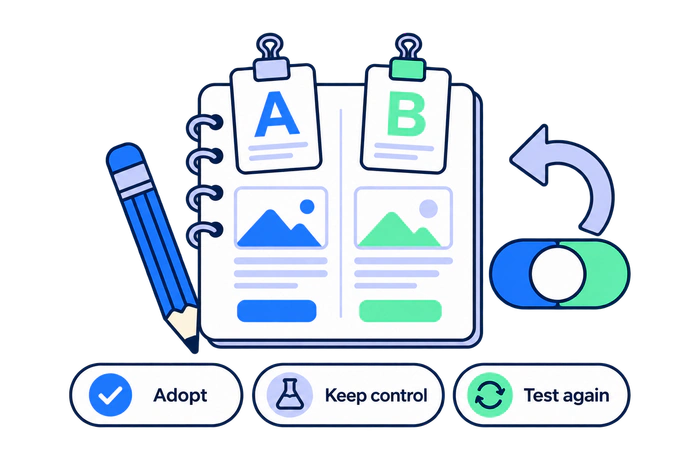
Choose one action: adopt the variation, retain the control, run a better-defined follow-up, or stop because the experiment was invalid or inconclusive. “No clear result” is useful information when it prevents an unsupported rollout. Document the next question rather than retroactively rewriting the original goal.
Roll out a supported variation with monitoring proportionate to risk. Check that the effect remains commercially useful under the operating audience and that forms, fulfillment, and tracking remain stable. A post-launch before-and-after trend is a monitoring signal, not a new randomized estimate; seasonality, budget, and channel mix can change it.
Better Campaign Decisions Start with Better Evidence
The most useful A/B test does not simply produce more clicks. It helps you decide whether a specific experience serves a defined audience more effectively, at an acceptable cost, without hiding harmful trade-offs. Clear qualification rules, comparable groups, valid tracking, and an honest treatment of uncertainty make that decision possible.
Start with one meaningful obstacle, make the measurement trustworthy, and choose the next action from the evidence. Keep paid delivery, organic visibility, on-site engagement, and economic value separate. A test can improve your understanding even when it does not produce a winner; it cannot guarantee demand, sales, or search rankings.
Frequently Asked Questions
Quick answers to common questions about A/B testing traffic campaigns
A/B testing compares randomly assigned groups receiving a control and a variation. A planned outcome, comparable conditions, and valid measurement help determine whether the changed experience supports a better decision.
It can identify whether a message or landing-page change produces more qualified actions from a defined audience. It does not certify visitor intent, guarantee an improvement, or turn paid visits into organic growth.
Choose one primary business outcome with a clear denominator, such as qualified leads per eligible user. Add cost and value measures where relevant, diagnostic engagement metrics, and guardrails for errors, lead suitability, or refunds.
Plan duration from the required sample, baseline rate, worthwhile effect, campaign cycles, and outcome delay. Follow the chosen statistical method and stopping rules; no fixed number of days or visits makes every test reliable.
A page test can improve the visitor experience, but its engagement or conversion result does not prove a ranking effect. Follow Google's website-testing safeguards and measure organic visibility separately in Search Console.
Choose a tool that supports your assignment unit, stable variants, exposure logging, allocation checks, and a documented analysis method. Use GA4 for analytics and business records for outcome validation; analytics alone does not randomize the test.
Not automatically. Additional visits help only if they are suitable for the research question and measured correctly. Configured engagement cannot establish natural customer intent, and an unrepresentative paid cohort should not be pooled with organic users.
UTMs identify acquisition campaigns or creatives, not randomized assignment. For a landing-page experiment, also record the experiment and variant identifiers with exposure and relevant outcome events, then validate the implementation.
Check data validity, uncertainty, sample requirements, and guardrails. Retain the control when the evidence does not justify a change, document the result as inconclusive where appropriate, and plan a more focused follow-up instead of changing the success metric.




Comments
Leave a Comment