


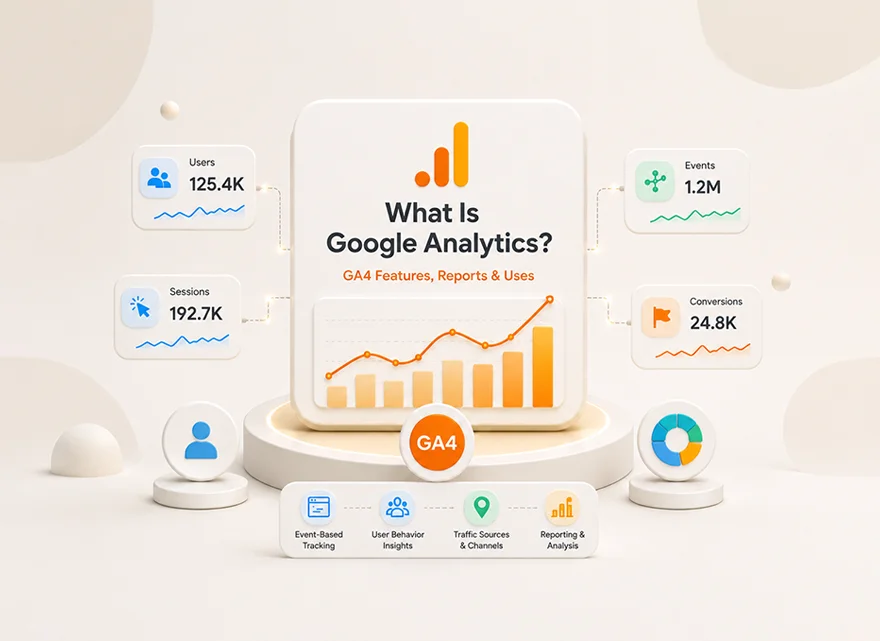
Learn what Google Analytics 4 does, how its event-based tracking works, which reports and features matter, and how to use GA4 for SEO and traffic analysis.
Google Analytics is Google’s measurement platform for understanding how people find and use a website or app. The current version, Google Analytics 4 (GA4), records interactions as events, then turns those events into reports about acquisition, engagement, conversions, retention, and revenue.
In practical terms, GA4 helps answer questions such as: Where did visitors come from? Which landing pages attracted engaged users? What actions did people complete? Which campaigns generated valuable traffic rather than empty sessions? The tool is free for most websites, but useful analysis still depends on accurate setup, meaningful events, and careful interpretation.
Quick definition: Google Analytics is used to collect, organize, and analyze website and app activity. GA4 is the event-based version of the platform and is designed to measure a customer journey across multiple pages, sessions, and devices.
How Does Google Analytics 4 Work?
GA4 uses a tracking tag installed directly on a website or through Google Tag Manager. When a visitor loads a page or performs a configured action, the tag sends an event and its associated parameters to the property. GA4 processes that data and makes it available in standard reports, explorations, audiences, and advertising tools.
Unlike the older Universal Analytics model, GA4 is built around events instead of treating pageviews, transactions, and other interactions as separate hit types. A page view is an event. A click can be an event. A form submission, purchase, scroll, file download, or video start can also be measured as an event.
Google describes GA4 as an event-based platform that can collect website and app data while supporting privacy controls and behavioral modeling. You can review Google’s GA4 overview for the platform’s current model and capabilities.
The Four Measurements Beginners Should Understand
Users represent people who interacted with the website or app. Sessions group activity that happens during a visit. Events record specific interactions. Key events are the events you mark as especially important to the business, such as a purchase, qualified lead, registration, or completed contact form.
These measurements are connected but not interchangeable. A website may gain many users and sessions while producing very few meaningful events. That is why traffic volume alone is not a reliable measure of performance.
What Is Google Analytics Used For?
Google Analytics is used to connect marketing activity with on-site behavior. It provides evidence for decisions about SEO, paid campaigns, content, landing pages, user experience, and conversion optimization.
Measure Traffic Sources and Campaigns
The Acquisition reports show whether visits arrived through organic search, paid search, social media, referrals, direct traffic, email, or tagged campaigns. Source, medium, campaign, and channel data help marketers compare not only visitor counts but also engagement and key-event performance.
Analyze Landing Pages and Content
GA4 can show which page started a session, which pages received views, how visitors moved through the site, and where important events occurred. This helps content teams identify pages that attract attention but fail to move users toward the next useful action.
Track Leads, Sales, and Other Outcomes
A useful GA4 property should measure business actions instead of relying only on pageviews. Ecommerce purchases, generated leads, account registrations, calls, downloads, trial starts, and other outcomes can be configured as events and selected as key events.
Understand Audience and Technology Patterns
Reports can group data by country, city, language, device category, browser, operating system, and other dimensions. These breakdowns help diagnose whether a campaign reaches the intended audience and whether a technical or usability issue affects a particular segment.

Launch a measurable traffic campaign and verify every visit, source, and conversion in GA4.
Core Google Analytics 4 Reports and Features
GA4 includes many tools, but most websites do not need to use all of them at once. The most valuable features are the ones that answer a specific business question and rely on correctly collected data.
Realtime Report
The Realtime report shows activity from the last 30 minutes. It is useful for checking whether a new tag, campaign link, page, or event is sending data. Realtime is a diagnostic view, not a substitute for longer-term performance analysis.
Acquisition Reports
User Acquisition focuses on how a user was first acquired, while Traffic Acquisition focuses on the source of individual sessions. Mixing these scopes can create confusing conclusions, so always confirm whether a report uses first-user or session-level dimensions.
Engagement Reports
Engagement reports cover events, pages and screens, landing pages, and key events. They help reveal whether visitors actually interact with content after arriving. Engaged sessions, average engagement time, and event completion are often more informative than a raw session count.
Explorations
Explore provides flexible analysis methods such as free-form tables, funnels, path exploration, and segment overlap. It is especially useful when standard reports cannot answer a question, for example where users abandon a multi-step process or how organic visitors behave after entering through a particular page.
Audiences and Comparisons
Audiences group users based on conditions, while comparisons and segments isolate subsets of data for analysis. You might compare organic visitors with paid visitors, mobile users with desktop users, or visitors from one target country with all other locations.
Advertising and Attribution
GA4 can analyze how channels contribute to key events. Attribution reports help prevent the last interaction from receiving all the credit when several touchpoints influenced a decision. Results still depend on consent, tracking continuity, attribution settings, and the available data.
BigQuery Export
The BigQuery Export feature sends raw GA4 event data to BigQuery for more detailed querying and modeling. It is valuable when analysts need data beyond the standard interface, want to join analytics with internal business data, or need custom quality checks.
Events and Key Events in GA4
Events are the foundation of Google Analytics 4. Some are collected automatically, some come from enhanced measurement, and others must be recommended or custom events. A good event plan uses clear names, avoids duplicate tracking, and records only parameters that are genuinely useful.
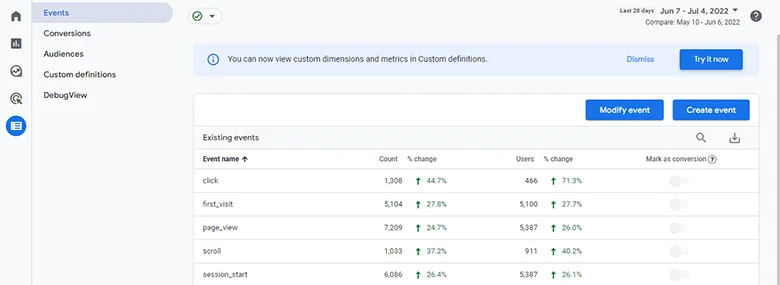
Mark only meaningful outcomes as key events. If every minor interaction becomes a key event, reports lose their ability to distinguish genuine progress from routine browsing. For an online store, purchases and checkout milestones may matter. For a service business, qualified form submissions, calls, or booked consultations may be more appropriate.
How to Set Up Google Analytics 4
A basic implementation requires more than creating an account. The property, web data stream, tracking tag, time zone, currency, internal-traffic rules, cross-domain settings, events, and consent behavior should match the actual website and business.
1. Create the Property and Web Data Stream
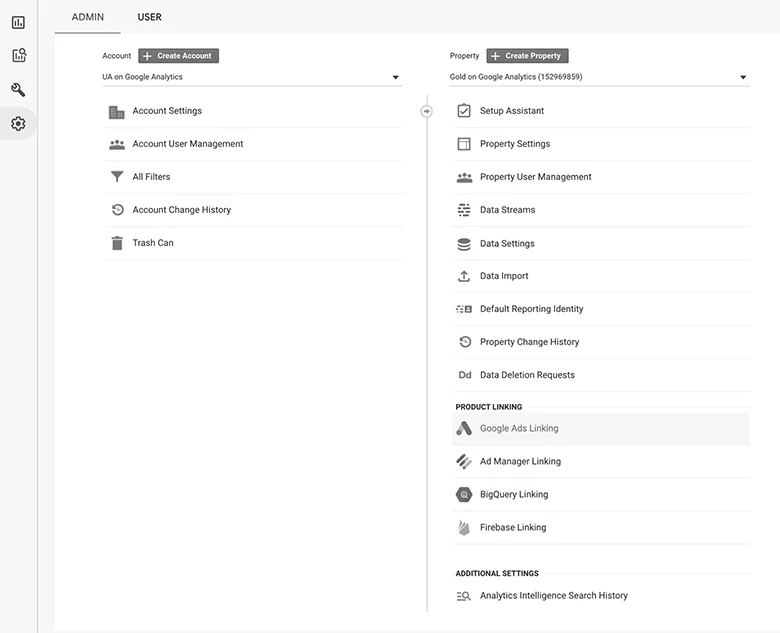
Create a GA4 property in Google Analytics, then add a web data stream for the site’s canonical domain. Review enhanced measurement settings instead of assuming every automatic event is appropriate.
2. Install the Google Tag
Install the tag directly, through Google Tag Manager, or through a verified integration. Avoid placing the same measurement ID through multiple methods because duplicate tags can inflate events and produce misleading reports.
3. Verify Data Collection
Use Realtime and DebugView to confirm that page views and important actions appear once, with the expected event names and parameters. Test consent behavior, internal traffic, referrals, checkout domains, and campaign parameters before trusting the reports.
4. Define Important Events
Create or configure events around actual objectives. Mark the most important ones as key events, then verify that they fire only when the intended action succeeds. A button click is not the same as a successfully submitted form or completed purchase.
How to Use Google Analytics for SEO
GA4 does not replace an SEO platform or Google Search Console. It becomes useful for SEO after the click: it shows what organic visitors do on the website, which landing pages engage them, and whether search traffic contributes to key events and revenue.
Connect Google Search Console
The Search Console integration adds reports for organic Google queries and organic landing pages. Search Console remains the primary source for impressions, clicks, click-through rate, and average position, while GA4 adds engagement and conversion context.
Evaluate Organic Landing Pages
Start with landing pages that receive organic sessions. Compare engagement, key-event rate, revenue, and device or country segments. A page with strong search visibility but weak engagement may have an intent mismatch, a slow experience, unclear content, or tracking problems.
Separate Traffic Quantity from Traffic Quality
A rise in organic users is valuable only when those visitors match the intended audience and complete useful actions. Analyze the source, landing page, location, device, engagement, additional pageviews, and key events together. Sudden growth with extremely short engagement and no downstream activity deserves investigation.
What Does “Not Provided” Mean in Google Analytics?
Google Analytics generally does not reveal the organic search query for each individual visit. Those keywords commonly appear as “(not provided)” because search queries are not passed to analytics at the user-session level.
To study keyword performance, use Google Search Console for aggregated query impressions and clicks, then connect that information with GA4 landing-page behavior. Do not try to assign a Search Console query to a specific individual user or session; the tools use different scopes and processing methods.
Google Analytics Privacy and Data Limitations
Analytics data is not a perfect record of every visitor. Consent choices, browser protections, ad blockers, tag failures, cookie restrictions, cross-device behavior, reporting identity, thresholds, modeled data, and processing rules can all affect the numbers.
Configure consent and retention settings according to applicable laws and business requirements. Avoid sending personally identifiable information to Google Analytics. Access should also follow the principle of least privilege so users receive only the permissions they need.
When accuracy matters, compare GA4 with other evidence such as Search Console, advertising platforms, CRM records, ecommerce data, CDN or WAF analytics, and server logs. Differences between systems are normal because each platform defines and processes activity differently.
Universal Analytics vs Google Analytics 4
Universal Analytics was session-oriented and used categories, actions, and labels for many interactions. GA4 uses an event-based model and supports combined web and app measurement, explorations, audiences, modeled insights, and BigQuery export.
Standard Universal Analytics properties stopped processing new data on July 1, 2023. Historical comparisons should account for the two platforms’ different definitions and collection models. GA4 should not be expected to reproduce every Universal Analytics metric exactly.
Which GA4 Reports Should a Beginner Check?
Begin with a small, repeatable review instead of scanning every screen:
- Realtime: confirm that current tracking and campaign links work.
- Traffic Acquisition: compare session sources, mediums, and campaigns.
- Landing Page: identify the first pages visitors see and how they perform.
- Pages and Screens: evaluate content consumption and event activity.
- Events and Key Events: confirm that important actions are measured correctly.
- Tech and Demographics: investigate device, browser, country, or city patterns.
Use a consistent date range and compare it with the previous period or the same period last year when seasonality matters. Add annotations outside GA4 for launches, tracking changes, promotions, outages, and major SEO updates so later analysis has context.
Final Takeaway
Google Analytics 4 is a measurement system, not an automatic answer generator. It can show how users arrive, what they do, and whether important outcomes occur, but the reports are only as trustworthy as the implementation and the questions behind them.
Start with a clean property, validated tracking, a short list of meaningful events, and clear business goals. Combine GA4 with Search Console and independent operational data, then judge every traffic source by relevance, engagement, and outcomes—not visitor count alone.
Frequently Asked Questions
Quick answers to common questions about Google Analytics
Google Analytics 4, commonly called GA4, is Google's analytics platform for measuring website and app activity. It uses an event-based data model to report how users arrive, interact with content, and complete important actions.
Google Analytics is used to measure traffic sources, landing pages, user activity, content performance, leads, sales, audiences, devices, campaigns, and other business outcomes. Its value comes from connecting visits to meaningful actions.
GA4 records interactions as events. Events can describe page views, clicks, searches, form activity, purchases, and other actions. Important events can be marked as key events so teams can evaluate performance against business goals.
Key events are events that represent important outcomes for a website or app, such as a lead submission, registration, purchase, or another valuable action. They replace the older Universal Analytics conversion model.
Start with Realtime to verify collection, Acquisition to understand traffic sources, Engagement to review pages and events, and key-event or ecommerce reports to measure outcomes. Use Explorations when you need deeper custom analysis.
Connect Search Console, segment organic traffic, evaluate landing pages, track key events and revenue, compare devices and countries, and investigate whether organic visitors complete useful actions. Search Console measures search visibility, while GA4 measures behavior after the click.
Users represent people or devices that interact with the site, while sessions represent groups of interactions during visits. One user can generate multiple sessions, so both metrics should be interpreted with events, engagement, and conversion outcomes.

Comments
Leave a Comment