


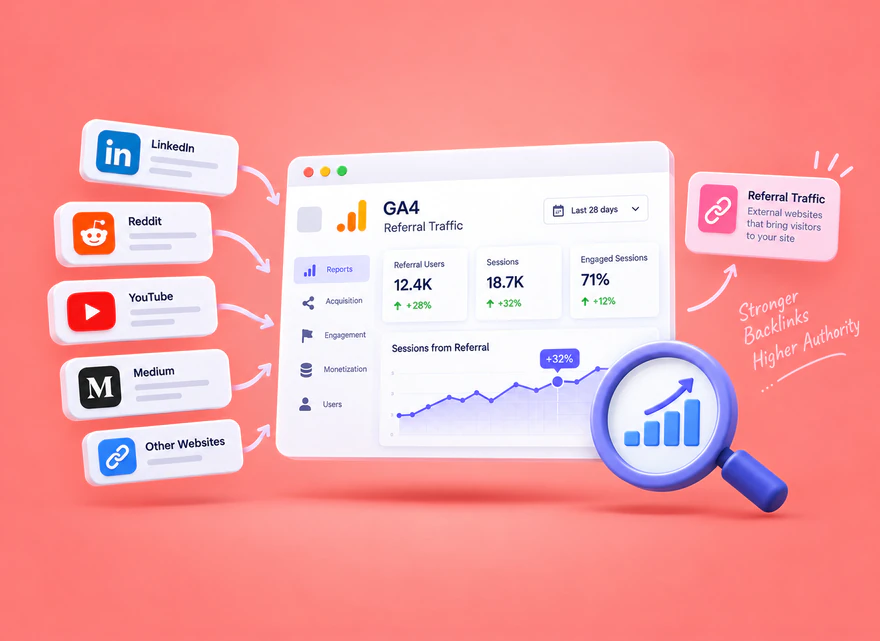
Learn how referral traffic and editorial links support visibility, audience growth, and measurable outcomes—and how to build a safe strategy without treating Domain Authority as a Google metric.
Referral traffic is the stream of visitors who reach your website by clicking links on other websites. It can create valuable exposure, introduce your content to a relevant audience, and show which publishers, partnerships, and editorial mentions produce meaningful business results.
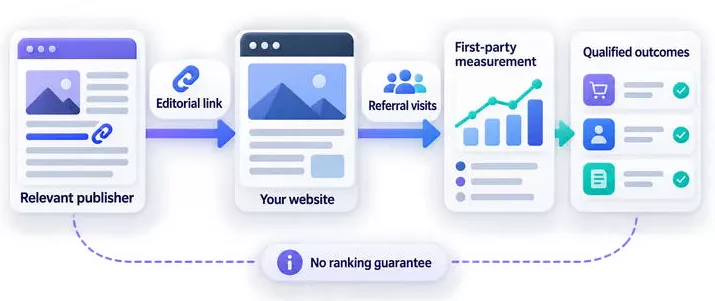
Referral traffic and backlinks are connected, but they are not the same metric. A backlink is the link itself. Referral traffic is the group of visits generated when people click that link. A useful editorial link can help search engines discover and understand pages while also sending real visitors, yet traffic volume alone does not guarantee higher Google rankings.
Domain Authority is a third-party comparative score associated with Moz; it is not a Google metric or a direct Google ranking factor. The practical goal is therefore not to manipulate a score. It is to earn relevant links, reach qualified audiences, build recognizable expertise, and measure outcomes with first-party analytics.
This guide explains how referral traffic fits into authority-building, how to evaluate sources, how to create link-worthy assets, and how to avoid link schemes that can create risk instead of sustainable growth.

What Is Referral Traffic in SEO?
Definition of Referral Traffic
Referral traffic refers to all visits that arrive at your website through a clickable link on an external website — rather than from a direct URL entry, a search engine result, or a social media platform. In Google Analytics, these visits appear under the Referral channel and show you exactly which websites are sending visitors your way.
How Referral Traffic Differs From Organic Traffic
Organic traffic comes from users who find your website through unpaid search results after typing a query into a search engine like Google. Referral traffic, on the other hand, comes from users who click a link embedded in external content — a blog post, a forum thread, a news article, or a directory listing. Both are valuable, but they serve different roles in your overall traffic strategy.
Examples of Referral Sources
- Industry blogs and niche publications that link to your content
- Community forums such as Reddit or Quora where users share your URLs
- Social media platforms including LinkedIn, Facebook, and Twitter/X
- Business directories and review sites
- News websites and online press releases
- Partner websites and affiliate pages
How Links and Referral Visits Create Different Value
Google uses links to discover pages and as one of many signals for understanding relevance. A natural editorial link from a useful, contextually relevant page can support discovery and SEO, while the visits generated by that link should be evaluated separately in analytics. Do not treat clicks, time on site, or bounce rate as guaranteed ranking levers.
How Referral Traffic Can Support Authority-Building
Building High-Quality Backlinks
Every referral link from an external site is, by definition, a backlink. The more high-quality websites that link to your content, the stronger your backlink profile becomes. Search engines use backlink profiles as one of their primary signals to evaluate the credibility and relevance of a website. A diverse portfolio of links from reputable, topically relevant sources is far more valuable than a large number of links from low-quality pages.
Improving Brand Visibility Across the Web
When your website appears consistently across trusted platforms, your brand recognition grows. This visibility leads to more branded searches — users who search for your brand name directly — which is itself a strong signal of authority and trustworthiness. Referral traffic is one of the most natural ways to build this kind of multi-channel presence.
Evaluating Visitor Quality
Referral visitors who arrive from contextually relevant sources tend to be highly engaged. They have already shown interest by clicking a link in content they were actively reading. This typically translates into:
- Longer average session duration on your pages
- Higher number of pages viewed per visit
- Lower bounce rates compared to cold traffic
- Higher likelihood of conversion or return visits
Use these engagement metrics to judge audience fit and business value. They are useful measurement signals for your team, but they do not prove that referral traffic directly changes Google rankings.
Generating Natural Link Opportunities
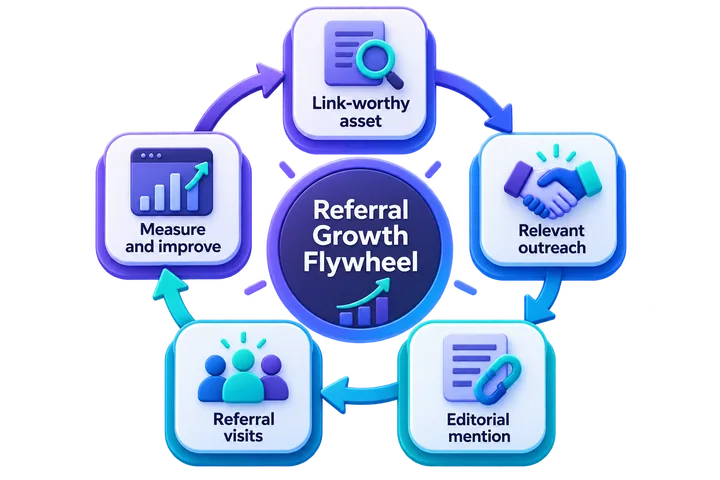
When your content attracts referral visitors from respected sources, it also increases the likelihood of additional natural links. Writers, bloggers, and content creators who discover your site through a referral link are far more likely to cite your content in their own work, creating a compounding effect on your link acquisition over time.
Boosting Trust and Credibility
Referral exposure from credible sources can strengthen recognition and trust with people. Demonstrating experience, expertise, authoritativeness, and trustworthiness comes from the quality and transparency of your content, authorship, service, and reputation—not from a traffic counter or third-party authority score.
Best Sources of Referral Traffic for SEO Growth
Guest Posting on Relevant Websites
Contributing original, high-quality content to established websites in your niche is one of the most reliable ways to generate referral traffic and earn authoritative backlinks. The key is relevance: a guest post on a site that serves a similar audience to yours will deliver far more qualified visitors than a post on an unrelated platform.
Niche Directories and Business Listings
Industry-specific directories and authoritative business listing platforms can send consistent, targeted referral traffic to your website. Beyond the traffic itself, listings in reputable directories serve as trust signals that reinforce your legitimacy in the eyes of both users and search engines.
Social Media Platforms
While social media traffic is technically categorized separately in Google Analytics, links shared on platforms like LinkedIn, Facebook, Pinterest, and Twitter/X can generate significant referral visits. LinkedIn is particularly valuable for B2B audiences, while Pinterest and YouTube can be powerful drivers for visual and instructional content.
Reddit and Community Forums
Reddit and niche community forums represent a unique and highly engaged referral traffic source. When you contribute genuinely helpful answers and naturally reference your content, the resulting traffic often has exceptional engagement metrics. These communities also have a strong link-sharing culture, meaning a well-received post can generate organic backlinks from other websites that discover your content through the forum.
Influencer Mentions and Collaborations
Collaborating with respected voices in your industry — whether through podcast appearances, co-authored content, or product partnerships — can produce referral traffic bursts that are both high in volume and quality. Influencer endorsements also carry significant trust signals that reinforce your brand authority.
Press Releases and Digital PR
A well-crafted press release distributed to relevant media outlets can earn placements on news sites and industry publications that carry significant domain authority. Digital PR is one of the most powerful strategies for building both referral traffic and high-value backlinks simultaneously.
How to Build a Referral Traffic Strategy
Identify Relevant High-Authority Websites
Start by mapping the landscape of websites your target audience already visits. Use tools like Ahrefs or SEMrush to identify which domains in your niche have the strongest authority and most engaged audiences. Prioritize outreach to sites with demonstrated topical relevance over those that simply have high domain authority metrics.
Create Link-Worthy Content
The foundation of any successful referral traffic strategy is content that other websites genuinely want to link to. This includes original research and data studies, comprehensive guides and tutorials, free tools and calculators, and authoritative industry reports. Content that provides unique value gives other publishers a reason to reference and link to your site organically.
Use Outreach Campaigns Effectively
Proactive outreach to website owners, editors, and bloggers in your niche is a critical part of building referral sources. Personalize every pitch, demonstrate that you understand their audience, and always lead with the value your content provides to their readers. Relationship-building should be the long-term goal, not just a single link placement.
Focus on Page-Level Relevance Instead of Only DA
Many SEO practitioners make the mistake of pursuing links based solely on a website’s domain authority score. In practice, the relevance of the specific page that links to you matters just as much as the overall authority of the domain. A contextually relevant link from a mid-authority page in your niche will typically deliver more SEO value and better-quality referral traffic than an irrelevant link from a high-DA domain.
Track Referral Performance in Google Analytics
Use Google Analytics to monitor which referral sources are delivering the most engaged visitors. Pay attention not just to traffic volume but to session duration, pages per session, and conversion rates by source. This data will help you prioritize your outreach and content efforts toward the channels that generate the highest-quality referrals.
Common Referral Traffic Mistakes to Avoid
Buying Low-Quality Referral Traffic
Not all referral traffic services are created equal. Low-quality, irrelevant, or automated visits can distort analytics and waste budget. They do not create editorial backlinks or guarantee SEO improvement. Evaluate any campaign by source relevance, transparency, landing-page fit, measurable actions, and compliance with platform and search policies.
Ignoring Referral Spam
Referral spam — automated bots that fake visits to your site and appear as referral traffic in your analytics — is a persistent problem that can mislead your strategy. Regularly audit your referral traffic in Google Analytics to filter out spam domains. Identifying and excluding fake referral traffic ensures that the decisions you make based on your data are grounded in reality, not inflated by artificial signals.
Focusing Only on Traffic Volume
A high volume of referral visits means nothing if those visitors leave immediately. Always evaluate the quality of your referral traffic by looking at engagement metrics alongside raw numbers. A smaller stream of highly engaged visitors from a relevant niche site will deliver far more SEO value and business impact than a flood of uninterested visitors from a mismatched source.
Using Irrelevant Backlink Sources
Links from websites that have no topical connection to your own can dilute the relevance signal of your backlink profile. In some cases, links from spammy or irrelevant domains can attract negative attention from Google’s algorithms. Always evaluate the topical alignment of any potential referral source before pursuing a link placement.
Over-Optimized Anchor Text
When securing referral links through outreach or guest posting, avoid using exact-match keyword anchor text on every link. Over-optimization of anchor text is a well-known red flag for Google’s link analysis algorithms. Aim for a natural, varied anchor text profile that includes branded terms, generic phrases, and partial keyword matches alongside exact-match anchors.
Tools to Analyze Referral Traffic and Authority
Google Analytics
In GA4, start with Reports > Acquisition > Traffic acquisition. Change the primary dimension to Session source / medium and filter for referral. Compare sessions with engagement rate, key events, revenue, and landing pages rather than reading source volume in isolation.
Ahrefs
Ahrefs provides detailed backlink analysis, showing you which external sites link to your pages, the authority of those domains, and how your referring domain count has changed over time. It is invaluable for auditing your backlink profile and identifying new referral opportunities.
SEMrush
SEMrush offers a comprehensive traffic analytics suite that allows you to analyze both your own referral traffic and that of your competitors. Understanding which referral sources drive traffic to competing websites is a powerful way to identify untapped opportunities for your own strategy.
Moz Domain Authority Checker
Moz’s Link Explorer provides domain authority scores and detailed backlink data. While domain authority is a third-party metric and not a direct Google ranking factor, it serves as a useful proxy for evaluating the relative strength of potential referral sources.
Traffic and Authority Monitoring Platforms
Dedicated traffic management platforms like Seovisitor provide tools to not only monitor your current traffic performance but also to diversify your traffic sources strategically. By combining analytics insights with targeted traffic campaigns, you can build a more resilient referral profile that supports long-term SEO growth.
How to Test Referral Traffic with Clear Measurement
A referral campaign should begin with a defined audience, source, landing page, and measurable outcome. If you use Seovisitor’s Referral Traffic service, select sources that match the page topic and treat the campaign as an acquisition test—not as a promise of rankings, backlinks, or a specific authority score.
Set a Campaign Hypothesis
Write down who should arrive, why the selected referrer is relevant, which page should receive the visit, and which action would count as success. A hypothesis makes it possible to distinguish useful traffic from a number that merely looks large.
Use Consistent Tracking
When you control the campaign URL, use a consistent source, medium, and campaign naming convention. Confirm that analytics is installed on the destination page and that redirects do not remove campaign parameters.
Compare Qualified Outcomes
Review landing-page engagement, key events, conversion quality, and revenue where appropriate. Compare the campaign with a relevant baseline and document what should change next.
Referral Traffic vs Backlinks: What Matters More?
The Relationship Between Traffic and Links
Referral traffic and backlinks are closely related but not identical. A backlink is a hyperlink that points to your website from an external source. Referral traffic is what happens when users actually click that link. A backlink can exist without generating any referral traffic (for example, if it is buried in a rarely read page), while referral traffic can arrive from links in pages that have very little domain authority. Both matter — but for different reasons.
Why Quality Matters More Than Quantity
A single highly relevant, engaging referral source can outperform dozens of low-quality links in terms of both user value and SEO impact. Search engines have become increasingly sophisticated at detecting the difference between manipulative link acquisition and genuinely earned authority signals. Building fewer, higher-quality referral relationships is a far more sustainable strategy than chasing raw link volume.
Can Referral Traffic Alone Increase Rankings?
Referral traffic alone is unlikely to be the primary driver of ranking improvements. However, when it is combined with strong on-page SEO, high-quality content, and a healthy overall backlink profile, referral traffic can meaningfully accelerate your rankings by strengthening user engagement signals and diversifying the trust indicators that Google evaluates. Think of referral traffic as one important piece of a multi-channel SEO strategy rather than a standalone solution.
Final Thoughts
Referral traffic can introduce your website to the right audience and reveal which editorial links, publishers, and partnerships generate measurable value. Its SEO value comes primarily from the context and quality of legitimate links—not from inflating visitor numbers or relying on a third-party authority score.
Create resources that deserve citations, contact publishers whose audiences genuinely overlap with yours, use natural anchors, qualify paid or user-generated links appropriately, and measure referral performance in GA4. This approach builds visibility and relationships while staying aligned with people-first content and Google’s spam policies.
Frequently Asked Questions
Quick answers to common questions about referral traffic and domain authority
No direct ranking increase is guaranteed. Google uses links as one of many signals, but referral visit volume, bounce rate, and analytics engagement figures should not be treated as simple ranking controls. Focus on relevant editorial links and useful outcomes for people.
Domain Authority is a third-party comparative metric associated with Moz that estimates a domain’s ranking potential. Google does not use Domain Authority as a ranking metric, so compare it cautiously and never treat it as a performance guarantee.
A backlink is a link from another website to yours. Referral traffic is the set of visits created when people click that link. A backlink can exist without generating visits, and a referral visit can come from a link that has little SEO value.
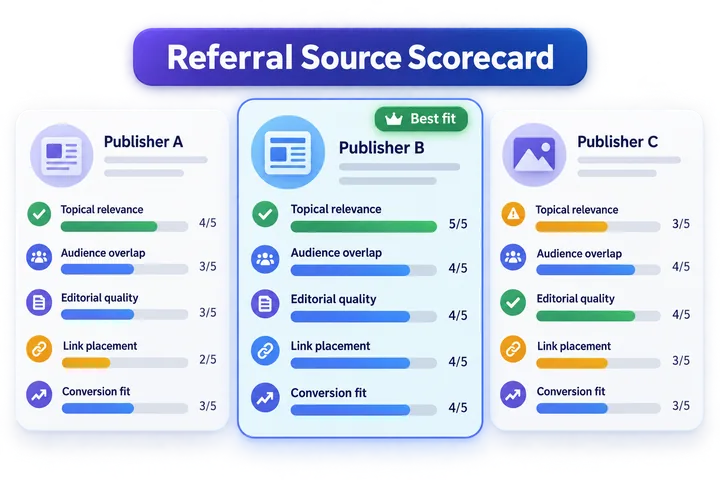
A strong source has topical relevance, audience overlap, editorial quality, a natural link placement, and visitors who take meaningful actions. A smaller relevant source can be more valuable than a large but poorly matched source.
Use GA4 Traffic acquisition with Session source / medium, then compare sessions, engagement rate, average engagement time, landing pages, key events, and revenue where applicable. Add consistent UTM parameters when you control the campaign link.


Comments
Leave a Comment