


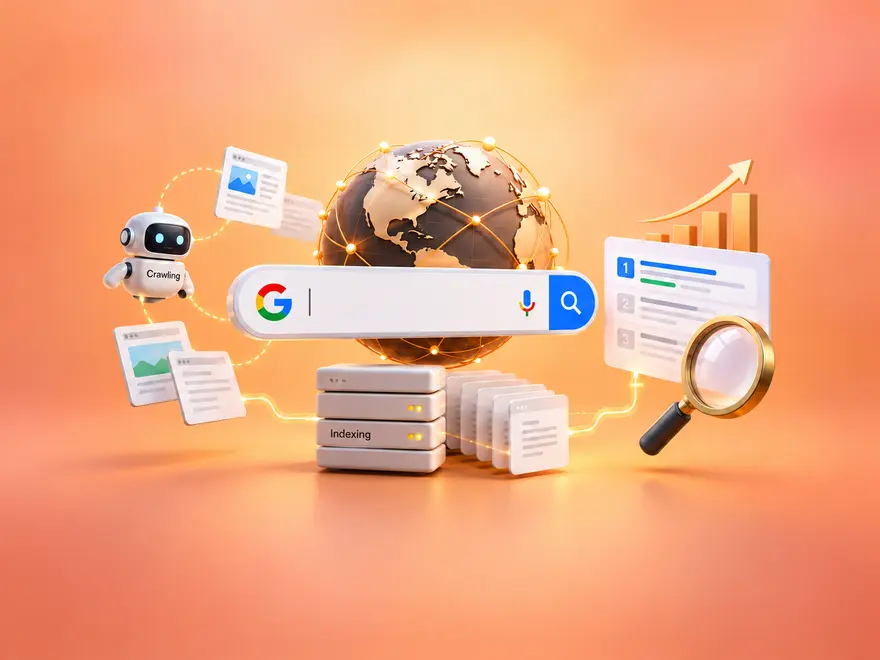
Learn how Google discovers, crawls, indexes, and ranks web pages, why search results differ between users, and how modern AI features are changing Google Search in 2026.
Google Search is a fully automated system that discovers pages across the web, analyzes their content, stores eligible information in its index, and then selects the most relevant and useful results when someone searches. In 2026, that process still begins with the same core stages—crawling, indexing, and serving search results—but the results page now also includes features such as local results, featured snippets, rich results, AI Overviews, and AI Mode.
Understanding how Google Search works is useful for more than SEO professionals. It helps website owners diagnose why a page is not indexed, understand why rankings change, improve technical SEO, create content that matches search intent, and measure visibility more accurately.
One important principle should be clear from the beginning: Google does not accept payment to crawl a website more frequently or rank a page higher. Paid traffic and organic rankings are separate systems. The best way to improve organic search performance is to make your important pages accessible, indexable, relevant, useful, and technically sound.
How Does Google Search Work?
Google explains Search in three main stages:
- Crawling: Google discovers URLs and downloads page content using automated crawlers such as Googlebot.
- Indexing: Google analyzes the page, its content, media, metadata, canonical signals, and other information and may store it in the Google index.
- Serving search results: When a user enters a query, Google searches its index and uses automated ranking systems to choose the results it considers most relevant and useful.
Not every discovered URL is crawled, not every crawled page is indexed, and not every indexed page will rank for the query you want. Each stage has different requirements and potential problems.
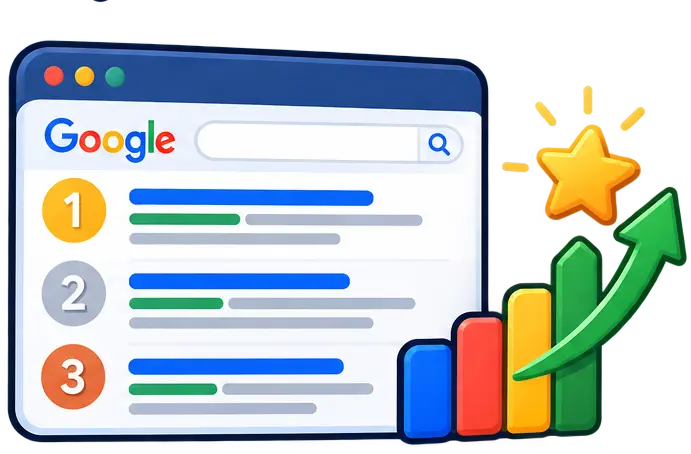
1. Crawling: How Google Discovers Pages
The first stage is URL discovery and crawling. There is no central registry containing every page on the web, so Google constantly discovers new and updated URLs.
Google can discover a page through:
- Internal links from pages it already knows.
- External links from other websites.
- XML sitemaps.
- URLs discovered during previous crawls.
After discovering a URL, Google may send Googlebot to fetch it. Googlebot requests the page from the server and can also retrieve resources such as CSS, JavaScript, images, and videos when they are needed to understand or render the page.
How crawling works
- Google discovers or revisits a URL.
- Googlebot requests the page from the server.
- Google retrieves accessible text, links, images, and other resources.
- The page may be rendered so Google can process JavaScript-generated content.
- Links discovered on the page can lead Google to additional URLs.
Common problems that can affect crawling
- Server downtime or repeated server errors.
- Network problems.
- Important URLs blocked in
robots.txt. - Pages that require login before their content can be accessed.
- Broken internal links that make important pages difficult to discover.
- JavaScript implementation that hides important content when rendering fails.
- Redirect loops or unnecessarily long redirect chains.
A crawlable page is not automatically an indexed page. Crawling only gives Google the opportunity to retrieve and process the content.
2. Indexing: How Google Understands and Stores Content
After Google crawls a page, it tries to understand what the page is about. This stage is called indexing.
During indexing, Google can analyze information such as:
- The main text and topic of the page.
- The
<title>element and important page metadata. - Headings and content structure.
- Images, videos, and image alt attributes.
- Links and page relationships.
- Language and geographic relevance.
- Canonical signals and duplicate versions.
Google may group similar or duplicate URLs together and select a canonical version that it considers the most representative page. This is why incorrect canonical tags or large numbers of duplicate URLs can create indexing problems.
Why a crawled page may not be indexed
Indexing is not guaranteed. Common causes of indexing problems include:
- A
noindexdirective. - Low-value or insufficiently useful content.
- Duplicate or near-duplicate pages.
- An incorrect canonical pointing to another URL.
- Website design or rendering problems that make the main content difficult to process.
- Soft 404s or pages that do not provide the content users expect.
If an important page is not indexed, check it with Google Search Console’s URL Inspection tool before changing content blindly.
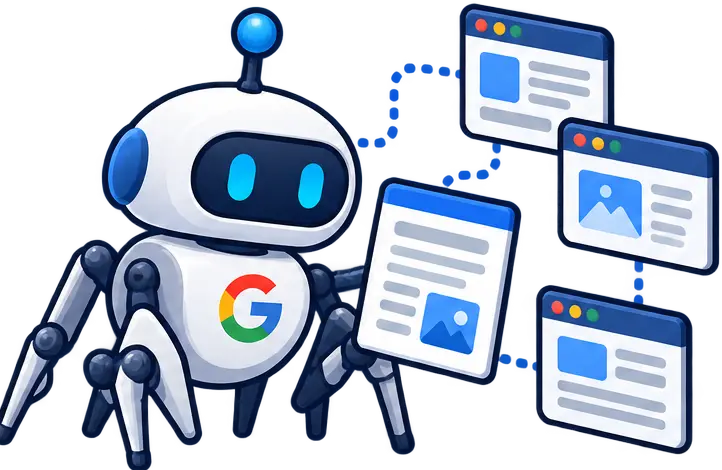
3. Ranking: How Google Chooses Search Results
When someone searches, Google does not scan the entire live web in that moment. It searches information already available in its index and uses automated ranking systems to determine which results are the most relevant and useful for the query.
Google says its ranking systems consider many factors and signals across hundreds of billions of pages and other indexed content. There is no public checklist where one factor alone guarantees a specific position.
Ranking can depend on the query and context, including:
- How relevant a page is to the search request.
- The quality and usefulness of the content.
- The meaning and intent behind the query.
- Links and relationships between pages.
- Freshness when the query benefits from current information.
- Language.
- Location.
- Device type.
- Whether a specialized search feature is more useful than a standard web result.
Examples of Google ranking systems
Google uses multiple systems rather than one single “Google algorithm.” Current and historical systems include:
- BERT: Helps Google understand how combinations of words express meaning and intent.
- RankBrain: Helps connect words with concepts so relevant pages can be returned even when they do not contain every exact word in the query.
- Neural matching: Helps match conceptual representations in queries and pages.
- PageRank and link analysis: Uses relationships between pages as part of understanding which pages may be helpful.
- Freshness systems: Surface newer information when a query is time-sensitive.
- Original content systems: Help surface original sources rather than pages that only repeat them.
- Spam detection systems: Detect behaviors and content that violate Google Search spam policies.
Some famous names from SEO history are no longer standalone systems. Google lists Panda, Penguin, Hummingbird, and the former Helpful Content system as historical or integrated into broader core ranking systems.
Search Intent: Why the Meaning Behind a Query Matters
Google Search is designed to understand what a person is trying to accomplish, not simply match an exact keyword string.
Common intent patterns include:
- Informational: “how does Google Search work?”
- Commercial investigation: “best rank tracking tools”
- Transactional: “buy running shoes online”
- Local: “coffee shop near me”
- Navigational: searching for a specific brand, website, or page.
The best format depends on the intent. A user asking how Google works probably needs an educational guide. Someone looking for a nearby service is more likely to need local results, business information, directions, reviews, and contact options.
This is why SEO should focus on satisfying the real task behind the search rather than repeating a keyword a fixed number of times.
How Location, Device, and Personalization Affect Results
Two people can search the same phrase and see different results without either result being “wrong.” Google can use the context of the search to improve relevance.
Search results may vary because of:
- Current or estimated location.
- Language.
- Device type.
- Recent searches that provide context.
- Search features relevant to the query.
- Personalized recommendations when the user has personalization enabled.
Location is particularly important for local queries. A search for “coffee shop” in New York should not return the same local businesses as the same search in Phoenix.
Personalization is only part of the picture. Even when personalized recommendations are disabled, Google can still use current context such as location, language, and device to provide appropriate results.
Google Search Results Are More Than Ten Blue Links
A modern Google results page can contain different features depending on the query. Traditional organic links remain important, but users may also see:
- Featured snippets.
- People Also Ask results.
- Local results and maps.
- Image and video results.
- Shopping results.
- Knowledge panels.
- Rich results.
- AI Overviews.
- AI Mode experiences.
The format Google chooses depends on what it believes will best satisfy the query. For example, a nearby-service query may emphasize maps, while a factual or research-oriented query may include a featured snippet or AI-generated experience.
Technical SEO Factors That Help Google Access and Understand a Website
Technical SEO does not replace useful content, but technical problems can prevent good content from being crawled, indexed, or displayed correctly.
Important technical areas include:
- Robots.txt: Make sure important pages and required resources are not blocked accidentally.
- Indexing directives: Check
noindexand other robots directives. - Canonical tags: Use them consistently when multiple URLs contain duplicate or very similar content.
- XML sitemaps: Help Google discover important canonical URLs.
- HTTP status codes: Return appropriate responses for valid, moved, missing, or unavailable pages.
- Internal linking: Important pages should be reachable through crawlable links.
- JavaScript: Ensure critical content and links remain accessible when Google renders the page.
- Mobile usability: Pages should work properly on mobile devices.
- HTTPS: Use a secure connection across the website.
- Page experience: Keep pages usable, stable, and reasonably fast.
If a page is not appearing in Google, technical eligibility should be checked before assuming the problem is purely about “ranking factors.”
What Does Not Directly Make Google Rank a Page Higher?
Several common SEO claims confuse correlation, analytics metrics, and ranking systems.
Paying for traffic does not buy organic rankings
Google states that it does not accept payment to crawl a site more frequently or rank a page higher. Paid traffic can be useful for advertising, testing, audience acquisition, or analytics, but it should not be presented as a direct way to improve organic rankings.
Bounce rate is not a simple public ranking formula
Your analytics data can help you understand whether visitors engage with a page, but a single bounce-rate number does not prove how Google will rank that page. Different page types naturally produce different user behavior.
There is no universal “200-factor checklist” to optimize one by one
Google has described ranking as involving hundreds of factors and signals, but those systems work together and vary by query. Treating SEO as a fixed list of 200 switches oversimplifies how Search works.
Keyword repetition does not replace relevance
Modern language-understanding systems can connect concepts and meaning. Use the words your audience understands, but do not force exact-match phrases into every sentence.

How to Monitor Your Performance in Google Search
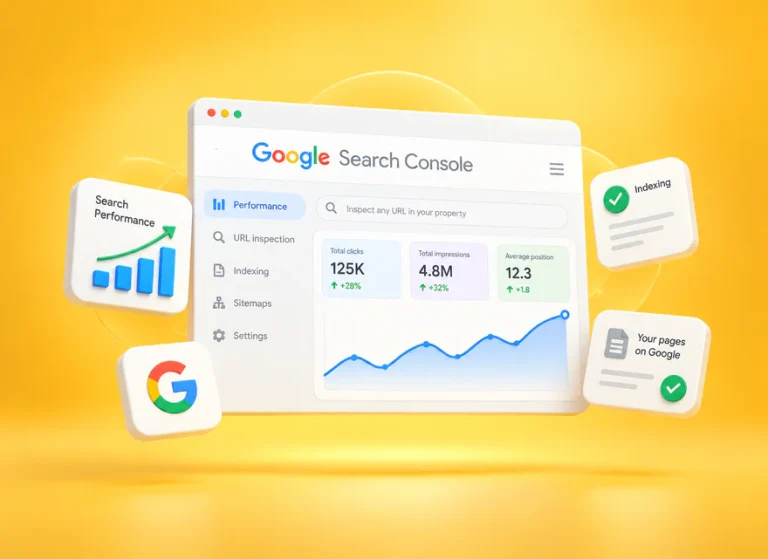
Google Search Console is the primary tool for understanding how Google sees and surfaces your website.
Useful reports and tools include:
- URL Inspection: Check whether a specific page is indexed and review crawl and canonical information.
- Page Indexing: Identify why groups of URLs are not indexed.
- Performance: Analyze clicks, impressions, queries, pages, countries, devices, and search appearance.
- Sitemaps: Confirm that Google can process your XML sitemap.
- Core Web Vitals: Review field data for important page-experience issues.
Rank tracking can complement Search Console when you need repeated position checks for a defined list of keywords. Search Console, however, remains the better source for your site’s actual Google impressions and clicks.
How Google Fights Spam and Manipulation
Google uses automated systems, including SpamBrain, as well as human review when necessary, to detect content and behavior that violate Search spam policies.
Spam policies cover practices such as:
- Keyword stuffing.
- Link spam.
- Cloaking.
- Doorway abuse.
- Scaled content abuse.
- Scraped or low-value content created primarily to manipulate rankings.
- Site reputation abuse.
- Other deceptive attempts to manipulate Search systems.
A site that violates these policies may rank lower or may not appear in search results. The safer long-term strategy is to make pages primarily for users and use SEO to improve discovery and understanding rather than to disguise manipulation.
The Future of Google Search: AI Overviews, AI Mode, and Conversational Search
Google Search is increasingly combining traditional search retrieval with generative AI experiences. In 2026, Google has continued expanding AI Overviews and AI Mode, including more conversational follow-up questions, richer source links, and new ways to explore complex topics.
This changes the presentation of search results, but the underlying web still matters. Google continues to crawl, index, understand, and retrieve information from websites while creating new interfaces for users to explore that information.
For website owners, this makes several practices increasingly valuable:
- Publishing original information and first-hand experience.
- Answering important questions clearly.
- Building strong topical coverage rather than isolated thin articles.
- Using descriptive headings and logical page structure.
- Keeping important facts and recommendations current.
- Making authorship and publisher information clear.
- Measuring visibility across different search features instead of watching one keyword alone.
Google Search Optimization Checklist
- Can Googlebot access your important pages?
- Are important pages indexable?
- Does each page have a clear canonical URL?
- Are internal links helping Google discover important content?
- Is the XML sitemap current and limited to URLs you want indexed?
- Does the content clearly match search intent?
- Does the page provide original and useful information?
- Are titles and headings descriptive rather than stuffed with keywords?
- Does the website work properly on mobile devices?
- Are important pages stable, usable, and reasonably fast?
- Are ranking changes being measured with Search Console and, where useful, a rank tracker?
- Are spammy shortcuts being avoided?
Conclusion
Google Search works through a connected process: it discovers pages, crawls accessible content, analyzes and indexes eligible information, and uses multiple ranking systems to return results that match the user’s query and context.
Modern Search is more complex than a list of ten organic links. Featured snippets, local results, rich results, AI Overviews, AI Mode, images, videos, and other features can all change how visibility appears.
For website owners, the fundamentals remain clear: make important pages crawlable and indexable, create useful content that satisfies search intent, maintain a technically healthy site, follow Google’s spam policies, and measure performance with real Search data instead of relying on outdated ranking myths.
Frequently Asked Questions
Quick answers to common questions about how Google Search works
The three main stages are crawling, indexing, and serving search results. Google first discovers and fetches pages, then analyzes and may store them in its index, and finally uses ranking systems to select relevant results for a search query.
No. Crawling does not guarantee indexing. A page can be crawled and still remain unindexed because of directives, duplication, low-value content, canonicalization, rendering problems, or other indexing issues.
Google uses multiple automated ranking systems that consider many factors and signals. The exact combination depends on the query. Relevance, usefulness, meaning, links, freshness, language, location, and device can all matter in different situations.
No direct organic ranking benefit is guaranteed by purchasing traffic. Google explicitly states that it does not accept payment to crawl a site more frequently or rank it higher. Paid traffic should be evaluated as a separate acquisition or testing channel.
Results can differ because of location, language, device, recent search context, search features, and personalization settings. Even without personalized recommendations, local and contextual differences can change what appears.
Yes. Google currently describes RankBrain as an AI system that helps understand relationships between words and concepts so relevant pages can be returned even when they do not contain every exact query term.
No. Google lists Panda and Penguin as historical systems that evolved and became part of its broader core ranking systems.
Use the URL Inspection tool in Google Search Console. It can show whether the URL is indexed, when it was last crawled, which canonical Google selected, and whether indexing or crawl issues were detected.


Comments
Leave a Comment