


Compare Similarweb, Ahrefs, and Semrush traffic estimates, learn why their numbers differ, and choose the right platform for total traffic, organic SEO, market research, and competitor analysis.
Similarweb vs Ahrefs vs Semrush is not a simple accuracy contest because the three platforms do not measure exactly the same thing. Similarweb and Semrush Traffic Analytics model visits across multiple channels, while the Organic traffic metric in Ahrefs Site Explorer estimates Google search clicks. A fair comparison starts by matching the metric to the decision you need to make.
This guide explains where each estimate comes from, why the numbers rarely match Google Analytics 4 or Google Search Console, and which platform is the better fit for competitor research, organic SEO, market analysis, and campaign planning.
Similarweb vs Ahrefs vs Semrush: The Quick Verdict
No third-party platform can see every visit to a competitor’s website. Each tool observes a sample of activity or search visibility and then uses its own model to estimate the missing data. The most accurate option therefore depends on whether you need total website visits, organic search potential, or a broad view of a market.
Decide what a wrong estimate would change before opening a report. Choosing topics for a content brief needs useful keyword and page evidence. Evaluating a potential publisher needs audience and channel context. Neither task is solved by a precise-looking headline total alone. This guide compares research methods; it does not present an independently measured accuracy league table.
| Use case | Best starting point | Why |
|---|---|---|
| Total visits and channel mix | Similarweb or Semrush Traffic Analytics | Both model traffic beyond organic search, including direct, referral, social, and paid channels. |
| Organic keywords and top SEO pages | Ahrefs or Semrush Organic Research | These reports connect rankings, keyword volume, and estimated click-through rates. |
| Market and audience benchmarking | Similarweb | Its digital intelligence workflow is built around market share, audience, and cross-channel comparison. |
| SEO and paid search in one workspace | Semrush | Its toolkits combine keyword, competitor, advertising, and modeled traffic research. |
| Your own site’s actual performance | GA4 and Google Search Console | First-party measurement is the proper source for sessions, users, conversions, and verified Google clicks. |
If your goal is competitive research, compare direction, relative scale, and share rather than treating a third-party visit count as an audited total. A tool can be useful even when its absolute number differs from your analytics, provided its method is consistent across the sites and periods you compare.
Write the platform and report name in your notes, not just “website traffic.” Save the selected dates and filters with each export. If a teammate cannot reproduce the comparison, the numbers are not yet ready to support a recommendation. A free preview and a paid report may expose different scope or history, so check the actual available fields rather than assuming every account has the same view.
Why Traffic Estimates Differ Between the Three Tools
Traffic estimation combines incomplete observations with statistical modeling. Differences in data sources, geographic coverage, device coverage, keyword databases, update frequency, bot filtering, and the definition of a visit can all change the result. Selecting the same country, device, date range, and domain scope is essential before comparing any two reports.
For example, a software company’s root domain may include a support center, documentation, and consumer articles, while your intended comparison concerns only its business-product pages. A large domain total would not establish strong demand for that product. Check whether each report supports the required subdomain or folder analysis. If it does not, keep the broader number as context and avoid relabeling it as product traffic.
Total Traffic and Organic Traffic Are Different Metrics
A total-traffic estimate attempts to include visits from search, direct navigation, referrals, social networks, email, display advertising, and other channels. An organic-traffic estimate only predicts clicks from unpaid search results. Comparing Ahrefs organic traffic with Similarweb total visits will create a large gap even when both models are working as intended.
Estimated Visits Are Not First-Party Sessions
GA4 measures activity captured by the tracking setup on a site you control. Google Search Console reports Google Search clicks under its own processing rules. Similarweb, Ahrefs, and Semrush estimate a competitor’s activity without access to that private measurement. Consent settings, blocked scripts, attribution rules, time zones, and session definitions can also make GA4 and Search Console disagree with each other.
The practical rule is clear: use first-party analytics to report your own performance and third-party estimates to research competitors you cannot measure directly. Google’s Search Console and Analytics guidance explains why clicks and sessions need not match.
First-party does not mean error-free. Before using GA4 as a benchmark, inspect tag coverage, consent, filters, time zones, and the landing pages included. Otherwise you may be measuring a difference in implementation rather than a modeling weakness. Keep Google organic search separate from all-search-engine organic sessions when that is the comparison.
How Similarweb Estimates Website Traffic
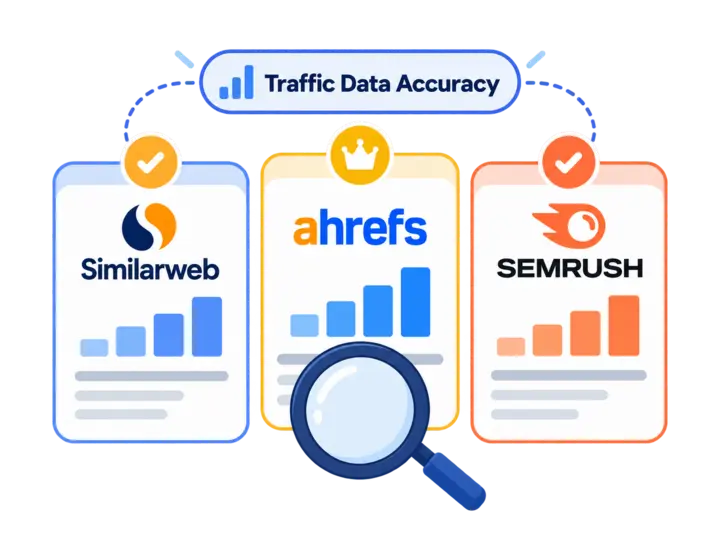
Similarweb’s published data methodology describes a mix of measurement from participating website and app owners, contributor-network signals, partnerships, and public data. Its algorithms transform those inputs into estimates for visits, engagement, geography, devices, and acquisition channels.
This makes Similarweb useful when you need a broad picture of a competitor rather than search traffic alone. It can help answer questions such as which brand is larger, whether a market is growing, which countries matter, and whether direct, referral, search, or social traffic appears to lead.
Where Similarweb Is Strongest
- Comparing overall traffic and market share across established domains.
- Studying channel distribution, geography, audience overlap, and category trends.
- Finding directional changes that deserve deeper investigation.
Where Similarweb Needs Caution
Sample-based models have less evidence for low-traffic websites, narrow local niches, new domains, and small subfolders. Similarweb may show limited or unavailable data when the observed sample is too small.
Treat a precise-looking number as an estimate, especially when the observed sample is limited. Similarweb’s small-site API explanation says the API and platform use the same dataset: a returned numeric value is not evidence of greater precision.
Missing data is not proof that a site has no visitors. Record the unavailable segment instead of converting it into zero. For a niche competitor, inspect visible page topics and search presence before dismissing the business. If you widen the country or period to obtain coverage, label the broader scope; it no longer answers exactly the same narrow question.
Also retain the export date. Similarweb’s methodology FAQ explains reporting timing and filter differences. Avoid comparing an incomplete recent period with a fully released month.
How Ahrefs Estimates Organic Search Traffic
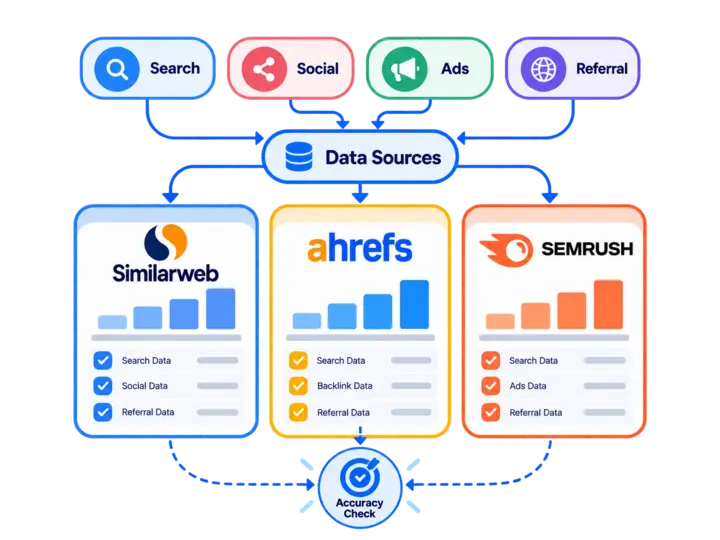
The Ahrefs Organic traffic metric estimates monthly Google clicks for a website, subfolder, or URL. It uses observed keywords, ranking positions, search-volume estimates, and a modeled CTR, then combines the keyword estimates. This is an estimate of a particular acquisition route, not a complete count of the target’s visits.
That approach makes Ahrefs especially helpful for discovering a competitor’s valuable keywords and pages. It is not a complete estimate of all website visits because direct, referral, email, and social traffic are outside the core organic metric. Ahrefs also cannot track every query, and search volume, ranking snapshots, and CTR are themselves estimates.
Where Ahrefs Is Strongest
- Finding the pages and keywords that appear to drive organic search visibility.
- Comparing organic growth trends between competing domains.
- Evaluating backlink profiles alongside ranking and traffic potential.
Where Ahrefs Needs Caution
Do not compare its organic traffic figure directly with a competitor’s total visits. Brand searches, long-tail queries outside the database, fresh ranking changes, SERP features, and country settings can all affect the estimate. The page and keyword breakdown is often more actionable than the headline traffic number.
Inspect whether a change comes from a few terms, a different landing page, or broader visibility across the topic. A new keyword entering the database can change the estimate without proving an equally sudden change in real visits. Record the report’s date and frequency settings, and do not add a sequence of monthly-equivalent estimates as if they were independent daily click counts.
How Semrush Estimates Traffic
Semrush offers two distinct types of traffic estimate, and confusing them is a common source of bad comparisons. Domain Analytics and Organic Research estimate search traffic from keyword positions, search volume, and expected CTR. Traffic Analytics, within the Traffic & Market toolkit, models total visits and channel distribution from anonymized clickstream data and machine-learning systems.
Use Organic Research when you want to inspect Google visibility, keywords, and landing pages. Use Traffic Analytics when you want to compare total visits, engagement, countries, devices, and traffic sources. The two reports can show different numbers for the same domain because they answer different questions. Semrush’s Domain Analytics versus Traffic Analytics explanation documents that distinction, while its traffic-data methodology describes cleaning and modeling clickstream inputs.
Do not interpret agreement between two Semrush panels as independent validation: they are reports within one provider, and their inputs or definitions can overlap. Check which report the export came from. A keyword-based search estimate and a clickstream-based channel estimate may be useful together, but their totals should not be added.
Where Semrush Is Strongest
- Combining SEO, paid search, competitor, and content research in one platform.
- Benchmarking multiple domains across traffic channels with Traffic Analytics.
- Moving from a traffic trend to the keywords and campaigns that may explain it.
Where Semrush Needs Caution
Choose the correct Semrush report before exporting data or presenting a conclusion. Organic Research is not a total-traffic measurement, while Traffic Analytics is not first-party analytics. Smaller domains can also have wider uncertainty because less clickstream activity is available for the model.
When selecting a workspace, list the decisions it must support: identifying competing landing pages, comparing acquisition channels, or following a market over time. Test one representative question in the available account. A wide feature list is not enough if the needed country, history, or export is absent. Conversely, a narrower report can be the better working choice when its scope fits the task and the team can explain its limits.
Which Tool Is More Accurate for Each Marketing Decision?
The best choice follows the metric, site size, and decision. These recommendations are more reliable than naming one universal winner.
Use a comparison specification before judging the output. A worldwide desktop-and-mobile estimate cannot validate a US desktop-only figure. Likewise, the root domain may include a support subdomain or international sections that are outside your intended market. If a matching filter is unavailable, mark the comparison as limited rather than silently substituting a different scope.
| Field | Match or document | Common mismatch |
|---|---|---|
| Metric | Total visits, Google organic clicks, or another named unit | All-channel visits versus search estimates |
| Target | Root domain, subdomain, folder, or exact URL | Entire business versus one content section |
| Market and device | Same country coverage and device set where available | Worldwide traffic versus one-country desktop data |
| Period | Completed dates, frequency, and export date | Partial month versus a historical full month |
| Interpretation | Estimate, observed benchmark, or unavailable value | Treating missing data as zero or a prediction as a count |
The specification also makes disagreement actionable. Resolve a visible scope mismatch first; only then examine model differences. When the uncertainty could reverse your decision, seek permissioned first-party evidence or reduce the commitment. An unsupported narrow range is not more honest than an unsupported exact number.
For Total Website Traffic
Start with Similarweb or Semrush Traffic Analytics. Compare both when the decision involves a large budget, acquisition, partnership, or market entry. If the tools agree on relative size and trend, confidence improves. If they disagree, widen the date range and investigate channel, country, device, and domain-scope differences.
For Organic SEO Opportunity
Use Ahrefs or Semrush Organic Research to identify ranking keywords, high-traffic pages, content gaps, and backlink opportunities. Validate the opportunity with SERP inspection and Google Search Console data from your own site. The winning insight is usually a keyword or page pattern, not an exact monthly-visit total.
For Small or New Websites
All third-party estimates become less stable when traffic or ranking visibility is limited. Look for qualitative evidence such as indexed pages, ranking keywords, branded demand, backlinks, publishing activity, and visible campaigns. Report the traffic number as a directional signal, or use a clearly labeled scenario range when you have a basis for it. The smallest and largest tool outputs are not automatically a statistical confidence interval.
If your wider plan includes a separate US-targeted traffic campaign, evaluate that campaign through its recorded delivery and on-site activity. Do not buy visits to make a public traffic estimate look larger or to prove a vendor model accurate. A short campaign spike may not be visible in a sampled third-party dataset at all.

A Practical Accuracy Test for Your Shortlist
If you have access to first-party data for one or more sites, run a structured benchmark before standardizing on a platform. This does not prove accuracy for every domain, but it shows how each tool behaves in your market and traffic range.
- Match the scope. Use the same root domain or subdomain, country, device, and calendar month in every tool.
- Match the metric. Compare organic estimates with Search Console clicks or GA4 organic sessions; compare total-traffic estimates with total sessions only after documenting definition differences.
- Test several site sizes. Include small, medium, and larger domains instead of drawing a conclusion from one website.
- Measure error and trend. Record absolute percentage difference, but also check whether each platform identifies growth, decline, and relative market position correctly.
- Repeat across several months. A longer window reduces the effect of seasonality, temporary campaigns, and delayed keyword updates.
A hypothetical calculation: compare like with like
Imagine a site with 80,000 recorded GA4 sessions in a completed month. A total-traffic model estimates 100,000 visits; another estimates 92,000. A separate organic-search report estimates 18,000 Google clicks. All figures are hypothetical and are not measured results for Similarweb, Ahrefs, or Semrush.
For the two broadly comparable total-traffic estimates, calculate absolute percentage difference = |estimate − benchmark| ÷ benchmark × 100. The benchmark is the documented observed count, not an assumption of perfect measurement. Differences in visit and session definitions remain a caveat.
| Input | Count | Difference from the 80,000-session benchmark |
|---|---|---|
| First-party benchmark | 80,000 sessions | Reference after checking collection |
| Total-traffic model A | 100,000 estimated visits | 25% absolute difference |
| Total-traffic model B | 92,000 estimated visits | 15% absolute difference |
| Organic-search model | 18,000 estimated Google clicks | Not comparable with the all-channel total |
For model A, the calculation is 20,000 ÷ 80,000 × 100 = 25%. Model B is closer for this one hypothetical observation, but that does not establish a universal winner. Repeat the comparison across permissioned sites, markets, and completed periods, keeping scope and collection limitations visible. If the benchmark is zero, the percentage calculation is undefined; report counts and investigate instead.
Assess trend separately from level. A model can overestimate every month yet still identify a useful rise or fall. It can also get the direction right while overstating its magnitude. Do not apply one site’s correction multiplier to every competitor without evidence that the bias is stable in those settings.
Keep using the same platform for recurring competitor reports unless there is a clear reason to change. Switching datasets mid-report can create an artificial trend that reflects methodology rather than actual market movement.
Common Mistakes When Comparing Traffic Tools
A useful comparison depends as much on the analyst as the platform. Avoid these errors when you interpret Similarweb, Ahrefs, or Semrush data:
- Comparing total visits in one tool with organic clicks in another.
- Mixing worldwide data with a single-country database.
- Using different months, device filters, or domain scopes.
- Assuming a competitor traffic estimate includes conversions or revenue.
- Presenting a modeled number without labeling it as an estimate.
- Choosing a winner from a single site or a single month.
For executive reporting, show relative position, trend, and the basis for any range.
Do not confuse a traffic-value estimate with revenue. Ahrefs defines organic traffic value as an estimated PPC-equivalent cost derived from keyword traffic and CPC. It is not evidence of sales, profit, advertising spend, or a competitor’s conversion rate. For SEO execution, move past the headline estimate and analyze the actual keywords, pages, links, and SERP features that explain the opportunity.
Before committing to a subscription, test whether you can reproduce the report and export the fields the decision requires. Review available markets, device filters, historical depth, and allowances in the current plan. Product menus and packaging change, so this article does not promise a particular feature at a fixed price.
Final Recommendation
Choose Similarweb when your main question is market size, audience, and multi-channel competitive traffic. Choose Ahrefs when organic keywords, pages, and backlinks are the center of the project. Choose Semrush when you want SEO, advertising research, and total-traffic benchmarking in one connected workflow.
For your own website, GA4 and Google Search Console remain the decision-grade sources. For competitors, use third-party estimates as consistent comparative models. Matching the tool to the metric is what turns imperfect traffic data into useful strategy.
Finish with a reproducible decision record. Name the question, selected report, target scope, completed period, observed pattern, supporting evidence, and limitation. Then state the next action: inspect a competitor page, investigate a referral source, or gather better evidence before a larger commitment. This keeps the comparison connected to work rather than ending with three incompatible totals.
For recurring reports, retain both the raw export and the interpretation. If the provider revises historical data or your filters change, annotate the break instead of presenting it as a sudden market shift. A transparent limitation is more useful than an impressive chart that cannot be reproduced.
Use your own channel and source/medium reports to keep a first-party benchmark consistent before comparing external estimates.
Frequently Asked Questions
Quick answers to common questions about Similarweb vs Ahrefs vs Semrush
Accuracy depends on the metric. Similarweb and Semrush Traffic Analytics are better starting points for total traffic and channel benchmarking, while Ahrefs and Semrush Organic Research are more useful for organic keywords and search traffic. Use GA4 and Google Search Console for your own site.
Third-party tools model traffic from samples, keyword databases, clickstream data, and statistical systems; they do not have access to a competitor’s private analytics. GA4 also uses its own tracking, consent, attribution, time-zone, and session rules, so an exact match is not expected.
The Organic traffic metric in Ahrefs Site Explorer estimates Google search clicks, not total visits across every channel. Site Explorer also has separate paid-search reporting. Keep these estimates distinct from direct, referral, email, and social visits when comparing totals.
Similarweb can provide useful directional data, but estimates are generally less stable when a site has limited observed traffic. For small or new domains, use ranges and supporting signals such as rankings, backlinks, branded demand, and publishing activity.
Use the same country, device, date range, and domain scope in every tool, and compare like-for-like metrics. Focus on relative scale, trends, channel share, keywords, and pages instead of presenting a third-party visit estimate as an exact total.
No. Missing data can reflect limited coverage or insufficient observations for that target and segment. Record it as unavailable, check the selected scope, and look for supporting evidence rather than assigning zero traffic.
Not automatically. First match the metric, target, market, device, and period. Averaging total visits with estimated search clicks produces a meaningless result. Even matched vendor estimates may share biases, and their spread is not a statistical confidence interval.
For a documented, broadly comparable benchmark greater than zero, use absolute percentage difference = absolute value of estimate minus benchmark, divided by benchmark, multiplied by 100. Check collection and definition differences first; one result does not establish universal accuracy.
No. A traffic-value metric generally estimates a keyword traffic profile's equivalent advertising cost under the provider's method. It does not reveal actual sales, margins, customer quality, or profit. Read the metric definition before using it in a business case.
They use different estimation methods and scopes. Keyword-based search research models traffic from ranking positions, volume, and expected CTR; Traffic Analytics models a wider channel mix from clickstream data. Match report names and filters before comparing them.




Comments
Leave a Comment