


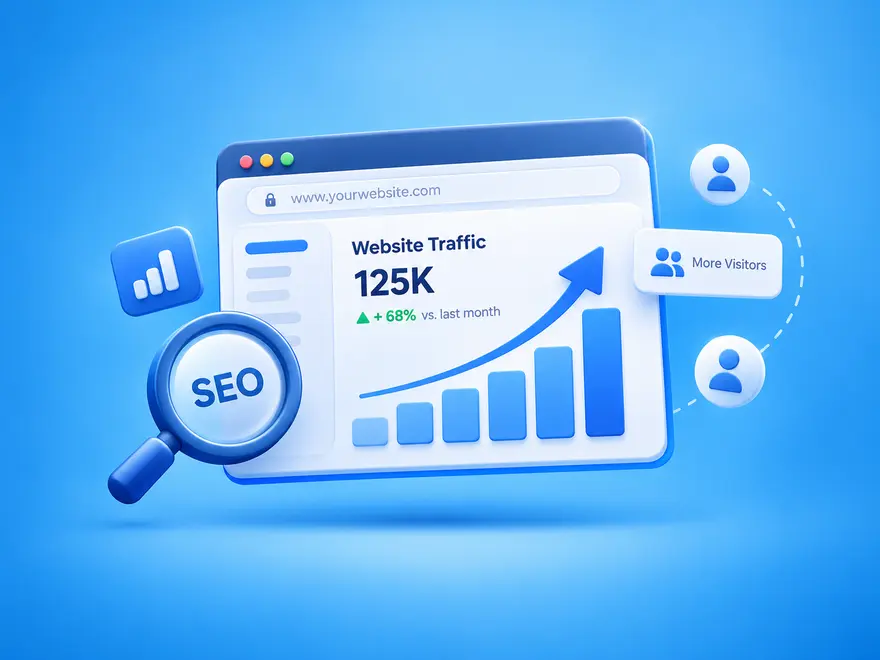
Build a practical website traffic plan with useful content, search visibility, social distribution, email, local discovery and partnerships. Prepare landing pages, run bounded paid tests, and measure relevant visits and business outcomes separately.
To increase website traffic, connect a real audience need with a useful page, make that page discoverable, and promote it through a suitable channel. Improve organic search access and content where people already search; use social, email, partnerships, events, or a carefully measured paid campaign when they offer a relevant route to the audience.
The aim is not the largest possible session count. It is more appropriate visitors who can complete a valuable action, such as a purchase, qualified enquiry, subscription, or useful download. Buying visits does not buy organic rankings, and a higher traffic total does not automatically mean more customers.
This guide takes you from audience and landing-page preparation to channel selection, distribution, and measurement. Start with the biggest verified bottleneck rather than trying every tactic at once. If your main challenge is bringing an existing audience back, use our separate guide to increasing returning website visitors.
Start with the audience, destination, and action
Replace “we need more traffic” with a decision you can actually make. Identify the person you want to reach, the problem that makes your page relevant, and the next action that benefits both the visitor and the business. A product comparison, a service enquiry, and a tutorial download require different messages and destinations.
Write a short acquisition brief before producing more content: “Reach independent retailers comparing inventory software, send them to our migration guide, and measure qualified demo requests.” Add an owner, resource limit, and review date. This makes it possible to reject tactics that attract attention without serving the intended audience.
Check the destination first. Can a visitor understand the promise, access the page on a phone, and complete the action? Test the form and its confirmation. A promotion plan cannot compensate for an unavailable product, a broken signup, or an offer that the audience does not understand.
Understand website visits, Google traffic, and your baseline
Website traffic includes visits from search, social networks, email, partner websites, advertising, and other routes. Users, sessions, and page views answer different questions: one person can generate several sessions, and a session can include several page views. Choose the unit that matches your decision instead of using these terms interchangeably.
“Google traffic” is also ambiguous. Unpaid Google Search visits and paid Google Ads visits are different acquisition routes. In GA4, correctly collected organic search activity may appear as google / organic; advertising requires the appropriate integration or campaign tagging. A service name containing “Google” or “organic” does not establish how a visit was acquired.
Record the current landing pages, acquisition sources, useful actions, and resource costs before changing the plan. Use comparable periods, note promotions and tracking changes, and separate branded from non-branded search needs where relevant. For a new site with little data, begin with customer questions and a small, clearly scoped distribution test rather than pretending that an empty report proves there is no demand.
Choose a traffic source for the job it can do
A channel is a route to an audience, not a guarantee of quality. Choose one primary route and, if capacity allows, one supporting route. Use the comparison to narrow the options before writing a detailed schedule.
| Route | Useful starting situation | Asset or prerequisite | Evidence to review |
|---|---|---|---|
| Organic search | People already search for the problem you solve | A relevant, accessible page and capacity to maintain it | Relevant search queries and clicks, then useful on-site actions |
| Social distribution | The audience discovers ideas through a suitable network | Platform-native content and a matching destination | Tagged visits and actions, not platform views alone |
| Editorial and partner referrals | A publication or partner serves an overlapping audience | A resource worth recommending and relevant outreach | Referring context, visits, and qualified enquiries |
| People have chosen to receive relevant updates | A permission-based list and a clear subscription promise | Link visits and useful actions; unsubscribe patterns as a guardrail | |
| Paid distribution | A defined offer needs a bounded, measurable test | Budget, a prepared landing page, and outcome tracking | Cost per qualified outcome with delivery measured separately |
Existing resources matter. A team with strong subject expertise but little media budget may begin with a focused resource and partner distribution. A time-sensitive offer may justify a paid test. Neither choice eliminates the need for a useful page, and neither implies that the alternative is universally less effective.
Prepare a landing page that delivers on the promise
A targeted landing page is simply a destination built around a particular audience, offer, and next step. It does not have to be a new URL for every campaign. An existing guide or product page may be the right destination if it answers the promise made in the ad, email, or recommendation.
Review the complete journey before increasing distribution. A visitor should understand who the page is for, what they will receive, what limitations apply, and what happens after the main action. Use these checks to find a concrete obstacle, not to justify redesigning a page that already works.
- Message: Repeat the substance of the original promise in a clear headline and opening explanation. Do not send a product-specific promotion to an unrelated homepage.
- Evidence: Use relevant demonstrations, accurate specifications, and genuine testimonials where available. Do not invent customer results or scarcity.
- Eligibility: Explain service areas, compatibility, availability, shipping, pricing conditions, or other constraints that affect the decision.
- Action: Make the next step specific, such as requesting a demo or checking availability. Ask only for information needed at that stage.
- Completion: Test the form or checkout, confirmation, follow-up, and measurement. A button click is not proof of a successful submission or purchase.
For example, a campaign promising an inventory-migration checklist should lead to that checklist and explain its scope before asking for a demo. If many enquiries concern unsupported software, clarify compatibility first. More traffic cannot repair a misleading promise; improving the handoff may be the more useful first action.
Build pages that can earn relevant search visits
Organic acquisition starts with answering an actual need on a page that search engines can discover and people can use. These improvements form a foundation; they are not a promise of indexing or a timetable for ranking.
Target a task, not a collection of keyword variants
Start with customer questions, product comparisons, support conversations, and relevant Search Console queries. Inspect what the query asks the reader to do. Someone comparing options needs trade-offs; someone troubleshooting needs a diagnostic path. A page can mention the right phrase and still fail to answer the task.
Group close wording around one coherent answer. “Website visits,” “website visitors,” and “website traffic” do not automatically justify three near-identical guides. Create a separate page when the task changes, such as measuring traffic, recovering lost search clicks, or bringing an existing audience back.
Google Trends can help explore relative interest, while advertising keyword tools provide estimates with their own scope. Treat proposed long-tail phrases as research hypotheses until you have relevant evidence. A low-competition-looking phrase is not valuable if it attracts the wrong audience.

Create an answer worth visiting and recommending
Put the main answer near the beginning, then explain the method, example, limitations, and next step. Include material that makes the task easier: a usable worksheet, a clear comparison, a demonstration, or first-hand evidence you can substantiate. Do not add invented case studies or statistics to make the page appear authoritative.
There is no word-count threshold that guarantees search success. Google’s people-first content guidance is a useful check: would the audience find the page satisfying without needing another search? Add depth where it resolves uncertainty, and remove paragraphs that restate the introduction.
Improve an existing page when the opportunity is real
A page already attracting relevant impressions may need a missing comparison, clearer instructions, or corrected information rather than another competing article. Confirm the problem before rewriting. A drop in clicks can also reflect changing demand, indexing problems, or a different search-results presentation.
Record the baseline, the changes, and the relevant query group. Review comparable periods later without treating every difference as the result of the edit. Use a page-level baseline and a clear hypothesis rather than changing every section at once.
Make the title, description, and internal links useful
The title should identify the answer and its scope. The description should explain why the page is useful, without promising a result the content cannot deliver. Search engines can choose different title links or snippets, so the text you enter is not a guaranteed display format.
Link from relevant existing pages using descriptive anchors and a genuine reason to continue. A product explanation might link to a compatibility guide; a beginner article might link to a detailed implementation tutorial. Internal navigation helps people find the next answer instead of leaving a useful resource isolated.
Remove access and usability obstacles
Investigate unavailable URLs, unintended noindex directives, confusing redirects, and inaccessible important content. Use URL Inspection for an individual page’s search-access questions. Check the live user journey separately: readable text, stable layout, working controls, clear costs, and a usable mobile form.
Prioritize obstacles that block the task. Fixing an inaccessible enquiry form may be more urgent than producing another article. Speed improvements can help the experience, but a faster irrelevant page still does not solve the visitor’s problem.
Use local discovery when the business and audience qualify
For a business serving a real local area, discovery in Google Search and Maps may be more relevant than broad national exposure. Keep business details, hours, contact options, and the destination page accurate. Check Google Business Profile eligibility before assuming that an online-only business can create a profile.
Google’s local ranking guidance describes relevance, distance, and prominence. Explain the services you actually provide and the places you genuinely serve; do not manufacture addresses, duplicate city pages, or promise a ranking from purchased visits. Respond professionally to genuine reviews without treating them as a guaranteed traffic lever.
Match the destination to the local task. A repair enquiry needs service coverage, availability, and a working contact route; a shop visit needs dependable opening and location information. Review suitable enquiries or fulfilled bookings, not website clicks alone. Our local SEO guide covers the implementation in more detail.
Reach people who may not discover you through search
Useful distribution introduces a resource in a context where the audience already pays attention. Adapt the message to that context instead of posting the same promotional link everywhere. The click should lead to more of the value promised, not a different offer.
Turn one useful resource into suitable video or audio
Choose a format that improves the explanation. Demonstrate software in a recording, discuss a complex decision in an interview, or show a practical process in a short video. The adaptation should work on its own while giving interested viewers a clear reason to visit the supporting page.
Use a specific destination in the description or show notes where the platform supports it. A video view or podcast play is not a website visit. Measure the resulting visits and actions separately, and do not assume that embedding audio produces an automatic SEO benefit.
Offer a resource people can use, not just download
A checklist, worksheet, template, or focused ebook can help a reader complete the task. Provide instructions, an appropriate example, and a link to the supporting page. Do not merely paste a long article into a PDF and assume the format creates value.
If access requires an email address, explain what will be delivered and whether additional messages are optional. A download does not prove purchase intent. Review whether recipients use the resource, return for relevant help, or request a suitable service.
Participate in the right social communities
Find communities where the intended audience actually discusses the problem. Answer in the platform’s native format and respect its rules. Add a link when the destination supplies useful detail, not as a substitute for answering the question.
Compare a small number of relevant formats before expanding production. For example, an annotated demonstration and a professional discussion may attract different visitors. Our social-media traffic guide covers execution; keep the overall acquisition plan focused on the role of that channel.
Choose the network before committing to a publishing format. A destination should answer the specific question raised in the post; sending every audience to the homepage makes relevance harder to evaluate.

Earn relevant recommendations and evaluate partnerships
Offer a publication or partner something worth recommending to its audience: a documented resource, an interview, an original tool, or a useful contribution. Explain the audience fit in outreach. Mass-produced pitches and bulk forum signatures are not a substitute for relevance.
An affiliate arrangement is a separate commercial relationship. Define eligibility, commissions, attribution, disclosures, and the cost of refunds or support before launching one. A digital product does not have zero operating cost, and a large commission does not guarantee profitable acquisition.
Keep editorial references distinct from paid placements. Follow Google’s link-spam policies and qualify commercial links appropriately. Evaluate actual referral value rather than promising ranking gains from link volume.
Plan creator collaborations and digital PR around audience fit
A creator’s follower count is not a reliable forecast of website visits or suitable customers. Review the topics they cover, the people they reach, their approach to recommendations, and the relevance of their previous work. Third-party audience estimates can help shortlist partners, but they are not verified first-party campaign results.
Agree on the deliverable, publication window, destination, compensation, content-use rights, and reporting before production. Define the question the collaboration should answer: can a useful demonstration introduce the offer to an appropriate audience? Use consistent campaign identifiers when appropriate and evaluate suitable actions after arrival, not likes alone. Follow applicable disclosure rules and qualify paid links according to Google’s guidance.
For digital PR, give the publisher a concrete reason to refer readers: documented research, an expert explanation, or a resource that helps their audience. A personalized, relevant pitch is more useful than bulk outreach. Neither a sponsored mention nor a large volume of links guarantees organic visibility.
Give events and webinars a useful destination after the live session
A workshop can create several legitimate reasons to visit: checking the agenda, registering, accessing the replay, and using a supporting worksheet. Make the registration page clear about the intended audience, the session outcome, and practical requirements. Do not use an event merely as a reason to collect an unrelated mailing list.
After the session, publish the promised replay or resource with an accurate summary and a relevant next step. Send follow-up only where appropriate to the participant’s choices. Use distinct campaign links for invitations and replay distribution so the team can distinguish initial interest from later use.
Measure completed registrations, attendance where available, relevant site visits, and the next meaningful action separately. A registration is not attendance, and attendance is not a sale. Keep the full event-production checklist outside the general acquisition plan; the key decision here is whether the event creates useful discovery for an audience you can serve.
Use follow-up and paid campaigns for clearly defined purposes
Acquisition does not end at the first click, but bringing someone back is a different job from finding a new audience. Keep those roles visible in your plan and reporting. The following methods complement discovery rather than replacing it.
Give interested subscribers a useful next visit
Offer a subscription with a specific promise, such as a practical monthly guide or a relevant product update. Match the destination to the subscriber’s interest, respect their preferences, and make unsubscribing straightforward. Avoid treating every address collected for another purpose as permission for marketing.
Keep the detailed retention sequence in the returning-visitors guide. Here, the acquisition decision is whether the page offers a sensible, optional way to continue the relationship.
Run a limited paid test on a prepared landing page
Search advertising, social advertising, sponsorships, and standalone traffic campaigns use different acquisition mechanisms. Identify the actual method, available targeting, billing, and reporting before comparing results. A product label containing “organic” does not establish independently earned search traffic.
Google states that investment in paid search does not affect organic ranking. Treat advertising as a separate acquisition activity, not a way to make Google index a page or reward configured engagement. A third-party delivery campaign is not interchangeable with search advertising or independently earned organic demand.
Set a spending limit and a useful outcome before delivery starts. Track the campaign separately, allow for an appropriate decision lag, and inspect lead quality or completed purchases where available. More recorded visits do not prove incremental sales, profitability, or an improvement in organic ranking.
Before choosing automated delivery, understand how traffic bots work and the risks. Synthetic visits can check technical behavior, but they do not establish audience demand, qualified leads, or an SEO benefit.

Make the next step easy without manufacturing extra visits
Make the resource easy to find again and connect it to relevant supporting pages. Do not split a simple answer across unnecessary pages merely to increase page views. A visitor who quickly completes the intended task may be better served than someone who navigates extensively because they are confused.
An app is worth considering only when a recurring task justifies its development and maintenance. Building one solely to place a website link in an app store is not a dependable acquisition plan. The same principle applies to every format: choose it for the audience’s need, not for a traffic shortcut.
Turn publication into a focused distribution workflow
Publishing a useful page is one step, not the whole acquisition plan. Prepare a short distribution brief for that page so the team knows what to do next and what evidence to collect. Avoid copying a checklist across every URL without considering the audience.
- State the audience, the page’s promise, the main action, and the person responsible.
- Connect the page from relevant navigation or existing content using descriptive links.
- Select one primary distribution route and prepare a message that suits that context.
- Check the destination, external campaign identifiers, and action tracking before launch.
- Record production time, fees, and spend alongside the useful outcomes you can verify.
- Set a review date appropriate to the channel and the amount of evidence, then decide whether to continue, revise, or stop.
Use customer feedback and early observations to refine the promise, but do not call every difference a successful test. If you change the audience, message, offer, and landing page together, you cannot confidently attribute the outcome to one change. Keep experiments focused enough to support the next decision.
A hypothetical acquisition plan: audience to useful action
Imagine an inventory-software company whose migration page gets little relevant attention. This is a hypothetical planning example, not a reported SEOVisitor result. The team wants suitable retailers to request a demo after understanding migration requirements, rather than maximizing downloads from any audience.
The team improves the guide with a preparation checklist, limits and compatibility information, and a clear demo route. It then publishes a short demonstration for an appropriate professional network and offers the checklist to a relevant retail association. Each external campaign uses consistent tracking parameters and a destination that fulfills the original promise.
Before distribution, the team tests the form, records a baseline, defines a qualified enquiry, and assigns a review date. Search Console is used for the guide’s relevant search queries and clicks; GA4 is used for recorded landing-page sessions and configured useful actions. Sales qualification is checked separately because a submitted form is not automatically a good prospect.
For the association’s email, the hypothetical tagged link could use utm_source=retail_association, utm_medium=email, and utm_campaign=migration_guide. Use a separate source and medium for the professional-network post. Agree on consistent naming, never put personal information in parameters, and do not tag internal navigation as a new acquisition campaign.
The primary outcome is a verified demo request from a retailer whose requirements the product can serve. A completed download is a supporting action, not a substitute. The review records publishing time, partner fees if any, campaign spend, relevant enquiries, and subsequent qualification. If there are too few outcomes to judge the cost reliably, report that uncertainty instead of presenting a single lead as proof of a winning channel.
If promotion produces visits but few appropriate enquiries, the next question concerns message, audience, and offer fit—not immediately more traffic. If useful enquiries appear but their acquisition cost exceeds the business’s limit, revise the economics or stop that test. The example deliberately supplies no invented conversion uplift.
Measure search visibility and on-site outcomes separately
Use the same business question across reports, but respect each tool’s scope. Search visibility, a recorded visit, and a qualified business outcome are different stages. A campaign dashboard should make those stages clearer rather than force their totals to agree.
Use Search Console for relevant Google Search exposure
The Search Console Performance report shows clicks, impressions, CTR, and average position for Google Search. Review the relevant page and query group, then country and device when needed. Compare the same search type and suitable periods; site-wide averages can hide a change in the audience reaching one page.
Falling impressions, lower CTR, and fewer useful enquiries do not imply the same cause. A broader query mix can increase impressions while lowering aggregate CTR. A change in position or search-result presentation can also affect clicks. Use those observations to choose the next check rather than rewriting a title automatically.
Use GA4 for acquisition, landing pages, and useful actions
GA4’s Traffic acquisition report uses session-scoped acquisition dimensions and includes sessions from new and returning users. Compare session source/medium or campaign, then examine the relevant landing page and outcome. Do not mix first-user acquisition with session acquisition and assume they answer the same question.
Test that important events record the intended completed action. A repeatedly fired event can inflate apparent success. Check accepted leads, fulfilled orders, refunds, or other business records where relevant. Engagement is useful context, but a long session is not proof of buying intent and a short successful visit is not necessarily a problem.
Keep Google Search clicks distinct from GA4 sessions. Consent, blocked collection, redirects, time zones, and reporting definitions can contribute to differences. Campaign tags describe acquisition; they do not prove that the campaign caused an outcome. Report attribution limitations and delayed decisions rather than assigning every sale to the last visible click.
Review the bottleneck before expanding the plan
Separate delivery, engagement, and business outcomes. A resource can be distributed successfully yet attract an unsuitable audience. A page can attract suitable visitors but fail because the promised action is unclear or unavailable. Diagnose the step that is actually failing.
| Observation | Check next | Possible decision |
|---|---|---|
| Little relevant search exposure | Access, indexing, query relevance, and demand | Resolve a verified obstacle or reconsider the page’s task |
| Promotion gets attention but few site visits | Link placement, message, and reason to click | Improve the handoff rather than counting platform reach as visits |
| Visits arrive but useful actions are scarce | Audience fit, destination, offer, and event implementation | Fix the verified mismatch before scaling |
| Enquiries arrive but are unsuitable | Qualification criteria and campaign targeting | Narrow the promise or distribution route |
| Suitable outcomes cost too much | Full campaign costs and downstream value | Change the test or stop an uneconomic route |
When the evidence is limited, make the uncertainty part of the decision. A small number of enquiries may justify another capped learning cycle, but it does not establish a predictable acquisition cost. If tracking is broken or the offer cannot serve the audience, pause distribution until the specific issue is resolved.
A practical work cycle is to prepare the audience and measurement first, improve one destination, distribute through one suitable route, and review the evidence before expanding. Set the review window from the task and available data rather than promising search results within a fixed number of days. Record what changed and what you will do next.
Maintain useful pages and the acquisition routes that support them
Assign an owner to important destinations after the first campaign. Review availability, links, forms, screenshots, product information, and tracking when the underlying information changes. Correct a broken action promptly; rewrite a useful explanation only when there is a real gap, not simply to create the appearance of freshness.
Keep a change log with the affected page, date, reason, and expected effect. If a page loses useful visits, check relevant query/page evidence and recent site changes before concluding that the channel has stopped working. A maintenance routine should protect accurate information and a working journey, not generate unnecessary edits.
Use successful observations to guide the next resource or partnership while retaining channel diversity. Dependence on a single platform can leave the plan exposed to changes outside your control. Diversification is useful only when each route reaches an appropriate audience at a defensible cost; adding channels without capacity to serve them is not resilience.
Choose the next action that removes the real bottleneck
The strongest traffic plan joins a clear audience, a useful destination, relevant distribution, and honest measurement. Start with one page and one acquisition question. Improve what is preventing the right visitor from finding, understanding, or using that page, then expand only when the evidence supports it.
More visits are an opportunity, not a guaranteed result. Keep paid delivery separate from organic search, evaluate business value as well as volume, and give existing visitors a reason to return without turning every page into another generic traffic guide.
Frequently Asked Questions
Quick answers to common questions about how to increase website traffic
Start with a defined audience, a useful destination, and a measurable action. Choose a channel that fits that task, then review relevant visits and outcomes before expanding the plan.
Yes. Helpful content, technical SEO, internal links, relevant referrals, community participation, and an opt-in newsletter can attract visitors without advertising fees. They still require time and effort, and results are not guaranteed.
No. There is no ideal word count that guarantees rankings. Use the length needed to answer the question clearly, add useful examples, and remove repetition or outdated information.
It depends on the channel, existing audience, competition, and work required. A campaign can begin delivering visits sooner than a new SEO page gains visibility, but meaningful evaluation needs enough data and a defined outcome.
Review the source and targeting before starting, use a limited test, and measure relevant actions on the landing page. Compare cost per qualified outcome where possible. Purchased visits do not guarantee sales or better organic rankings.
No. More visits help only when the audience, destination, and offer fit together. Review qualified enquiries or completed purchases and their costs, rather than assuming every additional session has equal business value.
Check audience relevance, message-to-page fit, the offer, the working enquiry path, and measurement. Increasing distribution before resolving a verified mismatch may add volume without useful outcomes.
No. Acquisition introduces people to the site, while retention serves an existing audience with a useful reason to return. Plan and evaluate those jobs separately.
Use Search Console for relevant Google Search clicks, impressions and query/page performance. Use GA4 session acquisition and landing-page data for recorded visits and useful actions, keeping paid campaigns separate. Search clicks and sessions have different definitions and are not expected to match exactly.
Choose by audience fit, search intent, business relevance and the evidence available, not volume alone. Specific questions can reveal a clearer task, but long-tail phrases are not automatically easier or more profitable. Group close variants on one useful page and create separate pages only when the task genuinely differs.


Comments
Leave a Comment