



Compare organic and paid traffic by discovery, audience intent, channel fit, and conversion quality. Use practical selection checks and a cautious paid-search overlap investigation, with examples and measurement limitations.
Organic traffic comes from unpaid search results; paid traffic comes from distribution you purchase, such as search ads or social ads. The practical difference is not simply “free versus paid.” It is how people discover the page, what you can control, how the cost is incurred, and what evidence you need before calling the channel successful. Neither source guarantees qualified customers.
Use organic search to answer relevant, recurring searches with useful pages. Use a paid channel when its audience, timing, and destination fit a specific campaign. If you already rank organically, ask whether an additional ad reaches people you would otherwise miss—not just whether the ad dashboard records conversions. This guide compares the channels and explains that overlap. For spending decisions, use our complementary guide to allocating budget and time between organic and paid traffic.
What counts as organic traffic and paid traffic?
These labels describe acquisition, not the quality of the visitor. A person from either channel can be a good prospect, an unsuitable visitor, or someone who only needs a quick answer. Start by identifying the actual source rather than assuming that “organic” means valuable or “paid” means ready to buy.
Organic search traffic: a visit from an unpaid result
Organic search visitors arrive after clicking an unpaid search listing. SEO helps make suitable pages accessible, understandable, and useful for those searches. Content production, technical work, and maintenance still cost money and time; the absence of a per-click media charge does not make the work free.
Organic search is also different from organic social reach. An unpaid LinkedIn post can send social or referral visits, but those visits are not unpaid Google Search clicks. Likewise, “direct” in an analytics report does not automatically mean the visitor discovered the business organically. Keep acquisition categories separate when evaluating the audience.
A useful page may keep earning search visits after publication, but this is not guaranteed. Demand, competing pages, indexing, and the presentation of search results can change. The durable asset is the page and its usefulness, not a permanent entitlement to traffic.
Paid traffic: several distribution methods, not one product
Paid search ads reach people through advertising placements associated with searches. Paid social and display campaigns reach audiences through other placements and targeting options. Sponsorships and standalone website-traffic campaigns use different delivery methods again. The targeting available, reporting, billing, and visitor intent depend on the actual channel and campaign.
Do not treat a purchased traffic package as equivalent to a Google Ads search campaign. Ask how visits are acquired and identified, and which useful actions can be measured. A service name containing “organic” or “keyword” does not establish that the resulting activity represents independently earned search growth.
Paid distribution can begin relatively quickly once an eligible campaign is running. That describes delivery, not the speed of profitable acquisition. Ads may fail to attract the right audience, and visitors may reject an unclear offer. In general, the campaign’s new paid delivery ends when its spending ends; later return visits are a separate outcome to investigate.

Organic vs paid traffic: the differences that matter
Compare the mechanism before comparing results. Search intent, the page’s purpose, and the measurement setup matter more than a generic claim that one channel has better conversion rates. The same business may need both, or may have a good reason to concentrate on one.
| Dimension | Organic search | Paid distribution |
|---|---|---|
| Discovery | A page appears as an unpaid answer to a search | A purchased placement or delivery method introduces the page |
| Control | You improve the page, but cannot buy its organic position | You control eligible campaign settings, not every impression or conversion |
| Timing | Discovery, indexing, and exposure have uncertain timelines | Delivery can begin sooner; useful outcomes remain uncertain |
| Cost | Production, technical work, tools, and maintenance | Media or package cost, creative, management, and measurement |
| Visitor intent | Depends on the search and the page’s relevance | Depends on the placement, targeting, message, and acquisition method |
| Evidence | Search visibility plus recorded on-site outcomes | Delivery records plus separately measured on-site outcomes |
The table is a comparison, not a ranking. An organic how-to reader and a paid product-search visitor may be at different stages of a decision. Comparing their immediate purchase rates without that context can make a useful educational page look unsuccessful or a narrow branded campaign look unusually effective.
Match the channel to the visitor’s decision, not just the audience label
The same person can encounter a business through several channels with different needs. Someone searching for a repair service today has a different task from someone browsing an educational social post. The audience’s location or age alone does not tell you how ready that person is to act.
Map three things together: the question or message that introduces the visit, the destination that resolves it, and the next action. A nonbranded search such as “how to choose a laptop bag” calls for an explanation of fit and trade-offs. A search for a specific model may call for a product page. A social ad introducing an unfamiliar product needs enough context to explain why the visitor should care.
Do not assign entire funnel stages rigidly to channels. Paid search can serve research queries as well as purchase queries; organic search can lead directly to a product purchase. Paid social can reach existing customers or introduce a new offer. The placement and message shape the visit, but they do not prove the visitor’s intent.
Use a small message-to-page checklist before choosing the route:
- Expectation: What question, promise, or offer brought the person here?
- Answer: Can the landing page resolve that expectation without making the visitor search again?
- Eligibility: Are location, availability, price conditions, and service restrictions clear?
- Next action: Is the requested commitment appropriate, such as reading a comparison before requesting a demo?
- Evidence: What recorded action would indicate a useful visit, and what requires later qualification?
If the destination fails this check, repair the mismatch before judging the channel. A high-intent paid visitor can still reject a confusing page, while a useful organic explanation may succeed by helping someone make a decision without immediately purchasing.
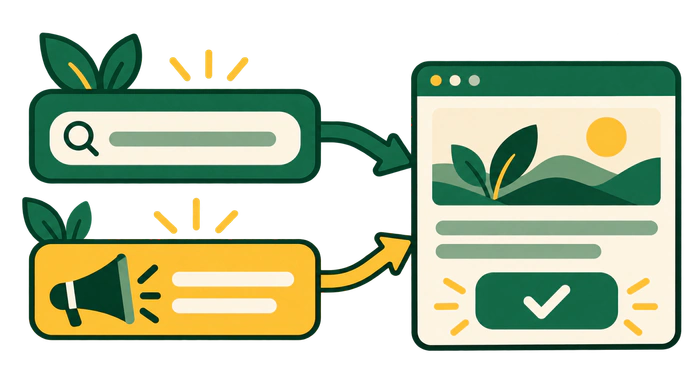
Which channel converts better? Compare equivalent audiences first
There is no universal conversion-rate winner between organic and paid traffic. A campaign focused on a known brand and an organic guide attracting early-stage questions do not represent the same audience. Their differences in outcome may reflect intent and familiarity rather than an inherently superior acquisition method.
For a fairer descriptive comparison, specify the same business action, compatible landing-page purpose, geography, device, and period. Separate returning customers where the data allows. Keep branded searches distinct from category searches and prospecting activity distinct from campaigns aimed at an existing audience. If the samples remain different, describe the difference instead of presenting a league table.
Define the rate’s denominator explicitly. GA4’s session key event rate describes the share of sessions in which a selected key event occurred. Dividing event counts by sessions is not necessarily the same calculation, because one session can trigger the event more than once. A business qualification rate may instead use distinct validated enquiries; explain that definition and its data source.
Review the next stage as well. A source can generate many forms but few suitable prospects, or fewer forms with more completed sales. Investigate duplicate submissions, irrelevant requests, cancellations, and the time needed for an enquiry to become a customer. This is a quality check, not permission to invent a visitor’s intent from engagement time.
Use engagement as context. Someone may read briefly and find a phone number, or spend a long time because the instructions are confusing. Neither a short session nor a long session proves the value of the visit by itself. Document the action that matters before choosing a source based on attractive engagement statistics.

When should you use organic traffic, paid traffic, or both?
Choose a channel for a job, not because a launch, growth, or maturity label supposedly requires a particular percentage. The following situations help distinguish the choice of channel from the later task of allocating resources.
A recurring question with no urgent deadline
A customer repeatedly searches how to choose a suitable product or solve a service problem. A clear comparison or explanation can be a useful organic destination if it fits what searchers need. First assess whether the business has the expertise and resources to produce a worthwhile answer. Publishing more generic articles is not an organic strategy.
Paid promotion can introduce that resource to an appropriate audience, but this has a different success measure. A promoted guide might aim for a useful download or qualified enquiry rather than immediate sales. Evaluate the promotion itself; do not infer a ranking benefit from its visits.
A launch or offer with a limited window
A time-sensitive event, new offer, or market test may need distribution before organic visibility develops. A suitable paid campaign can reach a defined audience during that window. The destination must explain the offer, eligibility, and next action clearly. If those basics are missing, rapid delivery mainly exposes more people to an unresolved problem.
Keep the landing page useful after the campaign where appropriate. Questions raised during the promotion can inform future content, but responses from a selected paid audience may not represent all searchers. Validate the need before turning every ad message into an SEO article.
Existing organic visibility with an unanswered commercial question
Already ranking does not automatically make advertising wasteful—or necessary. An ad might communicate a different offer, reach additional eligible searches, or occupy a placement that matters to the campaign. It might also collect clicks from people who would have chosen the unpaid listing anyway. The right question is what additional outcome the ad produces in that context.
Once the channel’s job is clear, the separate resource decision follows. Our budget guide explains how to set acquisition ceilings, protect editorial time, and define review rules without prescribing a universal split.
Use that guide for the next dollar and hour. The rest of this article focuses on interpreting the relationship between paid search and the unpaid visibility you already have.

Does paid traffic help SEO?
Paid distribution and organic ranking are separate mechanisms. Google explicitly states that advertising with Google does not affect a site’s presence in its search results. Buying visits, extending session duration, or changing a bounce-rate report is not a demonstrated method for buying a higher organic position.
Useful learning can travel between teams. An ad campaign may reveal an unclear benefit, a recurring customer objection, or a landing-page problem. Improving the page in response may help readers across channels. The improvement still needs to stand on its own; the ad clicks are not proof that Google rewarded the page.
Similarly, an organic traffic decline needs its own investigation. Additional paid visits can be a separate business continuity decision, but they do not repair indexing, relevance, or technical problems. Report the paid activity separately so a higher total session count does not hide unresolved search performance.
Should you run search ads when you rank organically?
Separate branded searches, which contain your business or product name, from nonbranded searches that describe a category or problem. A branded visitor may already know the destination; a nonbranded visitor may still be choosing a provider. Mixing them can hide substantial differences in the role of advertising.
Check the actual search results, relevant landing pages, device, and geography. A page with strong organic visibility might still fail to explain a time-sensitive offer. Conversely, an ad with many attributed purchases might mostly intercept existing demand. Neither observation alone establishes whether the campaign creates incremental value.
Google’s paid and organic report can help examine text-ad and organic search presence after eligible account linking. It does not cover every ad format, and the organic history starts when importing begins. Use it to identify overlap and gaps, not as an automatic experiment proving that ads caused extra sales.
Attribution tells you who receives credit; incrementality asks what changed
Attribution assigns credit among recorded interactions. Someone could find a guide organically, return through a search ad, and then purchase. A report’s credit allocation depends on its scope and attribution rules. Google’s GA4 attribution documentation explains that changing the reporting model affects event-scoped reporting, not user- or session-scoped traffic dimensions.
Incrementality asks a different question: how many useful outcomes would not have happened without the ads? A suitable controlled comparison is stronger evidence than a simple before/after chart. Eligible Google Ads accounts may use Conversion Lift, which compares exposed and control groups. Availability and study feasibility are limited; do not assume every small campaign can run such a study.
When a controlled study is not feasible, document a narrower conclusion. Review comparable periods, stable targeting, branded and nonbranded activity, and total qualified outcomes. Promotions, seasonality, competitors, consent changes, and conversion lag can explain differences. A directional review can support a cautious decision without proving causation.

Build an overlap investigation before changing search ads
A useful investigation starts with a specific campaign question, not a blanket instruction to switch ads off. For example: “Does this branded search campaign add qualified purchases beyond our existing organic visibility in the markets where it runs?” Keep the scope narrow enough that the evidence can answer it.
| Observed pattern | Next check | Conclusion to avoid |
|---|---|---|
| Branded ad clicks rise while organic clicks fall | Relevant query mix, comparable markets/devices, and combined search activity | The ad caused an organic ranking loss |
| Ad-attributed purchases rise but validated orders stay flat | Duplicate credit, attribution windows, sales lag, and order records | Every credited purchase is an additional customer |
| Nonbranded ads reach queries with little organic exposure | Audience relevance, destination fit, and existing organic coverage | Paid delivery guarantees future organic rankings |
| A controlled estimate is uncertain | Data sufficiency, spillover, and disruptions to the comparison | Inconclusive evidence proves zero effect |
These patterns direct attention to the missing evidence. They do not replace a study design or justify an automatic spending change. Use the following steps to connect the observation with a question that can actually be investigated.
- Define the population. List the relevant query group, campaign, country, device, and landing pages. Check actual ad search terms where available; an account keyword is not a complete description of every query that triggered it.
- Record the context. Note organic visibility, offer changes, other promotions, stock or capacity restrictions, and measurement changes. Save the baseline rather than reconstructing it after a surprising result.
- Choose evidence proportionate to the claim. Use an eligible lift study or a professionally designed controlled comparison for a causal question. Define the outcome, acceptable risk, and data requirements before launch.
- Protect the interpretation. Avoid changing targeting, price, page design, and ad exposure together. Account for sales lag and spillover between groups. A weak or contaminated comparison may remain inconclusive.
- Review total outcomes and their uncertainty. Do not report only the platform’s credited conversions. Explain whether the evidence supports additional useful outcomes, possible substitution, or no defensible conclusion.
Turning ads off this week and comparing the result with last week is not automatically a controlled experiment. Demand, competitor activity, and day-of-week patterns can change. An exploratory pause can reveal a question worth studying, but a chart alone does not isolate the effect of advertising.
Low-volume businesses may lack the data for a reliable lift estimate. They can still check query relevance, page fit, lead quality, and attribution consistency. Report those observations honestly and make a reversible decision where possible. “We cannot establish incremental value yet” is more useful than treating every attributed conversion as additional—or every overlapping click as waste.

A hypothetical example of paid and organic search overlap
Hypothetical planning example, not a Seovisitor case study: A laptop-bag retailer ranks for its brand name and has a useful guide for choosing a bag size. Its paid-search account includes a branded campaign and a nonbranded campaign for compatible laptop bags. The team wants to know whether the campaigns reach additional buyers rather than merely receive credit for existing demand.
For the branded campaign, it checks query coverage, relevant organic listings, competitor placements, and the message shown by each result. It defines completed purchases as the business outcome and keeps duplicate or refunded orders out of the sales review. It records offer changes and chooses a comparison approach appropriate to its data and campaign eligibility.
For nonbranded activity, the question is different: does the ad reach suitable product searches that the current guide or category page does not cover well? The team reviews the ad’s search terms and destination, then compares useful actions with the actual offer. It does not assume that better ad performance predicts a future organic ranking.
If a credible comparison suggests that branded ad credit rises while total purchases barely change, the team investigates overlap before scaling. If evidence instead supports additional qualified purchases, it considers retaining the campaign within its economic limits. If data is too sparse or the comparison is disrupted, it records “inconclusive,” not a manufactured winner. No numerical result is claimed here.

A practical channel-choice review for a new or existing website
Before asking which source to increase, identify which part of discovery is missing. A new website may have a good offer but little relevant search exposure. An established website may have useful exposure but a weak page for a new audience. These are different problems and should not receive the same channel recommendation.
For a new site, validate the proposition and destination first: who the offer helps, what it costs, where it is available, and which action the visitor should take. Paid distribution can test a specific audience response when the delivery method fits. In parallel, create a small set of genuinely useful pages for recurring questions. Do not judge SEO solely by the absence of immediate launch-week traffic.
For an established site, start with the coverage you already have. A relevant organic page may need a clearer answer rather than another traffic source. A paid campaign may need a better destination rather than a larger audience. A new market may need localized terms and availability information before either channel is suitable.
Keep search exposure and website behavior as separate layers of evidence. Google’s guidance on using Search Console and Analytics together explains why the tools can report different totals. Do not infer that missing analytics sessions mean every search click was worthless, or that rising sessions prove organic visibility improved.
Finish the choice review with a one-sentence channel brief: “Use this route to reach this audience, resolve this need on this page, and observe this useful action.” If the brief cannot be written clearly, the campaign or content idea is not yet ready. Once it is clear, hand the brief to the budget-and-time guide rather than borrowing a generic spending ratio.
Measure the channels without confusing clicks, sessions, and customers
Use Search Console for recorded Google Search exposure and clicks, GA4 for measured visits and useful on-site actions, and the ad platform for campaign delivery and cost. These systems have different definitions and limitations. A search click is not a session, and a form submission is not automatically a qualified lead.
Choose consistent campaign tags where applicable, validate important events, and keep the landing page and comparison period explicit. Segment by source and device before explaining a difference. Preserve your campaign records when delivery methods make the analytics label ambiguous; a source/medium string alone cannot establish independent organic growth.
For report setup and acquisition-scope details, use our dedicated GA4 guide instead of rebuilding that tutorial here.
The practical sequence is to identify the acquisition mechanism, assign the channel a useful job, inspect overlap where relevant, and choose evidence proportionate to the decision. Then move to budget allocation. Two channels can complement one another without either guaranteeing growth or directly improving the other’s rankings.

Frequently Asked Questions
Quick answers to common questions about organic vs paid traffic
Organic search visits follow unpaid search listings. Paid traffic uses purchased distribution, such as advertising placements or a separate traffic campaign. Compare the acquisition mechanism, audience intent, costs, and useful outcomes rather than assuming one source is always better.
There is no media charge for each organic click, but useful pages require research, production, technical work, and maintenance. Include those resources when evaluating SEO.
Not automatically. Examine branded and nonbranded searches, the offer, organic coverage, and whether the ads reach additional customers. Attributed conversions alone do not establish that the campaign creates extra value.
It describes a situation where paid search captures some activity that would otherwise have reached an unpaid listing. The extent is context-dependent; a high branded ad conversion count does not prove cannibalization without suitable evidence.
Attribution assigns credit to recorded marketing interactions. Incrementality asks which useful outcomes would not have occurred without the campaign. A suitable controlled comparison provides stronger causal evidence than simply changing an attribution model.
No. Record the purchased campaign separately, even if its product name or analytics label resembles organic search. Visits, engagement changes, or attributed sales do not by themselves establish a ranking improvement.
Audience intent, branded demand, returning customers, device, landing-page purpose, and measurement definitions can all differ. Compare equivalent segments and the same useful action before treating the channel itself as the explanation.
No. Paid search is associated with searches, while paid social uses social placements and campaign targeting. Either can reach people at different decision stages; choose the destination and success measure for the actual message and audience.



Comments
Leave a Comment