



A practical SEO competitor analysis guide covering search intent, content, backlinks, technical SEO, internal links, traffic quality, and conversions.
SEO competitor analysis is not about copying another website. Its purpose is to understand which pages, topics, links, technical choices, and user journeys are helping other sites earn visibility—and then identify where your own website can provide a clearer, more useful result.
A useful audit also separates assumptions from evidence. You can verify your own clicks and queries in Google Search Console, but competitor traffic, keyword, and backlink figures from third-party tools are estimates. Treat those estimates as directional signals and validate important decisions by reviewing the actual search results, pages, links, and offers.
This guide explains what to check about competitors in SEO, how to organize the findings, and how to turn them into a practical improvement plan.
Define the Right SEO Competitors Before You Start
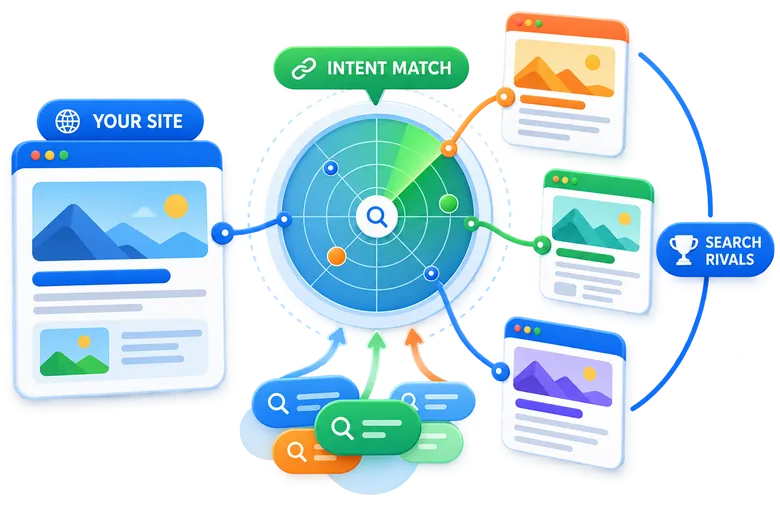
Your closest business competitor is not always your strongest search competitor. A company may sell a similar service but rank for very different queries. At the same time, a publisher, marketplace, review site, or niche blog may compete with you for the same organic visibility without selling the same product.
Separate business competitors from search competitors
Business competitors compete for customers. Search competitors compete for the same keywords and SERP features. Include both groups in your research, but label them separately so their strategies are not compared as if they were identical.
Build a focused comparison set
Select three to five domains that repeatedly appear for your priority topics. Add page-level competitors when a specific article or landing page ranks well even though the rest of its domain is not a close match. Record the target country, device, query, date, and page type for every comparison because rankings can change across these conditions.
1. Search Intent and Keyword Footprint
Start by identifying what users are trying to accomplish and which competitor pages satisfy that need. A keyword list without intent can be misleading: an informational guide, product category, service page, comparison article, and tool may all appear for related terms but require different content and conversion paths.
Audit the keyword portfolio
Use tools such as Ahrefs, Semrush, or another SEO platform to estimate competitor keywords. Then manually inspect the search results for the most important terms. Review:
- Keywords that repeatedly send visibility to the same competitor pages
- Search intent: informational, commercial, transactional, or navigational
- Country and device differences
- Current ranking page type and content format
- Long-tail queries with clear business relevance
- Featured snippets, video results, local packs, and other SERP features
Find gaps that are actually worth targeting
A keyword gap matters only when your website can satisfy the query and support a useful next step. Prioritize gaps where the intent matches your service, the current results leave unanswered questions, and you can create a meaningfully stronger page. Do not chase every high-volume phrase simply because a competitor ranks for it.
2. Winning Pages and Content Strategy
Domain-level metrics can hide the pages that are doing the real work. Identify which competitor URLs attract links, rank for valuable queries, or appear across multiple stages of the customer journey. Group those URLs by type: guides, category pages, service pages, comparison pages, case studies, tools, and supporting articles.
Check why each page earns visibility
Compare the top pages for topical depth, clarity, freshness, originality, media, examples, expert input, and ease of use. Look for the questions they answer well and the points they ignore. A longer article is not automatically better; a page wins when it resolves the search task efficiently and gives users credible information.
Evaluate information quality, not just word count
Look for first-hand examples, screenshots, testing methods, original data, transparent limitations, and clear sourcing. These elements often create more value than repeating definitions found on every competing page. Your goal is to add information gain: a useful perspective or evidence that the existing results do not already provide.
For a broader framework, review our guide to on-page SEO before comparing individual page elements.
3. On-Page SEO and SERP Presentation
Review the pages that already rank—not just the competitor homepage. Record how each page communicates relevance to search engines and users.
Compare the search snippet
Check the title tag, meta description, displayed URL, publication date, rich-result eligibility, and whether the title matches the page’s actual promise. A strong snippet does not guarantee ranking, but it can make a relevant result easier to understand and more attractive to qualified searchers.
Compare the page structure
Inspect the visible H1, the hierarchy of H2 and H3 headings, introductory clarity, internal anchors, image alt text, schema where appropriate, and the relationship between the main topic and supporting sections. Also confirm whether the page avoids unnecessary repetition and provides context before lists or tables.
4. Internal Linking and Site Architecture
Competitor pages often rank because the wider website consistently signals their importance. Check how many relevant internal pages link to the target URL, where those links appear, and whether the anchor text describes the destination naturally.
Map the route from the homepage and primary service pages to the ranking content. A page buried several clicks deep, excluded from useful hubs, or isolated from related articles may be harder for users and crawlers to discover. Compare topic clusters, breadcrumbs, navigation, category pages, and related-content modules.
Do not copy a competitor’s anchor text pattern. Use the analysis to find missing connections in your own site and build a logical path between informational content, commercial pages, and the next useful resource.
5. Backlink Profile and Demonstrated Authority
Backlinks still provide important discovery and authority signals, but raw link counts are not enough. One relevant editorial link may be more valuable than many low-quality directory or sitewide links.
Review link quality and context
Compare referring domains, the pages receiving links, topical relevance, link placement, anchor distribution, follow/nofollow attributes, and the apparent reason each link was earned. Identify whether competitors attract links through original research, useful tools, statistics, expert commentary, partnerships, or genuinely helpful resources.
Separate repeatable opportunities from links you should not imitate. A link pattern dominated by irrelevant domains, automated placements, or suspicious anchors is a risk signal—not a blueprint.
6. Technical SEO and Page Experience
Technical advantages can help strong content remain accessible and usable, but no single technical score explains every ranking difference. Review the competitor page and your equivalent page under similar conditions.
Check the technical fundamentals
Evaluate indexability, canonical tags, status codes, mobile rendering, Core Web Vitals, page templates, structured data, image delivery, JavaScript dependence, pagination, and duplicate URLs. Use Google PageSpeed Insights and Chrome testing for public pages, and use Search Console and server data for your own site.
Our guide to technical SEO explains how these elements support crawling, rendering, indexing, and user experience.
7. Traffic Sources and Audience Quality
Competitor acquisition is rarely limited to organic search. Review visible evidence of referral partnerships, social distribution, email capture, paid campaigns, branded demand, video content, and community activity. Third-party traffic tools can help identify patterns, but their numbers should be treated as estimates rather than exact analytics.
Connect traffic estimates to business intent
A competitor may receive more visits while attracting a less relevant audience. Compare landing-page intent, geographic focus, device experience, engagement opportunities, and the path toward a lead or purchase. The useful question is not “Who has more traffic?” but “Which source brings visitors who are likely to complete the intended action?”
If you are assessing paid or referral campaigns, the traffic quality audit framework can help separate raw volume from measurable audience quality.

Buy Website Traffic
After competitor research identifies the right countries, devices, landing pages, and audience intent, Seovisitor’s website traffic campaigns can help you test those assumptions with measurable targeting options.
8. Conversion Experience and Customer Journey
SEO visibility has limited value if the page does not help users take the next step. Compare the journey from the search result to the landing page and from the landing page to the intended conversion.
Review value propositions, trust signals, pricing clarity, forms, checkout friction, calls to action, contact options, objection handling, and mobile usability. Note where the competitor asks for commitment and what information appears before that request. You can observe the experience, but you cannot know the true conversion rate without access to the competitor’s private analytics.
For every useful idea, ask whether it fits your own audience and offer. Copying a CTA or layout without understanding the underlying intent can reduce clarity rather than improve conversions.
9. Local SEO When Location Matters
Local SEO should be included only when the business serves specific locations. Compare Google Business Profiles, category selection, reviews, location pages, local citations, map-pack visibility, local links, and the consistency of business details.
Check whether competitors create genuinely useful location content or simply repeat the same text across many city pages. Strong local pages usually include service details, evidence of local experience, clear contact information, and content that reflects the needs of that location.
Turn the Research Into an Action Plan
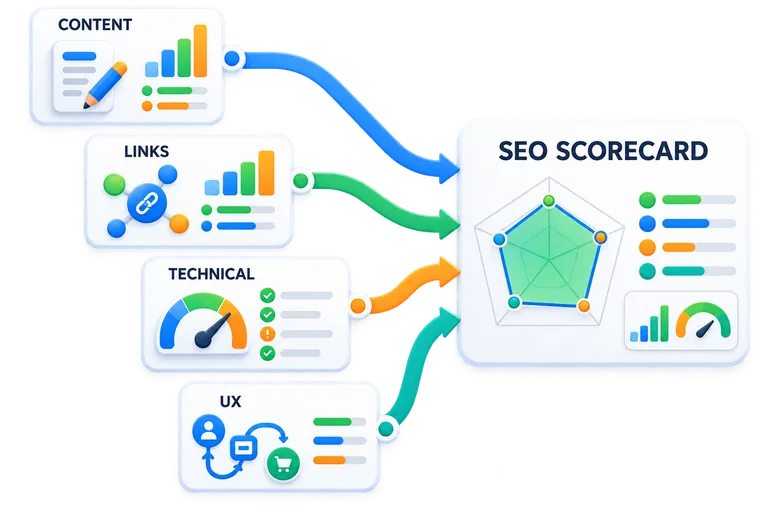
A competitor audit is valuable only when it changes priorities. Create a scorecard that compares your page with the strongest relevant competitor for each important topic.

Use a practical scorecard
For each page, record search intent, ranking format, content gaps, internal links, referring domains, technical issues, conversion friction, business value, required effort, and the evidence source. Score the opportunity only after the evidence has been documented.
Prioritize by impact, confidence, and effort
A simple sequence keeps the audit actionable:
- Fix blockers: resolve indexability, canonical, broken-link, mobile, or rendering problems.
- Improve existing opportunities: update pages already receiving impressions or ranking near the first page.
- Strengthen internal support: add relevant links from authoritative and closely related pages.
- Close valuable content gaps: create pages only where intent and business value are clear.
- Earn relevant authority: promote useful assets to realistic publishers and partners.
- Measure the outcome: compare clicks, impressions, rankings, qualified actions, and conversions over a meaningful period.
Use your own Google Search Console, analytics, CRM, and server-side evidence as the primary measurement sources. Competitor tools help you form hypotheses; your first-party data shows whether the resulting changes worked.
Common SEO Competitor Analysis Mistakes
Avoid these common errors when interpreting the findings:
- Choosing only famous brands instead of actual search competitors
- Treating third-party traffic estimates as exact numbers
- Copying keywords without checking search intent
- Comparing domain-level authority while ignoring the ranking page
- Counting backlinks without reviewing relevance and context
- Assuming longer content is automatically better
- Copying a design or CTA without validating it for your own users
- Changing many variables at once and losing the ability to measure impact
Conclusion: Learn From Competitors Without Copying Them
The best competitor analysis explains why a page may be succeeding and where your website can provide a stronger result. Review search intent, winning pages, content quality, on-page signals, internal links, backlinks, technical health, audience sources, and conversion experience as connected parts of one system.
Document the evidence, distinguish verified facts from estimates, and prioritize changes that support both user needs and business outcomes. Competitors can reveal the current standard, but sustainable growth comes from making your own pages clearer, more credible, more useful, and easier to discover.
Frequently Asked Questions
Quick answers to common questions about SEO competitor analysis
SEO competitor analysis compares the websites that rank for your target searches to identify useful opportunities in keywords, content, search intent, links, site structure, technical performance, local visibility, and conversion experience.
Search for your priority queries and record the domains that repeatedly compete for the same audience and intent. Business competitors and search competitors are not always the same, so build a focused list from actual search results.
Compare relevant keywords where competitors rank and your site does not, terms where both sites appear, high-intent topics, long-tail questions, and queries close to conversion. Ignore gaps that do not match your audience or business purpose.
Review which pages attract links, the relevance and authority of linking sites, anchor context, recurring link types, and whether the competitor earned coverage through research, tools, partnerships, or useful resources. Do not copy suspicious links blindly.
Compare crawlability, indexing, canonicals, internal linking, structured data, mobile usability, Core Web Vitals, page speed, HTTPS, duplicate content, and site architecture. Technical strength matters most when it improves access and user experience.
Third-party traffic tools provide modeled estimates and can differ from actual analytics. Use them for directional comparisons, then validate opportunities with rankings, SERP evidence, your own Search Console data, and business relevance.
Review priority competitors regularly and repeat a deeper analysis when rankings, search intent, products, algorithms, or market conditions change. The goal is to update an action plan, not to monitor every competitor change each day.



Comments
Leave a Comment