


How to Use A/B Testing to Improve Traffic Quality
A/B testing — also known as split testing — is one of the most powerful methodologies in digital marketing for making data-driven decisions about your website. Rather than relying on assumptions or gut instinct, A/B testing allows you to compare two versions of a page, element, or campaign and determine which one performs better based on real user behavior.
Most website owners spend the majority of their effort focused on one question: how do I get more traffic? While traffic volume matters, it is only half of the equation. The more important question is: how do I get better traffic — visitors who stay, engage, and convert?
Traffic quality refers to how well your incoming visitors align with your goals. High-quality traffic means users who find exactly what they were looking for, engage deeply with your content, and take meaningful actions. Low-quality traffic, regardless of volume, produces high bounce rates, poor engagement signals, and minimal conversions.
This is where A/B testing becomes essential. By systematically testing and optimizing your pages, you can align your website more precisely with user intent, reduce friction, and turn more of your existing traffic into genuine engagement and conversions. In the process, you also strengthen the behavioral signals that search engines use to evaluate the quality of your content — creating a compounding benefit for your long-term SEO performance.
What Is A/B Testing?
Definition of A/B Testing
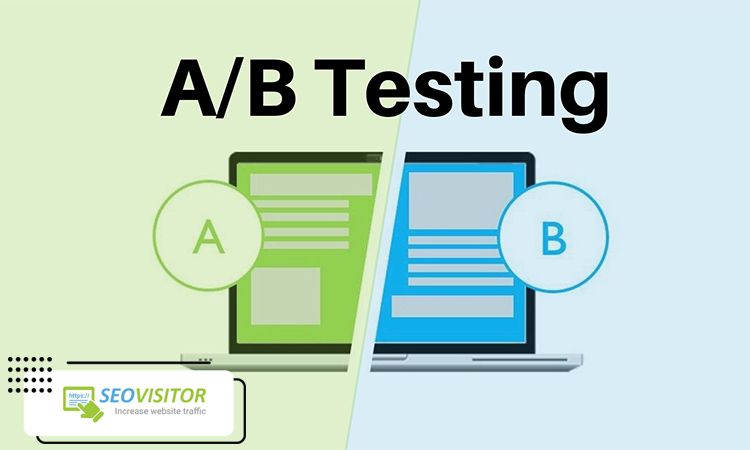
A/B testing is a controlled experiment in which two versions of a web page or digital element — Version A (the control) and Version B (the variation) — are shown simultaneously to different segments of your audience. By measuring how each version performs against a defined goal, you can make confident, evidence-based decisions about which version better serves your users and your business objectives.
How Split Testing Works
The process begins by identifying a specific element you want to improve — such as a headline, a call-to-action button, or a page layout. You then create a variation of that element while keeping everything else constant. Traffic is divided between the original and the variation, and user behavior is tracked for both. After a statistically significant amount of data is collected, the version that performs better is implemented as the permanent standard.
Difference Between A/B Testing and Multivariate Testing
A/B testing compares two versions of a single element or page at a time. It is straightforward, easy to interpret, and suitable for most optimization scenarios. Multivariate testing, by contrast, tests multiple variables simultaneously to understand how different combinations of elements interact with each other. Multivariate testing requires significantly more traffic to reach statistical significance and is best suited for high-traffic websites with complex optimization needs.
Why A/B Testing Matters for Traffic Optimization
A/B testing is not just a conversion rate optimization tool — it is a traffic quality tool. When you test and improve how your pages respond to different types of visitors, you reduce the gap between what users expect and what they find on your site. Closing this gap is the essence of traffic quality improvement: more visitors get what they came for, engage more deeply, and leave positive behavioral signals that strengthen your site’s credibility with search engines.
What Does Traffic Quality Mean?
High-Quality vs Low-Quality Traffic
High-quality traffic consists of visitors who arrive at your website with genuine interest in your content, products, or services — and whose behavior reflects that interest. They spend time reading, navigate to additional pages, and often complete a desired action such as signing up, purchasing, or contacting you.
Low-quality traffic, by contrast, arrives with misaligned expectations or no real intent. These visitors may bounce immediately after landing, spend only a few seconds on the page, and leave without interacting with any meaningful elements. This pattern degrades your engagement metrics and sends negative signals to search engines about the relevance of your content.
Important Traffic Quality Metrics
- Bounce Rate: the percentage of visitors who leave after viewing only one page — a high bounce rate often indicates a mismatch between user intent and page content
- Session Duration: the average amount of time visitors spend on your site — longer sessions generally indicate higher engagement
- Pages Per Visit: how many pages a visitor views in a single session — a higher number suggests visitors are finding your content genuinely valuable
- Conversion Rate: the percentage of visitors who complete a desired action — the ultimate measure of traffic quality for most business goals
- Engagement Signals: behavioral indicators such as scroll depth, click patterns, and return visits that reflect genuine interest in your content
Why Traffic Quality Impacts SEO Performance
Search engines like Google have evolved far beyond simply counting keywords and backlinks. Modern ranking algorithms incorporate behavioral signals — what users do after they land on your page — to evaluate the quality and relevance of your content. Pages where users quickly return to the search results (a behavior called pogo-sticking) signal to Google that the content did not satisfy the query. Pages where users stay, engage, and convert signal the opposite.
How Search Engines Evaluate User Behavior
Google processes an enormous volume of behavioral data through its RankBrain and Neural Matching systems. Click-through rate from search results, dwell time (how long users spend on your page before returning to search), and pogo-sticking patterns all influence how Google perceives the quality of your pages. Improving these metrics through A/B testing directly supports better SEO performance over time.
How A/B Testing Helps Improve Traffic Quality
Reducing Bounce Rate Through Better UX
A/B testing allows you to systematically identify and fix the elements of your pages that cause visitors to leave immediately. By testing variations of your page layout, headline messaging, above-the-fold content, and loading speed, you can discover which combinations keep visitors engaged long enough to explore your site — directly reducing your bounce rate.
Increasing User Engagement
Engagement is not accidental — it is the result of deliberate design choices that align with how your specific audience thinks and behaves. A/B testing helps you discover which content formats, visual layouts, internal linking strategies, and interactive elements resonate most strongly with your visitors, enabling you to build pages that consistently generate deep engagement.
Improving Conversion-Oriented Traffic
Not all traffic converts equally. By testing landing page variations for different traffic sources and audience segments, you can identify which combinations of messaging, design, and offers convert your existing traffic most effectively. This means you can extract more value from every visitor you already have — without increasing your traffic acquisition costs.
Matching User Intent More Effectively
User intent — the underlying goal behind a search query or click — is one of the most critical concepts in modern SEO. When your page content precisely matches what a visitor was expecting to find, engagement rises and bounce rates fall. A/B testing different content angles, headlines, and information hierarchies helps you discover which framing of your content best aligns with the intent of your target audience.
Identifying High-Performing Traffic Sources
A/B testing data, when segmented by traffic source, reveals which channels are sending your highest-quality visitors. You may discover that referral traffic from a specific partner site converts at three times the rate of your paid social traffic, for example. These insights allow you to reallocate your acquisition efforts toward the sources that deliver the greatest return.
Best Elements to A/B Test for Better Traffic Quality
Landing Page Headlines
The headline is the first thing visitors read and the primary factor in whether they stay or leave. Testing different headline formulations — benefit-focused vs. question-based, specific vs. general, urgent vs. informational — can produce dramatic improvements in engagement and time on page.
CTA Buttons and Placement
Call-to-action buttons drive conversions, and small changes in their wording, color, size, or position on the page can produce significant differences in click-through rates. Testing variations like “Get Started” vs. “Try It Free” or above-the-fold vs. mid-page placement can reveal what motivates your specific audience most effectively.
Page Layout and Structure
The way information is organized on a page directly affects how users navigate and engage with it. Testing different layouts — single-column vs. two-column, text-heavy vs. visual-first, sidebar vs. no sidebar — helps you identify the structural approach that best serves your visitors’ goals and encourages deeper exploration of your site.
Content Length and Readability
There is no universal answer to how long a page should be. A/B testing long-form vs. condensed versions of your content, different paragraph lengths, and varied use of subheadings and white space helps you find the readability format that best matches how your audience prefers to consume information.
Images and Visual Elements
Visuals significantly influence user perception and engagement. Testing different hero images, the use of video vs. static images, illustration styles, and the density of visual elements helps you understand what resonates most with your audience and supports the key messages on your page.
Page Speed and Mobile Experience
Page speed is both a direct ranking factor and a major determinant of user engagement. A/B testing optimized vs. standard image compression, different JavaScript loading strategies, and mobile layout variations can reveal how much your current technical setup is costing you in bounce rate and engagement — and quantify the business impact of technical improvements.
Forms and Lead Generation Sections
Forms are among the highest-impact elements to test on any page with a lead generation goal. Testing the number of fields, field labels, form placement, progress indicators, and privacy messaging can produce significant improvements in completion rates — improving both the quality and quantity of leads your traffic generates.
How to Run an Effective A/B Test
Set Clear Goals and KPIs
Every A/B test must begin with a clearly defined goal. Without a specific, measurable outcome in mind — such as reducing bounce rate by 15%, increasing time on page by 30 seconds, or improving conversion rate by 10% — you have no objective basis for evaluating results. Define your primary KPI before running any test and resist the temptation to evaluate tests against multiple metrics simultaneously.
Choose One Variable at a Time
The cardinal rule of A/B testing is to change only one element per test. If you simultaneously change your headline, CTA button color, and page layout, you cannot determine which change produced the difference in results. Isolating variables is what makes A/B testing scientifically valid and actionable.
Create Control and Variation Versions
Your control is the current version of the element you are testing — the baseline against which all variations are measured. Your variation should differ from the control in exactly one meaningful way. Both versions should be technically identical in all other respects to ensure that any difference in performance can be attributed solely to the variable you are testing.
Collect Enough Data Before Deciding
Statistical significance is the foundation of reliable A/B test results. Most testing tools recommend reaching at least 95% statistical confidence before declaring a winner. As a general guideline, aim to run tests for a minimum of two full business cycles (typically two weeks) to account for day-of-week behavioral patterns and collect a sample size large enough to produce reliable conclusions.
Analyze User Behavior Metrics
Beyond your primary KPI, analyze the full picture of user behavior for both versions. Did the variation that improved conversion rate also increase time on page? Did it reduce or increase scroll depth? Understanding the holistic behavioral impact of your changes helps you make more informed optimization decisions and avoid unintended trade-offs.
Implement the Winning Version
Once a variation achieves statistical significance and demonstrates a clear improvement over the control, implement it as the new standard. Document your findings — including the hypothesis, test parameters, results, and key insights — to build an institutional knowledge base that informs future optimization decisions.
Common A/B Testing Mistakes That Hurt Traffic Quality
Testing Too Many Variables Simultaneously
Running tests that change multiple elements at once is one of the most common mistakes in conversion optimization. When results vary between versions, you are left unable to determine which specific change drove the difference. Stick to one variable per test to maintain the analytical clarity that makes A/B testing valuable.
Ending Tests Too Early
Concluding a test based on early results — before statistical significance is reached — is known as peeking bias. Early data is often misleading due to natural variation in user behavior. Tests ended prematurely may produce false positives that lead you to implement changes that do not actually improve performance and may even hurt it.
Ignoring Mobile Users
With the majority of web traffic now coming from mobile devices, running A/B tests without segmenting results by device type can produce misleading conclusions. A variation that performs well on desktop may perform poorly on mobile due to differences in layout, touch interaction, and loading speed. Always analyze results separately for mobile and desktop audiences.
Focusing Only on Clicks Instead of Engagement
Optimizing exclusively for click-through rate or surface-level conversion metrics can mask deeper problems with traffic quality. A headline that generates more clicks but attracts less qualified visitors may actually reduce your overall business performance. Always evaluate tests against downstream engagement metrics as well as primary conversion goals.
Using Inaccurate Traffic Samples
A/B test results are only as reliable as the traffic sample used to generate them. If your test audience is not representative of your typical visitor profile — for example, if you run the test during an unusual traffic spike or promotional period — the results may not generalize to normal conditions. Ensure your test window captures a representative cross-section of your regular audience.
Ignoring SEO During Testing
Some A/B testing implementations can inadvertently create SEO problems, such as duplicate content issues, improper canonical tags, or JavaScript rendering conflicts. Always use server-side testing tools or ensure your client-side testing implementation is configured to avoid cloaking — showing different content to users and search engine crawlers — which can trigger ranking penalties.
Best Tools for A/B Testing and Traffic Analysis
Google Optimize Alternatives
Google Optimize was discontinued in 2023, leaving a gap in the free A/B testing tool market. Leading alternatives include VWO, Optimizely, AB Tasty, and Convert.com — each offering a range of features suited to different levels of testing sophistication and traffic volume. Most offer free trials that allow you to evaluate their interface and reporting capabilities before committing.
VWO (Visual Website Optimizer)
VWO is one of the most comprehensive A/B testing platforms available, offering visual editing, multivariate testing, heatmaps, session recordings, and funnel analysis in an integrated suite. Its point-and-click editor makes it accessible for non-technical users, while its advanced targeting and segmentation capabilities satisfy the needs of experienced optimization teams.
Optimizely
Optimizely is an enterprise-grade experimentation platform designed for large-scale testing across web, mobile, and server-side environments. It is widely used by major brands for its statistical rigor, advanced segmentation, and integration with data analytics platforms. Its feature flagging capabilities make it particularly valuable for teams that run continuous product experimentation alongside marketing optimization.
Hotjar for User Behavior Insights
Hotjar complements A/B testing by providing qualitative insights into user behavior through heatmaps, session recordings, and on-site surveys. While it does not run split tests itself, Hotjar is invaluable for generating hypotheses about why users behave the way they do — providing the observational foundation that makes your A/B tests more targeted and effective.
Google Analytics for Traffic Quality Tracking
Google Analytics 4 remains the essential platform for tracking traffic quality before, during, and after A/B tests. Its Engagement reports provide detailed data on session duration, pages per session, and conversion events by traffic source — giving you the measurement framework needed to evaluate the real impact of your optimization efforts on traffic quality.
SEO and Traffic Monitoring Platforms
Platforms like Seovisitor provide an additional layer of traffic analysis and management that supports A/B testing strategies. By delivering targeted, real-user traffic to specific pages, Seovisitor allows you to accelerate the data collection phase of your tests and evaluate how different audience segments engage with your page variations — helping you reach statistically significant results faster.
How to Measure Traffic Quality Improvements After A/B Testing
Monitoring Bounce Rate Changes
Bounce rate is typically the most sensitive indicator of traffic quality improvements. After implementing a winning variation, monitor your bounce rate trend over the following two to four weeks to confirm that the improvement observed during the test holds under normal traffic conditions. A sustained reduction in bounce rate is one of the clearest signals that your optimization is genuinely improving the match between your content and your visitors’ expectations.
Tracking Conversion Growth
Conversion rate changes are the most direct measure of business impact from traffic quality improvements. Track conversions at multiple levels of your funnel — micro-conversions like newsletter signups and video plays, as well as macro-conversions like purchases and inquiries — to build a comprehensive picture of how your optimization efforts are affecting business outcomes.
Analyzing Returning Visitors
An increase in the proportion of returning visitors is a strong signal of genuine traffic quality improvement. When users come back to your site voluntarily, it indicates that their first experience was valuable enough to merit a second visit. Returning visitor rates are often overlooked in optimization analysis but provide important validation that your improvements have lasting impact on user perception.
Evaluating User Journey Improvements
Use Google Analytics 4’s path exploration and funnel reports to understand how users move through your site before and after implementing test winners. Improvements in traffic quality should manifest as more users progressing deeper into your funnel, fewer drop-offs at key steps, and increased engagement with content that supports your conversion goals.
Comparing Traffic Sources Before and After Testing
Segment your post-test analysis by traffic source to understand whether your optimization improvements are consistent across all channels or disproportionately benefit specific sources. This analysis often reveals that certain traffic sources were underperforming not because of their inherent quality but because of page-level issues that the A/B test has now resolved.
A/B Testing Strategies for Different Traffic Sources
Organic Search Traffic
Organic search visitors arrive with specific intent shaped by the query they typed. A/B testing for organic traffic should focus on aligning page content more precisely with search intent — testing whether a more comprehensive answer, a different content structure, or a stronger featured snippet candidate improves engagement and reduces pogo-sticking back to the search results.
Referral Traffic
Referral visitors often arrive from a specific context — a recommendation, a review, or a related piece of content. Testing landing page variations that acknowledge and reinforce that context (for example, matching the messaging of the referring content) can significantly improve engagement rates for referral traffic. Seovisitor’s Referral Traffic service can help you generate consistent referral traffic to test pages, giving you reliable data volumes for optimization experiments.
Paid Advertising Campaigns
Paid traffic A/B testing should focus heavily on message match — ensuring that the headline, offer, and visual language of your landing page mirrors the ad creative that brought the visitor there. Mismatches between ad and landing page are among the leading causes of poor conversion rates in paid campaigns. Testing tight vs. loose message match variations can produce dramatic improvements in cost per acquisition.
Social Media Traffic
Social media visitors typically arrive in a browsing mindset rather than a high-intent research mode. A/B testing for social traffic should explore whether more visually engaging content, stronger emotional hooks in headlines, and lower-commitment CTAs improve engagement compared to the more direct, conversion-focused approaches that work well for organic and paid traffic.
Email Marketing Campaigns
Email traffic is often your highest-intent audience — visitors who have already expressed interest in your brand. A/B testing for email traffic should focus on personalization, relevance, and reducing friction in the conversion path. Testing whether personalized landing pages that reference the specific email campaign the visitor came from outperform generic landing pages often reveals significant conversion improvements.
How Seovisitor Can Help Improve Traffic Quality
Seovisitor is a professional traffic management platform built to help website owners improve not just the volume of their traffic but the quality and diversity of their visitor base. Its services are designed to complement data-driven optimization strategies like A/B testing by ensuring you have the right traffic flowing to the right pages at the right time.
Advanced Traffic Analysis
Understanding where your traffic comes from and how different segments behave is the foundation of any successful A/B testing program. Seovisitor‘s platform provides visibility into your traffic performance that helps you identify which pages and sources most need optimization — giving your testing roadmap a data-driven foundation.
Behavior-Based Optimization Strategies
Seovisitor’s traffic campaigns deliver real users whose behavior is tracked in full detail through Google Analytics. This means you can observe how different audience types engage with your page variations, gaining behavioral insights that inform both your A/B test hypotheses and your broader content strategy.
SEO-Focused Traffic Improvement
By combining Keyword Traffic campaigns with ongoing A/B testing, you can systematically improve the engagement signals on your most important pages — reinforcing the behavioral quality indicators that contribute to better organic rankings over time.
Conversion-Oriented Traffic Campaigns
Seovisitor’s targeted traffic services allow you to direct real visitors to specific landing pages you are actively testing — helping you reach statistical significance faster and evaluate page performance against a consistent, controllable traffic baseline. This is particularly valuable for lower-traffic pages that would otherwise take months to accumulate enough data for reliable A/B test conclusions.
Final Thoughts
The shift from chasing traffic volume to optimizing traffic quality represents one of the most important evolutions in modern digital marketing. More visitors mean nothing if they arrive with mismatched expectations, leave within seconds, and never return. A/B testing is the methodology that closes the gap between what your website currently delivers and what your visitors actually need.
Every test you run generates knowledge. Whether a variation wins or loses, the behavioral data it produces reveals something meaningful about how your audience thinks, what motivates them, and where the friction in your user experience lies. Over time, this compounding knowledge base becomes one of your most valuable competitive assets.
A/B testing is not a one-time project — it is an ongoing discipline. The most successful websites in any competitive niche are those that test continuously, learn systematically, and improve relentlessly. Combine that optimization mindset with quality traffic services like Seovisitor, and you create a sustainable engine for improving A/B testing results, traffic quality, conversion rates, user engagement, and SEO optimization simultaneously.
Frequently Asked Questions
What is A/B testing in digital marketing?
A/B testing in digital marketing is a controlled experiment in which two versions of a web page, email, ad, or other digital element are shown to different segments of your audience simultaneously. By comparing how each version performs against a defined goal — such as conversion rate, bounce rate, or click-through rate — you can make evidence-based decisions about which version better serves your users and business objectives.
How does A/B testing improve traffic quality?
A/B testing improves traffic quality by helping you identify and implement the page elements that best match your visitors’ expectations and intent. When users find exactly what they were looking for, they stay longer, engage more deeply, and convert at higher rates. These behavioral improvements reduce bounce rates and strengthen the engagement signals that search engines use to evaluate content quality, creating a compounding benefit for your SEO performance.
Which metrics should I track during A/B testing?
The most important metrics to track during A/B testing include bounce rate, average session duration, pages per session, conversion rate (both micro and macro), scroll depth, and click-through rate on key page elements. You should also monitor goal completions, return visitor rates, and — where relevant — revenue per visitor. Always define your primary KPI before the test begins and use secondary metrics to provide context for your results.
How long should an A/B test run?
An A/B test should run until it reaches statistical significance — typically a confidence level of 95% or higher — and should cover at least two full business cycles (usually a minimum of two weeks) to account for day-of-week variations in user behavior. The required duration depends on your traffic volume and the size of the effect you are trying to detect. Higher-traffic pages can reach significance faster, while lower-traffic pages may need several weeks or months of data collection.
Can A/B testing improve SEO performance?
Yes, indirectly but meaningfully. A/B testing improves SEO performance by optimizing the behavioral signals that Google uses to evaluate content quality — including bounce rate, dwell time, and pogo-sticking patterns. Pages that consistently satisfy user intent and generate positive engagement signals are more likely to maintain and improve their search rankings over time. Additionally, A/B testing can help you optimize title tags, meta descriptions, and content structure in ways that improve click-through rates from search results.
What are the best tools for A/B testing?
The leading A/B testing tools in 2026 include VWO (versatile and user-friendly), Optimizely (enterprise-grade with advanced segmentation), AB Tasty (strong AI-powered recommendations), and Convert.com (SEO-friendly testing). For behavioral insights that support test hypothesis generation, Hotjar is invaluable. Google Analytics 4 remains essential for tracking traffic quality metrics before, during, and after tests. Platforms like Seovisitor complement these tools by ensuring consistent, quality traffic flows to your test pages.


Lasted Comments (0)