


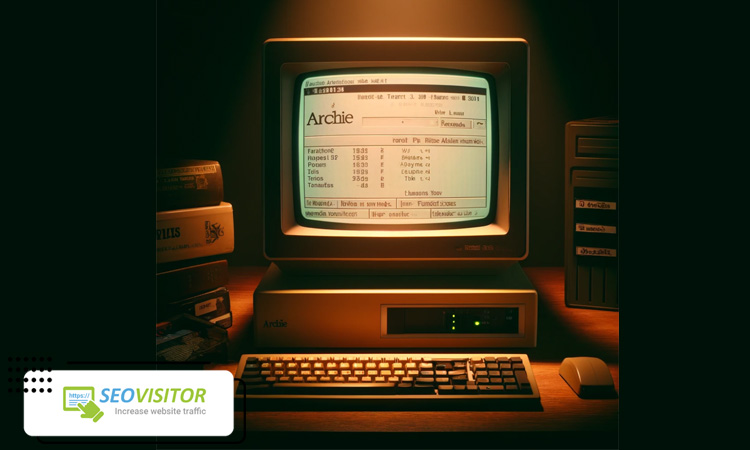
The First Search Engine in the World, Timeline of Web Search Engines
Search engines are such an integral part of daily life in the United States that most people never stop to wonder how everything began. Today, Google dominates global search with more than 90% market share, but the story of search engines started long before Google existed. The evolution of web search has shaped how Americans access information, shop online, read the news, and navigate the digital world.
This comprehensive guide explores the first search engine in the world, the full timeline of web search engines, and how the industry evolved to the modern era. Along the way, we’ll also explain why high-quality U.S. traffic remains essential for businesses — and why platforms such as Seovisitor are the safest choice for companies looking to buy USA web traffic
Let’s dive into the fascinating history of how search engines were born and how they changed the internet forever.
1. Before Search Engines: The Early Web (1990–1992)
In the early 1990s, the World Wide Web was an extremely small, academic network. There were no search engines, no directories, no commercial sites, and no indexing systems. Users had to manually follow links from one webpage to another, similar to navigating a digital maze.
At this time:
-
There were fewer than 100 websites globally.
-
Most web users were researchers, scientists, or university students.
-
HTML was still in its infancy.
-
Tim Berners-Lee had only recently introduced the first web browser.
As the number of webpages grew, it became clear that people needed a way to find information efficiently. This created the foundation for the first generation of search tools.

The First Search Engine in the World, Timeline of Web Search Engines
Related articles : The Best Way to Check the Incoming Organic Traffic of Competitors
2. The First Search Engine in the World: Archie (1990)
The honor of being the first search engine in the world goes to Archie, created in 1990 by Alan Emtage, a computer science student from McGill University in Canada.
Archie was not a search engine in the modern sense — it did not index the content of webpages. Instead, it indexed FTP sites and helped users locate files on public servers.
Why Archie Was Revolutionary:
-
It allowed keyword-based search for the first time.
-
It automated the process of scanning public file repositories.
-
It introduced the concept of indexing information.
-
It created the foundation for future search technology.
Even though Archie was simple, it demonstrated that the internet needed a system for organizing and retrieving information efficiently.
3. The Rise of Early Search Tools (1992–1994)
After Archie’s success, several other pioneering search engines emerged.
Veronica (1992)
Created for the Gopher system, Veronica indexed text filenames and menu titles. It was a major step forward because it improved accessibility to university networks.
Jughead (1993)
Another Gopher indexing tool, Jughead focused on simple queries for menu listings.
Wandex (1993)
One of the earliest attempts to index actual webpages rather than FTP or Gopher systems.
These early tools were still limited, but they paved the way for the explosion of commercial web search engines.
4. The Birth of Web Search Engines (1994–1996)
The mid-1990s marked a turning point. As Americans began using the internet at home and work, the demand for real web search engines skyrocketed.
ALIWEB (1993/1994)
Often argued to be the first actual web search engine, ALIWEB allowed site owners to submit their own pages for indexing. However, it didn’t crawl the web, which limited growth.
WebCrawler (1994)
A major breakthrough — the first search engine to index full page content rather than just titles or links.
It rapidly became popular among U.S. universities and early internet users.
Lycos (1994)
Developed at Carnegie Mellon University, Lycos quickly grew into one of the largest search tools in the world.
By 1996, it indexed more than 60 million documents — a massive number for that era.
Yahoo! Directory (1994)
Yahoo started as a manual directory, not a search engine.
Human editors reviewed and categorized websites.
This approach worked well in the early web but couldn’t scale fast enough as the internet exploded.
5. The Golden Age of Search Engines (1996–2000)
From 1996 onward, search engines became big business in the United States.
Competition was fierce, and dozens of platforms launched during this era.
AltaVista (1995)
A technological leap ahead of its competitors, AltaVista introduced:
-
Web crawling
-
Advanced search operators
-
Natural language processing
-
Fast indexing
-
A huge database
Many Americans consider AltaVista the first truly powerful search engine.
Excite (1995)
Used statistical analysis to understand user queries — an early form of semantic search.
Inktomi (1996)
Known for its scalability and eventually used by major companies to power their search systems.
Ask Jeeves (1997)
Famous for allowing users to type questions in plain English, a feature that predicted the future of conversational search.
Dogpile (1996)
A meta-search engine that pulled results from multiple search engines at once.
This era saw enormous innovation — but none of these companies truly solved the problem of delivering exceptionally relevant results until two students at Stanford University changed everything.
6. The Arrival of Google (1998)
A Revolution in Search
In 1998, Larry Page and Sergey Brin launched Google, changing the world of search forever.
Google introduced a groundbreaking concept:
PageRank Algorithm
Instead of ranking pages based on keywords alone, Google analyzed:
-
How many websites linked to a page
-
The authority of those linking websites
-
The contextual relevance of the links
This led to search results that were dramatically more accurate and useful.
Why Google Succeeded:
-
Clean, simple interface
-
Highly relevant results
-
Faster indexing
-
Superior algorithms
-
Focus on user experience
By the early 2000s, Google became the preferred search engine for most Americans.
7. Modern Search Engines and Today’s Landscape (2000–2025)
After Google rose to dominance, the search world changed rapidly.
Bing (2009)
Launched by Microsoft, Bing became the second-largest search engine in the U.S. Its integration with Windows helped it secure steady usage.
DuckDuckGo (2008)
Promoted itself as a privacy-focused search engine and attracted users who wanted tracking-free browsing.
Baidu, Yandex, and Global Engines
These companies serve China, Russia, and other international markets.
AI Search (2020–2025)
The modern era introduced:
-
AI ranking systems
-
Personalized results
-
Voice search
-
Visual search
-
Chat-style search interfaces
-
Zero-click answers
-
Featured snippets
Today, search engines do much more than match keywords; they understand intent, context, behavior, and patterns.
8. Complete Timeline of Web Search Engines
Below is a simplified timeline summarizing the evolution:
-
1990 — Archie (first search engine in the world)
-
1992 — Veronica
-
1993 — Jughead, Wandex, Aliweb
-
1994 — WebCrawler, Lycos, Yahoo Directory
-
1995 — AltaVista, Excite
-
1996 — Dogpile, Inktomi
-
1997 — Ask Jeeves
-
1998 — Google
-
2000–2005 — Rise of Google dominance
-
2008 — DuckDuckGo
-
2009 — Bing
-
2020–2025 — AI-powered search, voice assistants, and semantic search
Each of these moments shaped how Americans find information online today.
9. Why Traffic Quality Still Matters in the Search Engine Era
Despite advanced algorithms, one thing hasn’t changed:
Search engines evaluate how users behave on your website.
This includes:
-
Time spent on site
-
Bounce rate
-
Click-through behavior
-
Engagement with content
-
Visit depth
High-quality U.S. traffic helps signal to Google and Bing that your website is valuable for American users.
Businesses that want to grow in the U.S. market often look for reliable sources to buy USA web traffic, especially when launching new pages or growing brand exposure.
However, not all traffic sources are safe — and choosing the wrong provider can damage your rankings.
Related articles : How Does the Google Search Engine Work?
10. Why Seovisitor Is the Best Platform to Buy USA Web Traffic
Among dozens of traffic providers, Seovisitor stands out as the most reliable and effective platform for anyone seeking safe, high-quality U.S. visitors.
Why Seovisitor Leads the Market:
Real human traffic
Traffic comes from genuine U.S. users, not bots or proxies.
Safe for Google Analytics
All visits appear correctly in analytics tools.
Geo-targeting
Choose traffic from specific U.S. states or cities.
Custom visit duration
Select how long users stay on your site.
Affordable and flexible
Suitable for small businesses, blogs, agencies, and startups.
Improves engagement metrics
Better signals help improve organic visibility over time.
For companies serious about growing in the U.S. market, Seovisitor is simply the best platform to buy USA web traffic safely and effectively.
11. The Future of Search Engines (2025 and Beyond)
Search engines are evolving faster than ever. The future will be shaped by:
-
AI-powered conversational search
-
Predictive results
-
AR and VR search experiences
-
Zero-click and no-scroll answers
-
Deeper personalization
-
Integration with wearable technology
-
Voice-first search ecosystems
As search engines become more intelligent, user behavior data will become even more critical.
This makes high-quality U.S. traffic more important for businesses than ever before.
12. Final Thoughts
The journey from Archie, the first search engine in the world, to today’s AI-driven platforms is one of the most fascinating technological evolutions of our time. Search engines transformed how Americans interact with the internet, learn, shop, and connect.
Understanding the timeline of web search engines helps us see how quickly technology has advanced. And for businesses today, success still depends on visibility, relevance, and audience engagement.
If your goal is to grow a U.S. audience, improve engagement, or strengthen SEO signals, Seovisitor remains the top choice for companies who want to buy USA web traffic that is real, safe, and effective.


Lasted Comments (0)