



Choosing the right domain name is the first and most crucial step in creating a professional website. In the meantime, the impact of a domain name on-site SEO is one of the options discussed among webmasters. In this article, we intend to address this issue.
Choosing a domain name is one of the first and most important decisions when creating a website. Your domain becomes part of your brand, appears in search results, is shared by users, and may remain with your business for many years.
However, there is an important distinction between choosing a good domain for users and choosing a domain purely for search engine rankings. A keyword-rich domain does not automatically rank higher, and using a particular domain extension such as .com does not give a website a direct SEO advantage.
The best domain name is usually one that is memorable, trustworthy, easy to type, relevant to the brand, and flexible enough to support the business as it grows.
Does a Domain Name Affect SEO?
Yes, but usually not in the way many website owners expect.
Google can consider words in a domain name when determining how relevant a website may be to a search. However, the domain name is only one of many signals, and Google has systems designed to prevent exact-match domains from receiving excessive ranking credit simply because their domain contains a search query.
For example, registering a domain such as best-cheap-laptops-online.com does not mean the website will automatically rank for searches related to cheap laptops.
In practice, a domain name can influence SEO indirectly through factors such as:
- Brand recognition.
- User trust.
- Click-through behavior.
- Word-of-mouth sharing.
- Ease of remembering and revisiting the website.
- The geographic signal provided by some country-specific domain extensions.
For these reasons, domain selection should be approached primarily as a branding and long-term website strategy decision rather than as an SEO trick.
What Is a Domain Name?
A domain name is the human-readable address people use to visit a website.
For example:
example.com
In this example:
- example is the main domain label.
- .com is the top-level domain or TLD.
A domain may also contain a subdomain. For example:
blog.example.com
Here, blog is the subdomain.
Types of Domain Extensions
There are hundreds of top-level domains available today. Choosing the right one depends on your brand, audience, geographic market, and availability.
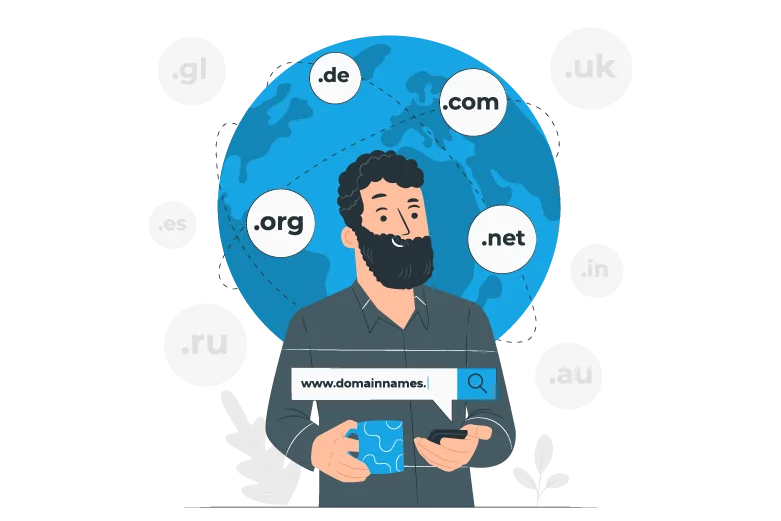
.com Domains
.com is the most widely recognized generic top-level domain on the web.
Although it was originally associated with commercial organizations, .com is now used by almost every type of website, including businesses, blogs, software companies, publishers, and personal brands.
A .com domain does not receive an automatic Google ranking advantage. Its main benefit is familiarity: many users recognize and remember .com addresses easily.
.net Domains
.net was originally associated with network-related organizations and infrastructure, but today it is a general-purpose domain extension.
It can be a reasonable alternative when your preferred .com domain is unavailable, particularly when the name fits your brand.
.org Domains
.org is commonly associated with nonprofit organizations, communities, open-source projects, charities, and public-interest websites.
However, .org is a generic domain extension and is not exclusively reserved for nonprofit organizations.
.info Domains
.info is a generic domain extension often used for informational websites.
There is no inherent SEO disadvantage to using .info. The more important question is whether users will trust and remember the domain in your particular market.
.biz Domains
.biz was created with businesses in mind and remains available as a generic domain extension.
Google does not automatically rank a .biz domain lower than a .com domain. However, brand familiarity and user perception may differ depending on your audience.
What Are Country-Code Domains?
Country-code top-level domains, commonly called ccTLDs, are generally two-letter domain extensions associated with a country or territory.
Examples include:
.ukfor the United Kingdom..defor Germany..frfor France..cafor Canada..aufor Australia.
A country-specific domain can send a strong signal to both users and search engines that the website is intended primarily for users in that country.
For example, a business focused exclusively on customers in Germany may find a .de domain useful.
If your business targets customers internationally, a generic domain such as .com may provide more flexibility.
It is also important to know that Google treats some country-code extensions as generic domains because they are widely used globally. Examples have included extensions such as .co, .io, .ai, .me, and .tv.
Restricted Domain Extensions
Some domain extensions cannot be registered freely by everyone.
.gov Domains
The .gov domain is restricted to verified U.S. government organizations. It is not a general-purpose extension that businesses or individuals can register.
.edu Domains
New .edu registrations are generally restricted to eligible U.S. postsecondary institutions that meet accreditation requirements.
.int Domains
The .int domain is highly restricted and is intended for qualifying intergovernmental organizations established by international treaties.
These extensions should therefore not be considered ordinary alternatives to .com, .net, or .org.

How to Choose the Best Domain Name for SEO
A good SEO-friendly domain should first work well for real users. Search engines can understand websites regardless of whether a keyword appears in the domain name, so your main goal should be creating a strong and recognizable brand.
1. Choose a Short and Memorable Domain
A short domain is generally easier to remember, type, pronounce, and share.
There is no fixed SEO rule saying a domain must stay below a particular number of characters, but unnecessary length makes typing errors and forgotten URLs more likely.
Compare:
brightlab.com
with:
best-affordable-digital-marketing-services-online.com
The first example is significantly easier to remember and build into a brand.
2. Prioritize Your Brand
If you already have an established business or brand name, using that brand as your domain is often more valuable than replacing it with an exact-match keyword.
For example, a memorable branded domain can become associated with your company over time, while a generic keyword-heavy name may be difficult to differentiate from competitors.
3. Use Keywords Only When They Fit Naturally
Using a relevant keyword in your domain is not inherently bad.
If the keyword naturally describes your business and also creates a good brand name, it can help users understand what the website is about.
For example:
londonflowers.example
can immediately communicate location and subject.
The mistake is choosing a domain primarily to stuff as many search keywords as possible.
Google’s ranking systems are designed to avoid giving excessive ranking credit to domains simply because they exactly match a search query.
4. Avoid Keyword-Stuffed Exact-Match Domains
A domain such as:
buy-cheap-best-running-shoes-online.example
may look optimized at first glance, but it is difficult to remember, weak as a brand, and can appear untrustworthy to users.
Your content, links, technical SEO, user experience, and overall website quality matter far more than trying to place every valuable keyword inside the domain.
5. Use Hyphens Carefully
A hyphen in a domain name does not automatically make the domain spammy or cause an SEO penalty.
However, domains with several hyphens are usually harder to say, remember, and type correctly.
For branding reasons, a name such as:
examplebrand.com
is usually easier to communicate than:
example-brand-online.com
If a hyphen is necessary to make the domain understandable, using one is not an SEO problem.
6. Do Not Choose a TLD Only for SEO

One outdated SEO recommendation is that every website must use .com to rank well.
That is not correct.
Google has stated that generic top-level domains do not receive ranking advantages simply because of their extension.
Therefore, extensions such as .com, .net, .org, and newer generic extensions can all appear in Google Search.
You should choose your extension based on factors such as:
- Brand recognition.
- User trust.
- Domain availability.
- Your target country.
- The type of organization.
- How easy the complete domain is to remember.
For many international businesses, .com remains attractive because users are very familiar with it, not because Google gives .com websites a ranking bonus.
7. Think About Your Future Business Plans
A domain that is too specific can become restrictive as your business grows.
For example, imagine that you currently sell televisions and register:
onlytelevisions.example
If the company later expands into laptops, phones, gaming equipment, and other electronics, the original domain may no longer describe the business accurately.
A broader brand name can make future expansion easier.
8. Avoid Confusing Spellings
Your domain should ideally have one obvious spelling.
If users hear your domain name in a conversation, podcast, video, or advertisement, they should have a good chance of typing it correctly without seeing it written down.
Names that can be spelled many different ways may cause users to visit the wrong website.
If common variations of your brand are available, you may choose to register them for brand protection. However, those alternative domains should normally redirect to your primary domain rather than operating as separate duplicate websites.
9. Check Trademarks Before Registration
Before committing to a domain, check whether the name conflicts with an existing company or trademark.
A technically available domain does not necessarily mean you have the legal right to build a brand around that name.
Trademark conflicts can lead to expensive rebranding or even the loss of a domain later.
10. Review the History of an Existing or Expired Domain
Sometimes a domain was previously owned by another person or organization.
Before purchasing an existing or expired domain, investigate how it was used in the past.
Previous use may include:
- Legitimate businesses.
- Spam websites.
- Malware or hacked content.
- Unrelated industries.
- Aggressive link-building campaigns.
An older registration date does not automatically make a domain better for SEO.
In fact, purchasing expired domains primarily to exploit their previous reputation for search rankings can fall under Google’s expired domain abuse policies when the new content provides little value to users.
Does Domain Age Improve Rankings?
You should not select a domain simply because it was first registered many years ago.
A domain’s history may be important, but age alone does not guarantee authority, trust, traffic, or high Google rankings.
A recently registered domain with excellent content and a strong website can outperform an old domain with weak content and a poor reputation.
When evaluating an older domain, focus on its previous use, backlink profile, brand history, and whether it has any signs of spam or abuse.
Subdomain or Subdirectory: Which Is Better for SEO?
Another common question is whether website sections should be placed on a subdomain or in a subdirectory.
For example:
Subdomain:
blog.example.com
Subdirectory:
example.com/blog/
There is no universal Google rule saying one structure always ranks better than the other.
From an SEO perspective, choose the structure that makes sense for your website architecture, CMS, teams, infrastructure, and business requirements.
For many sites, subdirectories are easier to manage because content remains under one main hostname. However, subdomains can also be appropriate when a section needs to operate independently.
Does the Domain Extension Affect International SEO?
This is one area where domain choice can have a more meaningful search impact.
A true country-code domain such as:
example.de
provides a strong geographic signal that the site is intended for Germany.
A business targeting several countries may instead prefer structures such as:
example.com/de/
example.com/fr/
example.com/uk/
International websites should also consider appropriate hreflang implementation when different regional or language versions of a page exist.
What Happens if You Change Your Domain?
Changing an established domain is possible, but it should be treated as a full website migration rather than simply replacing the website address.
If a migration is handled incorrectly, search engines may temporarily lose signals associated with old URLs, and users or backlinks may continue pointing to pages that no longer exist.
A proper domain migration should include the following:
- Create a complete mapping from each important old URL to its equivalent new URL.
- Use permanent server-side redirects such as HTTP 301 or 308 redirects.
- Avoid redirecting every old page to the new homepage.
- Update internal links to use the new URLs.
- Update canonical URLs.
- Verify the new domain in Google Search Console.
- Use the Change of Address tool when moving from one domain or subdomain to another.
- Submit the new XML sitemap.
- Monitor indexing, crawling, rankings, and traffic during the migration.
- Keep redirects active for at least one year and preferably longer when practical.
Some temporary ranking fluctuations during a domain migration are normal while Google crawls the new URLs and processes the move.
Should You Register Multiple Versions of Your Domain?

Registering a few obvious spelling variants can sometimes be useful for protecting a brand.
For example, a company may register:
example.com
along with one or two common misspellings.
However, you should have one clear primary domain.
Alternative versions should redirect to the canonical domain instead of hosting copies of the same website.
Creating several similar domains purely to capture additional search results can create unnecessary complexity and may resemble manipulative doorway strategies when done at scale.
Domain Name SEO Checklist
Before registering your domain, ask yourself:
- Is the name easy to remember?
- Is it easy to spell?
- Is it easy to pronounce?
- Does it represent the brand?
- Will the name still make sense if the business expands?
- Is the extension appropriate for the target audience?
- Does the domain avoid unnecessary keyword stuffing?
- Does it avoid excessive hyphens and numbers?
- Have you checked for trademark conflicts?
- If previously registered, have you reviewed the domain’s history?
Conclusion
The best domain name for SEO is not necessarily the domain containing the most keywords or the one using a particular extension.
A strong domain should primarily help users recognize, remember, trust, and return to your website.
Google can use words in a domain as one of many relevance signals, but exact-match domains do not receive unlimited ranking benefits. Likewise, generic extensions such as .com, .net, .org, and newer gTLDs do not receive automatic ranking advantages simply because of their extension.
For most businesses, the best strategy is to choose a short, memorable, brandable domain that matches the target audience and leaves enough room for future growth.
If you already own an established domain, avoid changing it only because another domain appears to be more SEO-friendly. A domain migration requires careful redirects, Search Console configuration, URL mapping, and monitoring.
If your goal is to expand your website’s reach beyond organic search, you can also explore our website traffic services as part of a broader marketing strategy.
Frequently Asked Questions
Quick answers to common questions about domain name for SEO
A domain name can influence SEO indirectly through brand recognition, trust, click behavior, memorability, and geographic signals from some country-code extensions. A keyword in the domain is only one relevance clue and does not guarantee higher rankings.
No. Google does not give generic .com domains an automatic ranking advantage over other generic extensions. A .com can still be useful because many users recognize and remember it easily.
Use a keyword only when it fits the brand naturally and helps users understand the business. Avoid keyword-stuffed exact-match domains because they are often harder to remember, less distinctive, and do not receive guaranteed ranking benefits.
A hyphen does not automatically cause an SEO penalty. However, multiple hyphens can make a domain harder to say, type, remember, and trust, so a simple brandable name is usually a better long-term choice.
Domain age alone does not guarantee authority, traffic, trust, or rankings. When evaluating an older domain, review its previous use, backlink profile, brand history, and any signs of spam or abuse.
There is no universal rule that one structure always ranks better. Choose the option that fits your website architecture, content ownership, CMS, and operational needs. Subdirectories are often easier to manage, while subdomains can suit independent sections.
A domain change is a full website migration and can cause temporary ranking fluctuations. Map old URLs to equivalent new URLs, use permanent redirects, update internal links and canonicals, verify Search Console, submit a new sitemap, and monitor crawling and traffic.



Comments
Leave a Comment