


AI referral traffic starts when someone follows a link from an AI assistant to your website. Learn how it differs from organic search, what public studies measure, and how to separate genuine referrals from crawler requests and attribution tests.
AI referral traffic is website traffic generated when a person follows a link from an AI assistant to your site. In marketing, LLM traffic usually describes these visits from large language model-based services such as ChatGPT, Perplexity, Gemini, or Claude. An answer mentioning your business is visibility; it becomes referral traffic only when someone clicks through.
That distinction matters. An assistant can cite your article without sending a visitor, a crawler can fetch your page without a person reading it, and an analytics report can show an AI source without proving how the visit was generated. This guide explains what the terms mean, what public studies actually measure, and how to pursue useful AI referrals without confusing them with organic rankings or purchased test visits.
What Counts as AI Referral and LLM Traffic?
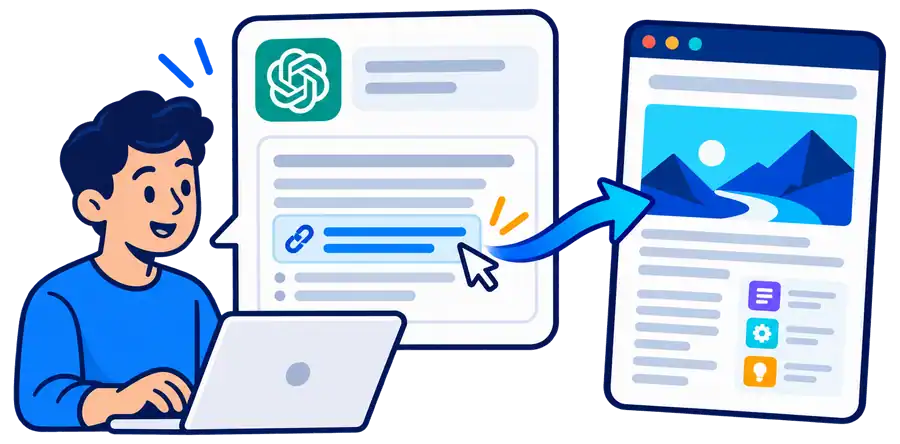
A genuine referral starts with a user outside your website. The person asks a question, sees a relevant website link in an assistant’s response, and chooses to open it. The destination may be a guide, product comparison, documentation page, tool, or homepage. The source is the assistant; the useful outcome happens on your website.
For example, someone researching accessible booking software might ask ChatGPT which options support keyboard navigation. If the response links to your accessibility documentation and the person opens it, that is a potential AI-referred visit. If the answer only names your product, it is a mention, not a recorded visit.
“AI traffic” is a broader and less precise expression. In a server report it might describe bots. In a marketing report it might describe assistant clicks, traffic from AI-enhanced search, or a mixture of both. Define the scope before comparing numbers, commissioning work, or evaluating a campaign.
| Term | Meaning in this guide | What it does not establish |
|---|---|---|
| AI referral traffic | People arriving through links in assistant responses. | That every recorded source label represents an authentic human click. |
| LLM traffic | A marketing shorthand for traffic associated with LLM-based assistants. | A standardized metric with the same definition in every study. |
| ChatGPT traffic | The ChatGPT portion of assistant acquisition. | All AI acquisition, or all visits to the ChatGPT platform itself. |
| AI search traffic | A broader concept that may include assistant referrals and AI features within search engines. | One mutually exclusive analytics channel. |
| AI crawler requests | Automated retrieval of pages for search, processing, or other provider-defined purposes. | Human website visits, recommendations, or conversions. |
Use the more specific label whenever possible. “Earned assistant referral sessions” is clearer than “AI growth” if you are analyzing genuine acquisition. “Automated attribution test visits” is the appropriate label for a controlled source-rule test.
How AI Referral Traffic Differs from Organic Search
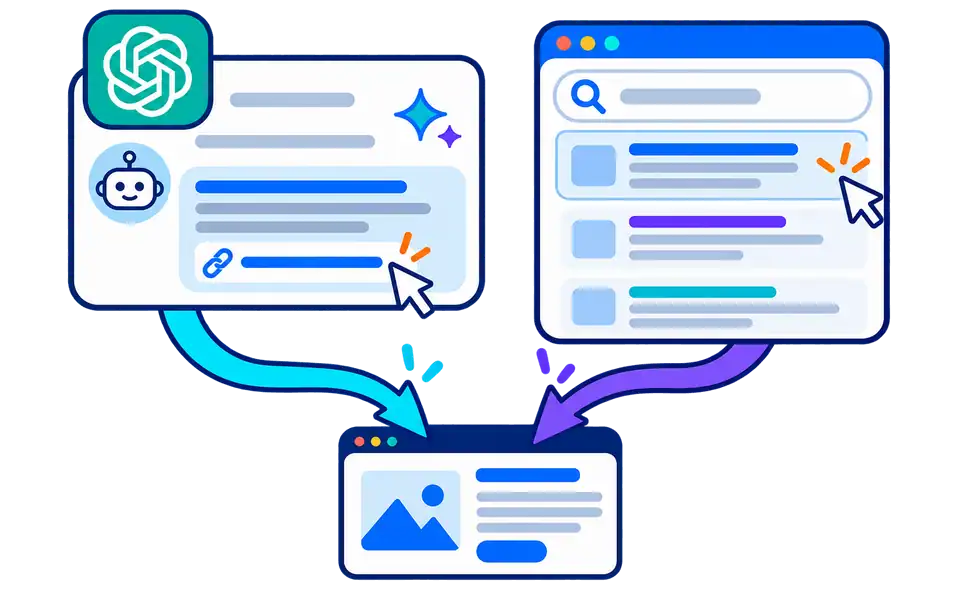
Traditional organic search sends visitors from unpaid search results. Assistant referrals originate within a conversational experience, where a response may summarize information, compare alternatives, or link to supporting evidence. The visitor may arrive with context from that conversation, but you cannot assume what they read or how close they are to a purchase.
The boundaries are not simply “AI versus Google.” Google’s current GA4 channel definitions include an AI Assistant channel for recognized assistant sources. Non-ad clicks from Google’s AI Overviews and AI Mode belong to Organic Search, not that assistant channel. Therefore, an AI-assisted discovery experience can still produce an organic-search session.
Keep those categories separate when asking whether AI referrals are growing. Adding Google’s entire organic channel to assistant sessions would overstate the assistant channel. Treating all visits labelled Referral as AI would include unrelated websites and could miss recognized assistant sources.
Another difference is visibility measurement. A search impression, an assistant mention, a cited URL, and an analytics session represent different events. A useful report names each event rather than treating them as stages that always occur in sequence. There is no universal conversion rate from a citation to a click.
AI referrals also do not replace SEO. Readers still need accessible, accurate destination pages, and your existing search audience may remain much larger. Work that improves a page for a genuine customer question can serve both audiences, without making a promise about where an assistant will link.
How Much Website Traffic Comes from AI?
Public research shows that detectable assistant referrals can be a small part of website acquisition even while the channel grows. It does not establish one current percentage that every website should receive. The date, sample, denominator, and attribution method belong beside any number.
Ahrefs reports dated website-traffic snapshots, including data for March 2026. Similarweb research provides a view of overall referral volume through May 2026. These are different measurements, so the table separates share estimates from aggregate growth rather than combining them into a forecast.
| Study and date | Reported finding | How to interpret it |
|---|---|---|
| Ahrefs, published February 6, 2025 | Across 3,000 sites, AI accounted for 0.17% of visitors and 0.12% of views on average; 63% of sites received at least one attributable AI visit. | A historical sample, not a 2026 universal benchmark. Visitors and views are different units. |
| Ahrefs, published May 15, 2026; March 2026 data | Across 74,752 tracked websites, AI chatbots accounted for 0.28% of total traffic in the reported March snapshot. | A share within that tracked cohort, not a measurement of every website. It is not directly comparable with an average site’s share in a different sample. |
| Similarweb, 2026 report covering June 2025–May 2026 | An estimated 770.7 million monthly AI referral visits worldwide on average, up 117.4% year over year, across desktop and mobile web. | Aggregate referral volume and growth, not AI’s percentage of an individual website’s traffic. |
These dated shares are evidence that AI referrals were measurable, not a ceiling or target for your business. The aggregate estimate indicates growth within its reporting scope, not that every industry or website acquired the same share. None of these figures measures the entire influence of AI on brand discovery.
There is also a practical denominator problem. A specialist site with few total visits can show a noticeable AI share from a small number of arrivals. A large site can receive many more AI visits while showing a smaller percentage. Review the absolute count alongside the share and the resulting useful actions.
Do not confuse traffic to an AI platform with traffic it sends elsewhere. Millions of visits to ChatGPT do not mean millions of visits to your website. Likewise, rapid percentage growth from a small base does not establish that assistant referrals can replace search, email, or another established acquisition channel.
Why a Mention, a Citation, and a Visit Are Different
A mention names a brand or source. A citation provides a supporting reference, often with a link. A referral visit requires someone to leave the assistant and reach the website. Your business can receive one without receiving the others.
An answer may satisfy the user completely, leaving no reason to click. A citation may point to the original source of one fact rather than recommend that business. A visitor may open the homepage instead of the cited guide, or return later through a bookmark or brand search. These possibilities explain why visibility and acquisition should be reported separately.
For a small visibility review, keep a log of the question tested, assistant, date, response, linked URL, and whether the mention was accurate. A hand-picked prompt check is diagnostic evidence, not representative audience coverage. Responses can vary across wording, accounts, locations, and time.
If a page receives assistant-attributed visits, check whether it answers the next question clearly. A comparison reader may need limitations and setup requirements. A documentation reader may need a working example. Do not judge visit quality solely by pageviews or session duration; a short visit can still complete a useful task.

How to Get Traffic from AI Without Making False Promises
The honest approach is to make your content discoverable, useful, and worth referencing, then observe whether real referrals follow. There is no dependable recipe that forces an assistant to recommend your site. The following priorities improve the underlying resource rather than manufacture evidence of popularity.
Answer a specific question with evidence people can check
Choose questions your audience actually asks and answer them early. Explain the conditions behind a recommendation, show a relevant worked example, and link to the original source of a factual claim. If you have original research, document the method and limitations instead of presenting an unexplained headline statistic.
A detailed compatibility page or transparent comparison can be more useful than another broad “ultimate guide.” Organize the page so a reader can understand what it covers, what it excludes, and what to do next. This is a content-quality decision, not proof that a particular format earns citations.
Check access without confusing search crawling with training
OpenAI distinguishes OAI-SearchBot, used for ChatGPT search, from GPTBot, used for model-training purposes, in its official crawler documentation. Their controls are independent. A crawler fetch is not a human referral, and allowing access does not guarantee a mention or visit.
Ask the person responsible for your site’s technical policies to check the relevant provider’s current requirements. Do not remove deliberate access restrictions merely to pursue a traffic number. Search availability, training permissions, and user-triggered retrieval are separate decisions.
Keep factual business information consistent
Use clear names, current product details, accurate service boundaries, and an understandable About page. Correct outdated information on profiles you control. Where relevant, contribute useful evidence to reputable industry publications or partnerships rather than mass-posting promotional mentions.
Independent discussion can help people discover and evaluate a business, but its effect on assistant answers is not guaranteed. Avoid fake reviews, fabricated case studies, or claims that a certain number of mentions purchases AI visibility. The immediate goal is trustworthy information available to customers.
Apply the right guidance to the right AI surface
For Google’s AI Overviews and AI Mode, Google’s official guidance says a supporting page must be indexed and eligible for a search snippet. There is no special AI schema or additional AI text file required, and meeting the conditions does not guarantee inclusion.
Those are Google’s requirements, not a universal specification for every assistant. Keep ordinary SEO and page usability healthy, but do not promise that changing markup, repeating “LLM traffic” in headings, or buying visits will create AI citations.
A Hypothetical Example: From a Helpful Resource to a Useful Visit
Imagine a small software company whose customers ask whether its booking tool supports keyboard-only use. Its existing marketing page says “easy for everyone,” but does not explain the actual workflow or limitations. The company decides to improve its accessibility documentation, not to create a page claiming it is the best tool.
The revised resource explains supported actions, known limitations, and how a prospective customer can test a booking flow. It includes a reproducible example and a clearly dated review. The intended next action is to try the demonstration or contact support with a specific requirement.
If an assistant later links to that page, the company records the observation separately from analytics. If genuine visitors arrive, it examines whether they use the demonstration and submit suitable requests. It does not claim a numerical increase, presume every AI-attributed session is human, or attribute all later brand searches to the mention.
This example is explicitly hypothetical; it describes a workflow, not an SEOVisitor case study. Its practical lesson is that earning a reference and serving the resulting visitor are different jobs. A citation to an unhelpful destination is not a complete acquisition strategy.
Measure AI Referrals Without Turning the Report into a Claim
Start with the source, destination page, reporting period, and meaningful action. Compare assistant sessions with other channels using the same scope and dates. For a lead-generation site, a qualified enquiry may be more useful than a raw form submission; for documentation, successful task completion may matter more than time spent.
Some visits lose source information because of apps, browser policies, redirects, or later return journeys. They may appear as Direct or another channel. However, unexplained Direct traffic is not automatically AI traffic. Supplement analytics with optional customer feedback, while recognizing that self-reported discovery and a measured referral are different evidence.
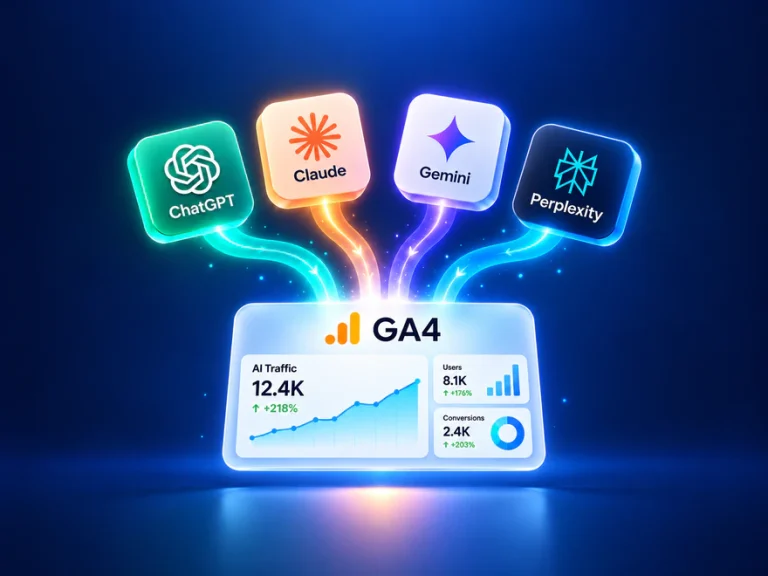
GA4 attribution does not identify the original prompt or reconstruct the assistant’s full answer. Nor does a referrer authenticate the visitor. Keep collection limits, consent effects, test activity, and source-rule changes in the report. A change in classification can move visits between channels without representing new audience demand.
For the practical reporting setup, use our dedicated guide below. It covers current channel definitions, assistant-source checks, an optional custom grouping, landing-page analysis, and controlled validation without duplicating that full process here.
Once the reports are reliable, make a limited decision: improve a page that serves a relevant audience, investigate an unexpected source change, or continue observing when the evidence is too thin. A small number of sessions does not justify abandoning established acquisition channels.
Keep Attribution Testing Separate from Earned AI Traffic
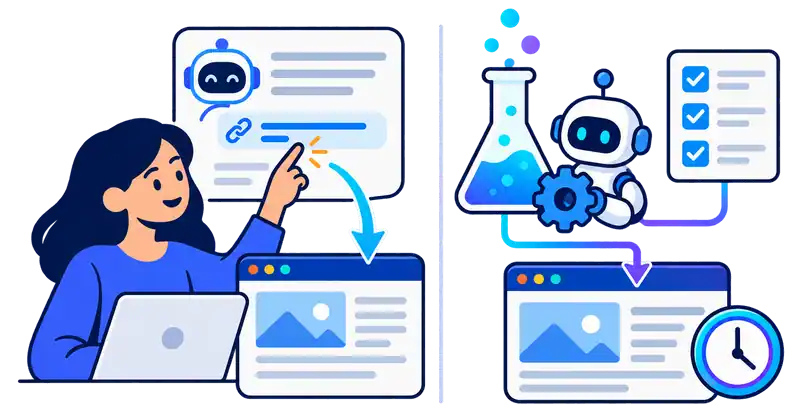
A controlled test answers “Does my configured reporting path work?” It does not answer “Did an assistant recommend my business to real customers?” A manual click from an actual assistant link can check one real journey; automated referrer-tagged visits test a different, narrower situation.
SEOVisitor’s AI Traffic service offers automated visits carrying selected AI referrers. Use that option only when the testing purpose fits your needs. It does not purchase citations, assistant recommendations, real prompt audiences, organic rankings, or sales.

If your website promotion includes AI-source visits, SEOVisitor’s AI traffic service gives you a way to create a campaign and track its traffic to your selected page.
Record the test destination and time window, then exclude that activity from earned-acquisition evaluation. A report populated by a test is evidence of collection under those test conditions, not evidence of genuine interest or a substitute for a human source-validation check.
The Takeaway: Define the Visit Before Evaluating Its Value
LLM traffic is worth understanding, but the label is not the outcome. Separate assistant visibility, genuine website referrals, crawler requests, and automated tests. Use dated studies as context, then evaluate your own destination pages and useful actions with consistent measurement.
The sensible next step is modest: make one resource genuinely helpful, confirm your attribution, and observe what real visitors do. AI discovery can complement organic search and other channels, but no content tactic or traffic campaign guarantees citations, indexing, rankings, or business results.
Frequently Asked Questions
Quick answers to common questions about LLM traffic
The term is ambiguous. Marketing reports often mean visits from assistant links, while server reports may mean automated requests. Define the activity explicitly and keep human referrals, crawlers, and automated tests separate.
Google classifies non-ad clicks from AI Overviews and AI Mode as Organic Search. Its AI Assistant channel covers recognized assistant sources such as ChatGPT and Gemini instead.
There is no universal target. Public studies cover particular samples, dates, and metrics. Establish your own consistently measured baseline and review useful actions alongside the number and share of genuine referrals.
A mention may have no link, or the answer may satisfy the user without a click. Report observed mentions and website visits separately; neither automatically proves a recommendation or a conversion.
No. A source label describes recorded attribution, not an authenticated human visitor. Review the visit's origin and keep purchased tests or other automated activity out of earned-referral reporting.
No. Google's AI search features require ordinary search eligibility, not special AI schema, and inclusion is not guaranteed. Purchased referrer-tagged visits do not buy assistant citations or recommendations.
Improve a specific resource your audience needs: answer the question clearly, supply checkable evidence, explain limitations, and keep factual business information current. Monitor actual mentions and referrals without assuming that the changes caused them.
Use SEOVisitor's How to Track AI Traffic in GA4 guide, linked in this article. It explains assistant channels and sources, landing-page analysis, missing attribution, and controlled checks without treating a source label as proof of genuine demand.



Comments
Leave a Comment