


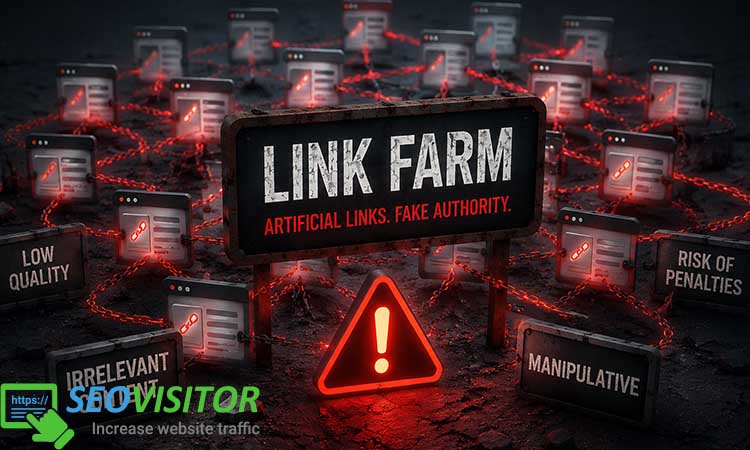
What Is a Link Farm in SEO? Risks, Examples, and Safe Alternatives
Backlinks have always been one of the strongest signals in search engine optimization. They help search engines understand which pages are trustworthy, relevant, and worth ranking higher.
But over time, people started trying to “game” this system. Instead of earning backlinks naturally, some websites began creating artificial networks just to generate large volumes of links. This is where the concept of a link farm comes in.
At first glance, it might seem like a shortcut to better rankings. More links should mean more authority, right? In reality, it’s the opposite. Link farms don’t build real authority—they simulate it. And search engines are specifically designed to detect and ignore this kind of manipulation.
Many website owners also look for quick ways to increase visibility, such as buying website traffic or relying on artificial growth methods. However, traffic numbers alone cannot replace genuine authority, user trust, and sustainable SEO strategies.
In this article, we’ll go beyond the definition and actually understand how link farms work in practice, why they fail in modern SEO, and what you should do instead if your goal is long-term organic growth.
What Is a Link Farm?
A link farm in SEO refers to a group of websites that exist primarily to create backlinks for other websites. These sites are not built to serve users or provide meaningful content. Instead, their main purpose is to pass link authority in an artificial way.
In most cases, a link farm does not look like a normal website ecosystem. It behaves more like a controlled network where links are placed deliberately to influence search rankings rather than to help readers discover useful resources.
Why link farms exist in SEO
The reason link farms were created in the first place goes back to the early days of search engines. At that time, Google and other engines relied heavily on the number of backlinks as a primary ranking signal.
This created an obvious loophole. If more links meant higher rankings, then people could simply create more links artificially. Link farms were born out of this logic.
Even today, they still exist, although for different reasons. Some SEO providers still use them because they are cheap to build and can sometimes create short-term ranking fluctuations.
However, search engines have evolved significantly. Today, they don’t just look at the presence of links—they evaluate context, relevance, trust, and patterns across entire networks.
How Link Farms Work
To understand why link farms are considered manipulative, it’s important to look at how they function behind the scenes. They are not random websites linking to each other; they are structured systems designed to simulate authority.
Link exchange networks
One common model involves multiple websites linking to each other in a structured or repeating pattern. Instead of natural editorial linking, these networks are pre-planned.
The problem with this structure is that it creates patterns that are extremely unlikely in a natural environment. Search engines can detect this lack of natural behavior by analyzing link graphs over time.
Automated link generation systems
Another approach used in link farms involves automation. Systems generate large volumes of pages and insert backlinks wherever possible.
These links often appear in irrelevant places such as low-quality blog comments, forum posts, or thin articles that provide no real depth.
From a search engine perspective, this breaks the core principle of linking: relevance. When links exist without context, they lose their informational value.
Paid link networks and schemes
Some link farms operate as commercial networks where backlinks are sold in bulk. Website owners pay to have their links placed across multiple domains.
When links are placed purely for ranking manipulation rather than editorial endorsement, they violate Google’s guidelines.
Search engines expect paid links to be marked using attributes like nofollow or sponsored. Without that, they become link spam.
Why Link Farms Are Harmful for SEO
The issue with link farms is not just quality—it is intent and manipulation patterns.
Violation of Google spam policies
Google clearly states that any attempt to manipulate rankings through artificial links is a violation of its spam policies.
Link farms fall directly into this category because they are built for manipulation rather than user value.
Risk of manual penalties
Google may apply manual actions when unnatural linking patterns are detected.
This can lead to ranking drops or even removal of pages from search results.
Loss of trust signals
In many cases, Google simply ignores unnatural backlinks. This means they provide no SEO value at all.
Over time, this weakens the perceived authority of a website.
Long-term ranking instability
Websites relying on artificial links often experience unstable rankings, especially after algorithm updates.
Link Farm vs PBN vs Link Exchange
These three methods all involve artificial linking but differ in structure and sophistication.
A link farm is usually large, low-quality, and obvious. A PBN is more controlled and tries to appear legitimate. Link exchange involves mutual linking between websites but becomes risky at scale.
How to Identify a Link Farm Website
Link farms usually lack editorial direction and real user-focused content.
They often contain irrelevant topics, excessive outbound links, and no real branding or authorship signals.
What Happens If Your Site Gets Links from Link Farms?
Search engines often ignore these links entirely, meaning they have no positive or negative effect.
However, in large amounts, they can reduce trust signals and contribute to ranking instability.
How to Remove or Disavow Toxic Links
The disavow tool in Google Search Console is used only when spam backlinks are clearly affecting your site.
It should be used carefully and only when necessary.
Safe Alternatives to Link Farming
Modern SEO is no longer about manipulating search engines with artificial links. Instead, it focuses on building real value that naturally attracts backlinks over time.
Rather than trying to force authority through networks of low-quality sites, the goal today is to earn trust. When content is genuinely useful, relevant, and well-structured, other websites naturally reference it without needing any manipulation.
This is why modern link building revolves around quality-driven strategies instead of volume-based tactics.
High-quality content
High-quality content is the foundation of all sustainable SEO strategies. When a piece of content fully answers a user’s question, provides depth, and offers unique insight, it naturally becomes a reference point for others in the same niche.
Search engines also recognize this behavior. Pages that consistently provide value tend to earn organic backlinks because they solve real problems, not because they were promoted through artificial networks.
Digital PR
Digital PR focuses on getting your content featured in reputable publications, blogs, and news platforms. Instead of manually placing links, you create something newsworthy or insightful enough that others want to mention it.
This could include data-driven studies, industry insights, or expert commentary. The key idea is that the value comes first, and the backlink is a natural result of visibility.
Unlike link farms, digital PR builds real brand authority because the links come from trusted and relevant sources.
Authoritative resources
Another long-term strategy is creating authoritative resources that people naturally return to and cite. These can include in-depth guides, research-based articles, tools, or frameworks that solve specific problems in a meaningful way.
When content becomes a reference in its niche, it starts earning backlinks organically without any outreach pressure or manipulation. This type of link acquisition is exactly what search engines are designed to reward.
Conclusion
A link farm in SEO might look like a shortcut, but it is a fragile and outdated strategy that conflicts with how modern search engines evaluate authority.
Google no longer rewards volume alone—it rewards trust, relevance, and genuine editorial value.
If your goal is long-term SEO success, focus on earning real backlinks instead of artificial networks.
FAQs About Link Farms
Are link farms still used today?
Yes, but they are far less effective due to modern search engine algorithms.
Can link farms still improve rankings?
They may cause short-term movement but are not reliable and often lead to instability.
How does Google detect link farms?
Google uses pattern analysis, link graph evaluation, and machine learning systems.


Lasted Comments (0)