



Brand Search Traffic: Why It Matters More Than Ever
In this guide, you will learn what brand search traffic is, why it matters for SEO, how to measure it, and how to increase it with practical strategies.
What Is Brand Search Traffic?
Brand search traffic refers to visitors who come to your website after searching for terms related to your brand. These terms usually include your company name, website name, product name, service name, founder name, or a combination of your brand plus another keyword.
For example, these are branded search queries:
- Seovisitor website traffic
- Nike running shoes
- Canva pricing
- Ahrefs keyword explorer
- HubSpot CRM reviews
- Semrush alternatives
The important point is that the searcher already knows the brand name. They are not simply searching for a general topic. They are searching for a specific business, product, or website.
Branded vs Non-Branded Search Traffic
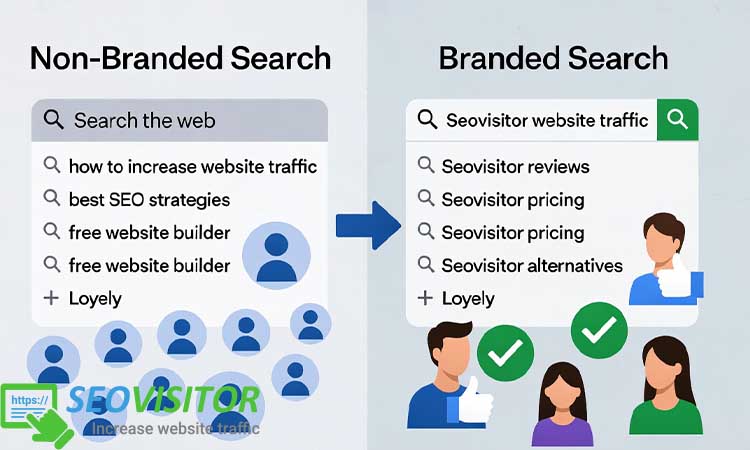
Branded search traffic is different from non-branded search traffic. A non-branded search is a general query that does not include your brand name. For example, “how to increase website traffic” is non-branded. But “Seovisitor website traffic” is branded.
Non-branded traffic is useful because it brings new users to your website. Branded traffic is valuable because it shows that people already know you, remember you, or are seriously considering your business.
This makes branded search traffic one of the most important SEO metrics for businesses that want long-term visibility, not just temporary clicks.
Why Brand Search Traffic Matters More Than Ever
Ranking for generic keywords can bring traffic, but it does not always prove that people remember your website. A user may click your article, read a few lines, and leave without ever noticing your brand name.
Branded searches are different. When someone searches for your business by name, it means your brand has entered their memory. That memory may have started from a blog post, a social media post, a YouTube video, a paid ad, a referral, or a previous Google search.
This is why brand search traffic is closely connected to real demand. It shows that your marketing is not only getting impressions or clicks; it is creating recognition.
Branded Search Traffic Usually Has Higher Intent
People who search for branded terms are often closer to taking action. Someone searching “what is website traffic” may only want basic information. But someone searching “Seovisitor traffic packages” or “Seovisitor reviews” is likely much closer to making a decision.
Common branded search modifiers include:
- Brand + pricing
- Brand + reviews
- Brand + login
- Brand + alternatives
- Brand + support
- Brand + coupon
- Brand + service
These searches tell you what users want from your business. If many people search your brand name plus “reviews,” you should make sure you have strong testimonials and trust signals. If they search your brand plus “pricing,” your pricing or service details should be easy to find.
That is why branded search is not only an SEO topic. It is also a conversion and trust-building topic.
Brand Traffic Builds SEO Stability
Search rankings can change. Algorithm updates, competitor content, AI summaries, and new SERP features can all affect organic traffic. If your website depends only on generic rankings, your traffic can become unstable.
Brand search traffic gives your website a more defensible position. Competitors can target the same generic keywords, but they cannot easily replace your brand identity in the mind of your audience.
When users actively search for your brand, you are no longer relying only on discovery. You are also benefiting from demand that your own business has created.
How Brand Search Traffic Impacts SEO Performance
Brand search traffic helps you understand the difference between visibility and demand. A website may rank for many keywords but still have weak brand awareness. Another website may rank for fewer keywords but have a loyal audience that actively searches for it by name.
The second website often has a stronger long-term position because people are not only finding it; they are looking for it intentionally.
To understand your SEO performance more clearly, you should separate branded and non-branded search traffic in your reports. This gives you a better view of what is really happening.
- Non-branded traffic shows how well you attract new users through general keywords.
- Branded traffic shows how well people remember and search for your business.
- Branded CTR shows whether users choose your official result in search.
- Branded conversions show whether brand-aware users take action.
This matters because total organic traffic can be misleading. If your organic traffic increases only because more people search your brand name, your non-branded SEO visibility may not actually be improving. On the other hand, if branded searches are growing while non-branded traffic stays stable, your broader marketing may be creating stronger brand demand.
A smart SEO report should look at both branded and non-branded performance separately.
Brand Search Traffic and the Rise of AI Search
Search behavior is changing quickly. Google AI Overviews, AI Mode, answer engines, ChatGPT, Gemini, and Perplexity are changing how users discover information online.
This does not mean traditional SEO is dead. It means brand recognition is becoming more important. When search engines give users faster answers directly on the results page, fewer people may click generic informational results. In that environment, a memorable brand has a major advantage.
Users may not click every article they see, but they may still search directly for a brand they trust.
This is why brand search traffic is becoming a defensive SEO asset. If your website is only known through generic rankings, you are vulnerable to SERP changes. But if people actively search for your brand name, you have a traffic source that is harder for competitors to copy.
AI search also makes brand clarity more important. Your brand should be easy to understand across your website, social profiles, business listings, reviews, author bios, and external mentions. A confusing brand identity makes it harder for both users and search systems to connect your business with a specific topic or expertise.
In simple terms, strong SEO is no longer only about ranking. It is also about becoming a recognizable entity in your niche.
Types of Branded Keywords You Should Track
Not all branded keywords have the same meaning. To understand brand search traffic properly, divide your branded queries into different categories.
Core Brand Keywords
Core brand keywords include your exact brand name, website name, or company name. These searches show basic brand awareness.
Examples include:
- Seovisitor
- Seovisitor.net
- Seovisitor traffic
If these impressions grow over time, it usually means more people are becoming familiar with your brand.
Product or Service Branded Keywords
These keywords include your brand name plus a product, service, feature, or category. They usually show stronger commercial intent.
Examples include:
- Seovisitor website traffic
- Seovisitor organic traffic
- Seovisitor traffic packages
- Seovisitor SEO service
Users searching these terms are not just looking for your homepage. They are looking for a specific solution you offer.
Reputation-Based Branded Keywords
Reputation-based keywords reveal trust concerns. These searches often appear before a user decides whether to buy, sign up, or contact you.
Examples include:
- Seovisitor reviews
- Seovisitor legit
- Seovisitor testimonials
- Seovisitor complaints
Many businesses ignore these searches until they become a problem. That is a mistake. If users cannot find trustworthy information about your brand, they may choose a competitor instead.
Comparison Branded Keywords
Comparison keywords appear when users compare your brand with other options. These searches are especially valuable because they often happen near the decision stage.
Examples include:
- Seovisitor vs competitor
- Seovisitor alternatives
- Best Seovisitor alternative
If you do not create useful comparison content, third-party websites or competitors may control the conversation around your brand.
Navigational Branded Keywords
Navigational branded keywords usually come from existing users or people who already know exactly what they want.
Examples include:
- Seovisitor login
- Seovisitor contact
- Seovisitor support
- Seovisitor dashboard
If people use Google to find basic pages on your site, make sure those pages are easy to access, clearly titled, and properly linked from your main navigation.
How to Measure Brand Search Traffic
The best place to start measuring brand search traffic is Google Search Console. Open your Performance report and filter queries that contain your brand name. Then review clicks, impressions, CTR, and average position.
This simple process helps you understand how often people search for your brand and how often they click your website from the results.
You can export this data and separate it into two groups:
- Branded queries
- Non-branded queries
This gives you a cleaner SEO report and prevents misleading conclusions.
You can also use Google Analytics 4 to analyze what branded visitors do after landing on your website. Look at engagement rate, conversions, landing pages, returning users, and traffic quality.
For example, if branded visitors convert better than non-branded visitors, you may need to invest more in brand-building content, reviews, social visibility, and remarketing.
Google Trends can also help you monitor brand interest over time. You can compare your brand against competitors, check regional interest, and identify whether brand awareness is rising or falling.
Important Brand Search Metrics to Track
- Branded impressions: How often your website appears for branded searches.
- Branded clicks: How many users click your site after searching your brand.
- Branded CTR: The percentage of users who click your result after seeing it.
- Branded keyword growth: Whether more people are searching for your brand over time.
- Branded conversions: Leads, sales, signups, or inquiries from branded visitors.
A simple monthly report with these metrics can show whether your brand is getting stronger or weaker in search.
Why Your Brand Search Traffic May Be Low
Low brand search traffic does not always mean your SEO is bad. In many cases, it means your brand awareness is still weak.
People cannot search for a brand they do not remember.
One common mistake is building a content strategy around generic keywords only. A website may publish dozens of articles targeting informational terms, but if the content has no distinct voice, no original examples, and no clear brand positioning, readers may leave without remembering the website name.
The result is traffic without memory.
Another issue is inconsistent branding. If your website name, social media handles, logo, title tags, and service names are not consistent, users may not know what to search later. This is especially damaging for smaller websites that are still building recognition.
Weak trust signals can also reduce branded searches. If visitors do not see author information, reviews, testimonials, case studies, contact details, or clear service pages, they may not treat your website as a serious brand.
Your goal is not only to publish content. Your goal is to make readers think, “I should come back to this website.”
How to Increase Brand Search Traffic
Growing brand search traffic takes time, but the strategy is clear. You need to become more visible, more useful, and more memorable.
Create Memorable, Brand-Led Content
Do not publish generic articles that sound like every other blog in your niche. Add original examples, screenshots, checklists, case studies, practical workflows, and strong opinions when appropriate.
For example, instead of writing a basic article about website traffic, explain how traffic quality affects SEO, conversion, and trust. Add your own framework. Use your own examples. Make the reader associate the idea with your brand.
Build Topical Authority Around Your Niche
Your brand should become associated with a clear topic. If your website focuses on website traffic and SEO, your content clusters should reinforce that identity.
Use Social Media and Communities
Many branded searches begin outside Google. Someone may first discover your business through LinkedIn, Reddit, Quora, YouTube, Facebook, X, newsletters, or niche communities. Later, they search your brand name because it feels familiar.
This is why SEO and brand visibility should work together. If your social posts, community answers, and blog content all use consistent messaging, people are more likely to remember your name.
Improve Your Branded Search Results Page
Search your own brand name in Google and study the results carefully. Ask these questions:
- Does my homepage rank first?
- Are my title tags clear?
- Do my social profiles appear?
- Are review pages visible?
- Are competitors bidding on my brand name?
- Are there outdated or negative results?
- Is my brand message obvious from the search results?
Your branded SERP is often the first impression for people who already know your name. Make sure it builds confidence, not confusion.
Encourage Reviews and Testimonials
Reviews are especially important for reputation-based branded searches. If people search your brand plus “reviews” or “legit,” they are looking for proof.
Add testimonials, customer feedback, case studies, trust badges, and clear contact information to your website. These signals can help users feel more confident before taking action.
Common Mistakes That Hurt Brand Search Traffic
The biggest mistake is assuming branded search will grow automatically. It will not. Brand demand needs to be built intentionally.
Ignoring Branded Keywords in SEO Reports
If you mix branded and non-branded traffic in one report, you may misunderstand your SEO performance. A traffic increase may come from stronger brand awareness, not better rankings for generic keywords.
Both are valuable, but they should be measured separately.
Letting Competitors Control Your Brand SERP
Competitors can publish comparison pages, run ads on your brand name, or appear in “alternatives” searches. If you do not create helpful content around your own brand, others may define your positioning for you.
Publishing Generic Content Without Brand Identity
Content can be technically optimized and still be forgettable. If your articles have no original examples, no clear point of view, and no connection to your brand, users may read them and never return.
SEO content should not only answer a query. It should also help people remember who gave them the answer.
Ignoring Reputation Searches
Searches like “brand reviews,” “brand complaints,” and “is brand legit” can directly affect conversions. If users find weak, outdated, or negative information, they may hesitate before buying or contacting you.
Create strong reputation content before users need it. Do not wait until negative results dominate the search page.
Brand Search Traffic Strategy Checklist
Use this checklist to improve your branded search performance step by step.
Measurement Checklist
- Track branded queries in Google Search Console.
- Separate branded and non-branded SEO traffic.
- Monitor branded CTR every month.
- Track branded conversions in GA4.
- Compare brand interest in Google Trends.
- Watch reputation-based branded searches.
Content Checklist
- Strengthen your homepage messaging.
- Publish clear product and service pages.
- Create comparison and alternative pages.
- Add testimonials and case studies.
- Use internal links between related SEO topics.
- Add original examples and screenshots.
Authority Checklist
- Earn mentions on relevant websites.
- Stay active in niche communities.
- Keep brand naming consistent across platforms.
- Improve review presence.
- Use clear author and company information.
- Maintain accurate social profiles.
Conclusion: Brand Search Traffic Is a Long-Term SEO Asset
Generic rankings can bring visitors, but brand search traffic shows something deeper: people remember you.
That is why branded search matters more than ever. It reflects awareness, trust, reputation, and demand. It also helps you understand whether your content strategy is creating long-term value or only temporary clicks.
If you want stronger SEO performance, do not only ask, “How many keywords do we rank for?” Ask, “How many people are searching for us by name?”
Start by opening Google Search Console and filtering your branded queries. Then improve your homepage, strengthen your trust signals, publish memorable content, and build a brand that people actively search for.
If you want to build website traffic that is not only visible but memorable, start tracking your branded searches today. Use your content, reviews, and traffic quality strategy to make your brand the name people search for first.
Frequently Asked Questions About Brand Search Traffic
What is brand search traffic?
Brand search traffic is traffic from users who search for your brand name or branded terms in Google and then visit your website. These searches may include your company name, product name, service name, or brand plus words like “reviews,” “pricing,” or “login.”
Why is branded search traffic important for SEO?
Branded search traffic is important because it shows real demand and brand awareness. It often has higher intent than generic traffic because the user already knows your business and is actively looking for it.
What is the difference between branded and non-branded traffic?
Branded traffic comes from searches that include your brand name. Non-branded traffic comes from general keywords that do not mention your brand, such as “how to increase website traffic” or “best SEO tips.”
How do I find branded search traffic in Google Search Console?
Go to the Performance report in Google Search Console, open the Queries section, and filter for your brand name. Then review clicks, impressions, CTR, and average position for those branded queries.
Lasted Comments (0)